At 3 a.m., my parents begged for 30,000 dollars. “Your brother’s girlfriend is in the ER!” I asked one question they wouldn’t answer. I said, “Call your favorite daughter,” and hung up. The next morning, police knocked on my door.
The second thing I understood was that my father wouldn’t tell me which hospital because there was no hospital involved in the money he wanted.
“Call your favorite daughter,” I said.
And I hung up.
At 3:09 a.m., I sat down on the edge of my bed with my heart pounding and my purse in my lap.
I didn’t know where my brother was. I didn’t know what the $30,000 was really for. I didn’t know whether Jaylen was actually sick or whether that was another lie.
And I had no idea that four and a half hours later, at 7:40 that morning, a police officer would be standing on my welcome mat, holding a car seat with a sleeping three-year-old girl inside.
My name is Desiree Bus. I’m thirty-four years old, and I’m a teller supervisor at a bank branch in Midtown Tulsa. I’ve held that position for five years. I manage six tellers and a vault, and I can spot a counterfeit twenty-dollar bill from across the lobby.
Before that, from 2016 to 2020, I worked patient registration in the emergency department of a large hospital downtown. Mostly night shifts.
I was the person who took your name and your insurance card while you stood there holding a towel against your bleeding hand.
It was the hardest job I’ve ever had, and I learned more about people there than I did in four years of college.
The biggest thing I learned was simple: an emergency room treats you first. Always. The law says so. Nobody asks you for a dime before you’re stable. The bills arrive afterward, in the mail, and sometimes they’re awful. But nobody demands a deposit at the door before providing emergency care.
My parents live in Sand Springs, about twenty minutes west of Tulsa, in the same brick house they bought in 1991, two years after they got married.
My father, Benny, is sixty-three. He drove a truck for a lumberyard for thirty years. My mother, Darlene, is sixty-one. She works part-time at a flower shop and runs the prayer chain at their church.
There are three of us kids.
I’m the oldest. The reliable one. The one who earned a scholarship, found a job with benefits, bought a condo with a thirty-year mortgage, and started a retirement account.
The one who gets the phone call whenever something breaks.
My brother, Justice, is thirty-one. He installs flooring, and he’s good at it when he actually shows up.
He got a DUI in 2022, and my parents called me at midnight that time, too. I paid his lawyer $2,500. Nobody ever mentioned paying me back, and I never asked.
Justice has a temper that comes out when he drinks, which he does most weekends. My parents call those episodes his “bad nights.” They say he’s a good man who just happens to have bad nights.
And then there’s Paige.
Paige is twenty-nine, the baby of the family. She’s married to a pharmacist and lives in a new house in Jenks with a three-car garage.
When Paige needs something, my parents give it to her.
When I need something, my parents tell me how capable I am.
When Justice needs something, my parents call me.
Paige is the favorite. Everybody in the family knows it.
My mother once introduced us at church by saying, “This is Paige, my sweetheart, and her sister Desi.”
She didn’t even notice what she’d done.
Jaylen Weatherly is Justice’s girlfriend. She’s twenty-seven, a nursing assistant at a nursing home in West Tulsa. She works double shifts. She’s tiny, tough, and funny, and she chews cinnamon gum constantly because she’s trying to quit smoking.
She and Justice have been on and off for five years.
In February 2023, she had a baby girl named Da. Da is three and a half now.
She has curly brown hair that sticks straight up in the mornings, and she’s obsessed with pink rain boots. She says “aminal” instead of “animal,” and I will never, ever correct her.
Since the spring of 2024, I’ve kept Da every Thursday night while Jaylen works a double shift. I pick her up from daycare at 5:30, and she stays at my condo until Jaylen gets off at 11:30.
We make grilled cheese. We watch the same movie about a talking dog every single week.
I bought her a car seat for my car, a good one with side-impact padding, because I didn’t trust the one Justice had in his truck.
My parents see her on holidays.
Justice sees her when he’s around.
Every Thursday for two and a half years, I was around.
After I hung up on my parents at 3:09 that morning, I didn’t go back to sleep.
I called Justice. His phone rang once and went to voicemail.
I called Jaylen. Her phone rang five times before her cheerful little recording answered.
“Hey, it’s Jay. Leave it at the beep.”
I texted Paige.
Is Jaylen in the hospital? What’s going on with Justice? Mom just called me for 30K.
Nothing.
Paige sleeps with her phone on Do Not Disturb. Or maybe she was awake and didn’t want to answer. With Paige, you never know.
I sat at my kitchen table with every light in the condo turned on and tried to think.
If Jaylen really was in the emergency room with something burst inside her head, then Da was somewhere. But with whom?
Justice? My parents?
Mom had said Da was fine too quickly. It was the same way she used to say the dog was fine when the dog had gotten out.
And if it was real—if Jaylen really was dying—then I had just hung up on my mother while she was crying.
That thought settled on my chest like a brick.
But if it was real, they would have told me which hospital.
That was the one thing I kept coming back to.
If your son’s girlfriend is dying and your daughter says, “Which hospital? I’ll call them myself,” you tell her.
You scream the hospital’s name at her if you have to.
You don’t cover the phone with your hand and whisper with your husband.
I made coffee at five. I watched the sky turn gray over the parking lot.
At 6:30, I called both downtown hospitals that had neurosurgery departments and asked whether they had a patient named Jaylen Weatherly.
Both politely told me they couldn’t share patient information.
I knew they’d say that. I’d said those same words a thousand times from behind a registration desk.
At 7:40, somebody knocked on my door.
I opened it wearing my T-shirt and pajama pants, with my coffee still in my hand.
There was a Tulsa police officer standing on my welcome mat, a young man with a buzz cut and tired eyes.
Next to him stood a woman in her forties, wearing a gray cardigan with a lanyard around her neck and a large canvas bag over one shoulder.
And between them, on the concrete, was a car seat.
The car seat I’d bought.
I’d have recognized it anywhere. Gray with pink trim, and a little unicorn sticker on the side that Da had put there herself.
Da was inside, fast asleep, her head tipped against the padding and her mouth hanging open.
She was wearing her pajamas with the yellow ducks on them. One pink rain boot was on her foot. The other was in the woman’s hand.
“Are you Desiree Bus?” the officer asked.
“Yes.”
My coffee cup was shaking.
“What happened? Is Jaylen okay?”
The woman in the cardigan held out her hand.
“My name is Miss Hooper,” she said. “I’m with Oklahoma Human Services Child Welfare. I’ve been doing this for eleven years. Can we come inside, Miss Bus? I promise I’ll explain everything.”
I carried Da’s car seat inside myself and set it down very gently on my living room rug.
She didn’t even stir.
Then I sat at my kitchen table across from Miss Hooper and the officer, and she told me what had happened.
At about ten minutes to one that morning, Jaylen had gotten the worst headache of her life.
That was how she described it later to the nurse.
The worst headache of her life.
She’d thrown up and then collapsed on her kitchen floor.
Justice had come home drunk from a bar just before it happened. At 1:02 a.m., he’d called 911.
Paramedics took Jaylen to a hospital downtown. A CT scan showed bleeding in her brain from an aneurysm, a weak spot in an artery that had ruptured.
At about 3:30, she’d been taken back for a procedure to seal it off.
Before Justice left with the ambulance, he’d taken Da, still in her pajamas, and left her with the neighbor in the apartment downstairs.
A woman he barely knew.
Then, at about 1:50 a.m., in the emergency room lobby, something else happened.
“Your brother was intoxicated,” Miss Hooper said. “He was demanding to go back and see Jaylen. There’s an off-duty Tulsa police officer who works security in that lobby at night. When the officer told your brother he’d have to wait, your brother shoved him into a metal doorframe.”
The officer sitting at my kitchen table looked down at his hands.
“He has a concussion,” he said quietly. “He’s going to be okay.”
“Your brother was arrested at 2:05,” Miss Hooper continued. “For assault and battery on a police officer, which is a felony in Oklahoma, and for public intoxication.”
2:05.
And at 3:05, my parents had called me asking for $30,000.
It wasn’t for a deposit.
It had never been for a deposit.
It was for a bail bondsman and a lawyer.
My brother had put a police officer in the hospital, and my parents had called me in the middle of the night and told me his girlfriend was dying so I’d pay to get him out.
And his girlfriend really was dying.
That was the part I couldn’t hold together in my head.
They’d used it.
They’d taken the real thing that was happening to her and wrapped it around what they needed for him.
I put my face in my hands.
“There’s more,” Miss Hooper said gently. “And it’s the reason we’re here.”
At about 2:30, before they took Jaylen back for the procedure, she’d woken up enough to speak.
She’d grabbed the ER nurse by the wrist. The hospital social worker had been standing right there.
“Don’t let Justice or his parents take Da,” Jaylen had said. “Call Desiree.”
Then she’d given them my phone number from memory.
Miss Hooper slid a single sheet of paper across my kitchen table.
It was a copy of the social worker’s note, with the time written on it.
2:32 a.m.
My name. My number.
“With Jaylen in surgery and your brother in jail, there was no parent available to care for Da,” Miss Hooper explained. “So at about 5:30, officers picked her up from the downstairs neighbor and placed her in protective custody. I was called in, and because her mother specifically asked for you by name, and you’ve been caring for her every week, I’d like to place her with you as an emergency placement.”
She paused.
“Just while her mom is in the hospital. There’ll be a background check and a home visit. Is that something you can do?”
I looked at the car seat on my living room rug.
At the little pink rain boot.
“Yes,” I said. “Yes, of course.”
Da woke up at 8:15.
She opened her eyes and looked around my living room without moving her head, the way little kids do when they wake up somewhere they didn’t fall asleep.
“Aunt Desessie,” she said.
“Hi, baby.”
“Where’s Mommy?”
I got down on the rug beside her car seat and unbuckled her. She climbed straight into my lap, still wearing her duck pajamas.
“Mommy’s at the doctor,” I said. “She got sick last night, and the doctors are taking care of her. So you get to have a sleepover with me on a Saturday.”
“On a Saturday?”
She thought about that.
“Can we have pancakes?”
I made pancakes.
They were supposed to be shaped like Mickey Mouse, but they came out looking like three shapeless blobs stuck together. Da said they were perfect and ate two and a half of them.
Miss Hooper sat at my kitchen table filling out paperwork and watched us with an expression I couldn’t read.
At ten o’clock, while Da was watching her talking dog movie on the couch, my mother called.
I took the call in the bathroom with the door shut.
“Is it true?” Mom demanded.
She wasn’t crying anymore. Her voice was hard and flat.
“Your aunt says the state gave that baby to you. Is that true?”
“Yes.”
“You bring her here,” Mom said. “Right now. You bring her to Sand Springs. She belongs with family, with her grandparents. Not with you.”
“I’m family, Mom.”
“You know what I mean.”
I looked at myself in the bathroom mirror. I looked like I hadn’t slept, because I hadn’t.
“What was the $30,000 for, Mom?” I asked.
She didn’t answer.
“The deposit,” I said. “For Jaylen’s surgery. At the hospital you wouldn’t name. What was it really for?”
There was a long silence.
Then my mother spoke very quietly.
“You don’t understand what your brother’s going through.”
And she hung up.
I couldn’t have brought Da to Sand Springs even if I’d wanted to.
The paper Miss Hooper had signed at my kitchen table said Da’s emergency placement was with me.
Not my parents.
Me.
And the social worker’s note explained exactly why, in Jaylen’s own words, recorded at 2:32 that morning.
I stood in my bathroom holding the phone and understood what my parents wanted.
They didn’t want to take care of a three-year-old. My mother hadn’t changed a diaper since 1997.
They wanted Da in their house so that when Justice stood before a judge for putting a police officer in the hospital, his lawyer could say he was a family man.
A father with a little girl waiting for him at home.
At two o’clock that Saturday afternoon, my phone rang from a number with a downtown Tulsa exchange.
It was the hospital social worker, the one who’d been standing next to Jaylen at 2:32 that morning.
“Jaylen named you before her procedure,” she said. “So I’m allowed to tell you some things.”
I sat down on the arm of the couch.
Da was asleep on the cushions beside me, her mouth open and a stuffed giraffe tucked under her chin.
Jaylen had made it through the procedure.
The doctors had gone in through an artery in her leg, threaded their way all the way up into her brain, and packed the aneurysm with tiny coils of wire so it couldn’t bleed again.
She was now in the neurological intensive care unit, sedated and on a breathing tube.
“The next two weeks are the dangerous part,” the social worker told me. “After a bleed like this, the arteries in the brain can go into spasm, sometimes days later, and cut off blood flow. It can cause a stroke. They’ll be watching her every hour. I won’t lie to you. It’s serious.”
“Is she going to live?” I asked.
I said it very quietly so Da wouldn’t hear.
“The doctors are hopeful,” she replied. “She’s young. She got here fast. That matters.”
I looked down at the curly head resting beside me on the couch.
“She asked for you, you know,” the social worker said. “Before they took her back. She kept saying your name and Da’s. She wouldn’t let go of the nurse’s wrist until we wrote your number down and read it back to her.”
On Sunday morning, Miss Hooper came to my condo for the home visit.
She walked through every room carrying a clipboard. She checked whether I had covers on the electrical outlets, which I didn’t.
So I ran to the hardware store while she waited, bought a pack of twenty-four, and installed them while she watched.
She checked my kitchen cabinets for anything poisonous under the sink.
Then she asked where Da would sleep.
“On the couch,” I said. “She always sleeps on the couch on Thursdays. She likes it for a night.”
“That’s fine for a night,” Miss Hooper said. “For weeks, she needs a bed.”
So on Sunday afternoon, I drove to the Target on 71st Street and bought a toddler bed shaped like a little white house.
I bought a mattress, rainbow sheets, and a night-light shaped like the moon.
I put the bed together in my spare room with an Allen wrench while Da handed me the screws one at a time, looking very serious.
“This one,” she’d say.
Then she’d pick up another.
“This one.”
That night, she wouldn’t sleep in it.
She stood in the doorway of the spare room wearing her duck pajamas, holding her stuffed giraffe, and looking at the little white house bed.
Then she started to cry.
“I want Mommy,” she said. “I want my mommy. I want to go home.”
“I know, baby. I know.”
I picked her up, carried her to the living room, and sat down on the couch with her in my lap, in the same corner where her car seat had been on Saturday morning.
She cried until she fell asleep against my chest, hiccuping.
I sat there for two hours without moving.
The little white house bed stayed empty.
On Monday morning, September 21, I called in sick to work for the first time in five years.
I took Da to her daycare, then sat in my car in the parking lot and looked up my brother’s case on my phone.
Oklahoma puts its court dockets online. Anybody can look them up.
State of Oklahoma versus Justice Bus.
Tulsa County District Court.
Count One: Assault and Battery Upon a Police Officer. Felony.
Count Two: Public Intoxication.
He’d been arraigned that morning by video from the county jail.
Bond had been set at $50,000.
Underneath the bond amount was a list of conditions.
No contact with the victim. No possession of firearms. No consumption of alcohol.
A bail bondsman usually charges ten percent to post a bond. On $50,000, that meant a $5,000 fee.
That was what my parents had been trying to get from me at three in the morning, along with a lawyer’s retainer, before anybody even knew what the bond would be.
They’d been told that a felony involving a police officer could mean a bond somewhere between $50,000 and $100,000.
So they’d asked me for thirty thousand to be safe.
I found out that afternoon who’d paid it.
Because she posted about it.
Paige put a picture on Facebook of herself and Justice hugging in the parking lot of the Tulsa County Jail, with the sun going down behind them.
He was wearing the same clothes he’d been arrested in.
She was wearing a pink sundress.
Family shows up for family. No matter what. Love you, Bubba. Welcome home.
Four hundred likes.
My mother commented with a row of praying hands.
I found out later from my aunt that Paige had paid the $5,000 fee to the bondsman herself, using money from her and her husband’s savings.
So when my parents couldn’t get it from me, they’d called their favorite daughter.
Just like I’d told them to.
At eight o’clock on Tuesday morning, September 22, my brother called me for the first time since the night everything happened.
I was getting Da dressed for daycare. She was sitting on the bathroom counter while I gathered her curls into two little puffs.
I stepped into the hallway to answer and pulled the bathroom door almost closed behind me.
“Bring me my daughter,” Justice said.
His voice was hoarse.
He sounded sober. He sounded like a man who’d spent the entire night listening to our parents tell him he was the victim.
“Justice. How’s Jaylen? Have you been to see her?”
“They won’t let me see her,” he said. “The hospital. They say she took me off her list. So I’m coming to get Da. She’s mine, Desi. She’s my kid. You don’t have any right.”
“Miss Hooper placed her with me.”
“I don’t care what some state lady did,” he snapped. “She’s my daughter. Bring her to Mom’s by noon, or I’m coming over there.”
I hung up and called Miss Hooper with my hands shaking.
She listened to everything I told her.
Then she asked me a question I hadn’t expected.
“Ms. Bus, do you happen to know if your brother ever signed an acknowledgment of paternity, or if there’s ever been a court order saying he’s Da’s father?”
“I don’t know,” I admitted. “I don’t think so. Why?”
“Because in Oklahoma, when parents aren’t married, the father doesn’t automatically have legal rights to the child,” she explained. “He has to establish paternity first. Either both parents sign a form, usually at the hospital when the baby’s born, or a court orders it after a DNA test. Until that happens, the mother has custody. And if the mother is unavailable, the state steps in. Not the father, and not his parents.”
“So he can’t just take her?”
“Not without a court order,” she said. “He has no custody rights to Da until a judge says he does. If he shows up at your door and tries to take her, call 911 and don’t let him in.”
“Can he see her at all? Supervised or something?”
“There’s nothing to supervise,” she said. “There’s no order. And Jaylen said no. Right now, her no is the only one that counts.”
That afternoon, the hospital social worker dropped off a plastic bag at my condo.
Jaylen’s things.
The hospital had cut her clothes off in the ER and kept them, but her purse had come in the ambulance with her. When they’d taken out her breathing tube that morning, Jaylen had asked for her purse to be given to me.
Her keys were inside. Her wallet. Her cinnamon gum. A half-eaten granola bar. A crayon.
And in the zipper pocket was a folded piece of thick paper with a raised seal.
Da’s birth certificate.
State of Oklahoma. Tulsa County.
Da Weatherly.
Born February 2023.
Mother: Jaylen Marie Weatherly.
And underneath that was a line that said:
Father:
Blank.
Not crossed out. Not left off by mistake.
Just a clean, empty line.
I sat on the edge of my couch with that birth certificate in my hands for a long time.
My brother was her father.
Everybody knew he was her father.
She had his chin and his dimples and his exact terrible laugh.
But on the only piece of paper that mattered on the day she was born, nobody had written his name down.
On Tuesday evening, Paige posted again.
This time it was a photograph of Da at her second birthday party, blowing out candles on a cake shaped like a castle.
Underneath the picture, in capital letters, Paige had written:
MY SISTER HAS KIDNAPPED MY BROTHER’S BABY.
While his girlfriend fights for her life in the ICU, my sister went behind his back and got the state to hand her his daughter.
Please pray for my brother. Please pray this baby comes home to her real family.
By nine that night, the post had two hundred shares.
People from my parents’ church were sharing it. People from my high school.
A woman I’d sat beside in the church choir for three years sent me a message.
How could you, Desiree? I thought you were a Christian.
I started typing an answer to Paige’s post.
I got three sentences in.
Then I remembered something Miss Hooper had told me on Sunday while she was standing in my kitchen with her clipboard.
“Don’t post about this online,” she’d said. “Not one word. Not to defend yourself, not to explain. If this ends up in front of a judge, and it might, anything you write can be printed out and handed to that judge. Let them talk. You just take care of that little girl.”
So I deleted the three sentences.
And I put my phone in a drawer.
On Wednesday morning, September 23, my branch manager called me into her office before we opened.
She’s a woman in her fifties who’s worked at the bank for twenty years.
She closed the door, sat down, and looked at me over her glasses.
“I got a phone call yesterday afternoon,” she said, “from a woman who said she was your sister. She said I should know that my teller supervisor was a kidnapper. That she’d stolen a child, and that the bank might want to look into what kind of person was handling its vault.”
I felt my face grow hot.
“I’m not going to ask you what’s going on,” she continued. “Unless you want to tell me.”
So I told her the short version.
The three-in-the-morning phone call. The emergency room. Jaylen. Miss Hooper. The car seat on my welcome mat.
She listened to the whole thing.
Then she took off her glasses.
“Desiree,” she said, “you’ve worked here five years. You once drove a customer’s lost wallet all the way to her house in Broken Arrow on your lunch break. I’m going to write a note in your file saying I received a harassing phone call, and that’s all it’s going to say.”
I thanked her.
Then I went out and opened my vault.
My hands didn’t stop shaking until almost noon.
That afternoon was day five.
The ICU nurses had told me that if Jaylen was stable, they’d allow a short, supervised visit from her daughter.
Ten minutes.
I’d have to stay with Da the entire time, and a nurse would be in the room.
I took Da out of daycare early.
I put her in her pink rain boots, even though it wasn’t raining, because she’d asked to wear them.
In the car, I explained that Mommy would have tubes attached to her and machines around her bed. The machines would beep, I told her, but it was a good kind of beeping.
The neuro ICU was on the eighth floor.
The lights were soft, and everything hummed.
A nurse in navy scrubs walked us down the hallway to a glass room at the far end.
Jaylen was lying propped up in the bed.
She looked so small.
Her face was pale and puffy, and her hair was matted flat on one side. There was an IV in each arm, wires attached to her chest, and a clip on her finger with a little red light. Above her head, a monitor displayed moving green lines.
But her eyes were open.
Da stopped in the doorway and grabbed my leg.
Then Jaylen slowly turned her head and saw her.
Her whole face broke open.
“Hey, bug,” she whispered.
Da let go of my leg.
She walked across that hospital room in her pink rain boots like she was walking on ice.
The nurse lifted her up and carefully set her on the edge of the bed, on the side without the wires.
Da looked at the tubes.
She looked at the beeping machine.
Then she lay down with her head on her mother’s shoulder.
Jaylen put one arm around her, IV and all, and closed her eyes.
We stayed exactly ten minutes.
The nurse let it stretch to twelve.
Before we left, the nurse changed Jaylen’s hospital bracelet because the old one had gotten wet.
She was about to throw the old bracelet away when Da held out her hand for it.
The nurse looked at Jaylen.
Jaylen nodded.
So the nurse wrapped the white plastic bracelet with her mother’s name printed on it around Da’s little wrist and snapped it closed.
It hung there, much too big, like a watch.
Before I carried Da out, Jaylen caught my hand.
Her grip was weak, but she held on.
“Come back tonight,” she whispered. “Without her.”
I leaned closer.
“It’s about your dad.”
I came back that same night at eight, after Da was asleep and my neighbor from across the hall had come over to sit with her.
The ICU nurse let me in for fifteen minutes.
Jaylen was more awake.
Her voice was scratchy from the breathing tube, and she spoke slowly, in short pieces, as if each sentence cost her something.
“Your dad,” she said. “Every month since Da was about four months old.”
“What about him?”
“He gives me money,” she said. “Three hundred dollars. Cash. In an envelope. He meets me in the Walmart parking lot in Sand Springs the first Saturday of every month. He says it’s from Justice.”
I stared at her.
“For three years?”
She nodded against the pillow.
“He said it was simpler this way,” she continued. “He said as long as I got my three hundred dollars, I wouldn’t need to file anything with the state for child support. And I wouldn’t make Justice sign the papers at the hospital. The paternity papers.”
She paused to gather her breath.
“He said Justice wasn’t ready to be tied down by the government. He said if the state got involved, they’d take it out of Justice’s paychecks, and it would ruin him with the DUI and everything.”
She swallowed. It looked like it hurt.
“I needed the money,” she said. “I make fourteen dollars an hour. I thought I was being smart. I thought, fine, keep your son off the paper. I’ll keep my baby.”
She looked at me.
“I didn’t know it would matter,” she whispered. “Until the ambulance. Until I was lying on the floor and I thought I was going to die. All I could think was, if I die, they’ll take her. Justice and your parents. They’ll take her to Sand Springs, and she’ll grow up in that house.”
“So you said my name.”
“You’re the only one who ever came on Thursdays,” she said. “Every single Thursday. Two years. You never missed one. Nobody in that family ever showed up for her but you.”
I did the math afterward, sitting in my car in the hospital parking garage with my forehead resting against the steering wheel.
Three hundred dollars a month from about June 2023 to September 2026.
Thirty-eight envelopes.
$11,400.
My father had paid cash in a Walmart parking lot for three years to keep my brother’s name off that birth certificate.
And now they wanted to know why Justice had no rights.
I called my father from the parking garage.
He answered on the second ring.
“Dad,” I said. “Jaylen told me about the envelopes.”
Silence.
“Three hundred dollars a month,” I continued. “For three years. So Justice would never sign the paternity papers. So she’d never file for child support.”
“I was helping that girl,” my father said.
His voice was stiff.
“She needed the money. She was struggling. I was helping.”
“You were helping Justice. You paid her to keep his name off the birth certificate. And now you can’t figure out why he doesn’t have any rights to his own daughter.”
“That’s not how it was.”
“Then how was it, Dad?”
He didn’t answer that, either.
He was very good that week at not answering questions.
“You don’t understand family, Desi,” he finally said. “You never have.”
Then he hung up on me.
On Thursday, September 24, the hospital social worker called me at work and asked whether I could come to the ICU at four o’clock.
“Jaylen wants to sign something,” she said. “I’ve arranged for a notary.”
When I got there, Jaylen was sitting up higher in bed than she had the day before, with more color in her face.
The social worker stood by the window holding a clipboard.
A notary from the hospital’s patient services office, an older man in a sweater vest, sat in the chair beside the bed with his stamp and logbook resting on his knees.
The social worker explained the document to both of us.
In Oklahoma, a parent can sign a written document, a power of attorney, giving another adult authority to care for their child. That includes enrolling the child in school, taking them to the doctor, and making everyday decisions.
It doesn’t take away the parent’s rights.
The parent can cancel it at any time.
But while the document is in effect, the person named in it has written authorization to care for the child, backed by a notarized signature.
“It says you,” the social worker told me. “Desiree Bus. Until Jaylen says otherwise.”
The notary asked Jaylen to show him her identification. The social worker had brought it from her wallet.
Then he asked whether she understood what she was signing and whether anyone was forcing her to sign it.
She said she understood.
She said no one was forcing her.
Then she added, “I’m the one forcing it.”
And she signed.
It took her almost a full minute.
Her hand shook so badly that the pen skipped across the paper. Her signature looked like a first grader’s.
The notary watched her write every letter. Then he signed beneath it and pressed his stamp into the paper.
That was all he did.
He didn’t read it to her. He didn’t explain it. He simply witnessed her signature and certified that she’d signed it.
He handed me the original.
The social worker kept a copy for the hospital, and Jaylen asked for another copy to be placed in her purse.
“Don’t let them take her,” Jaylen said to me after they’d gone.
Her eyes were closing. She was so tired.
“Promise me.”
“I promise.”
That night was Thursday.
Our night.
I picked Da up from daycare at 5:30, just as I had every Thursday for two and a half years.
In the car, she asked from her car seat whether it was Thursday.
I said yes.
She clapped her hands.
“Grilled cheese,” she announced.
“Grilled cheese,” I agreed.
I made it the way she liked it, cut into four triangles with the crusts left on, because the crusts were the handles.
We ate on the couch.
We watched the talking dog movie, the same one, for what must have been the hundredth time.
Da said every line along with the dog, half a second before he said it.
Halfway through, she stopped watching and looked at me.
“Mommy works on Thursdays,” she said. “That’s why I’m here. Because Mommy’s at work.”
She said it as if she’d figured something out, as if she’d found the one piece of that week that still made sense.
“That’s right, baby,” I said. “Mommy’s working really hard.”
She nodded, satisfied, and turned back to the movie.
Then she leaned her whole weight against my side.
At 11:30, the time Jaylen always finished her double shift and knocked on my door, Da was asleep.
I sat on the couch with her and watched the clock pass 11:30.
Then 11:40.
Then midnight.
Nobody knocked.
On Friday, September 25, I checked the court docket on my phone during my lunch break.
It had become a habit, the way some people check the weather.
There was a new case.
Justice Bus versus Jaylen Weatherly.
Tulsa County District Court.
Petition to Establish Paternity, Custody, and Visitation.
It had been filed that morning by a lawyer whose name I recognized from billboards along the Broken Arrow Expressway.
I called Miss Hooper from the bank’s break room.
“It’s his right to file,” she said. “Any man who believes he’s a child’s father can ask a court to establish it. The judge will order a DNA test. And Ms. Bus, if he’s the biological father, the test is going to say so.”
“He is,” I said. “Everybody knows he is.”
“Then the court will make it legal,” she replied. “After that, the judge decides custody, support, and visitation based on what’s best for Da. That takes time. Weeks, probably months. Jaylen will have a say. Her no still counts for a lot. But that court case is how he gets rights. Not by showing up at your door.”
“Does Jaylen have a lawyer?”
“She does now,” Miss Hooper said. “The hospital social worker connected her with legal aid this afternoon.”
I thanked her and hung up.
Then I sat in the break room staring at my untouched sandwich.
I knew my family.
I knew exactly what they’d heard from that billboard lawyer.
Once the paternity case was filed, they’d think it was as good as won. They wouldn’t wait weeks for a judge.
They’d believe that piece of paper meant Justice was legally her father starting that very day.
And that I was the one breaking the law.
They were going to come.
That Friday night, Da fell asleep on the couch again.
She’d given up on the little white house bed completely.
She liked the corner of the couch where her car seat had sat that first morning.
She called it her spot.
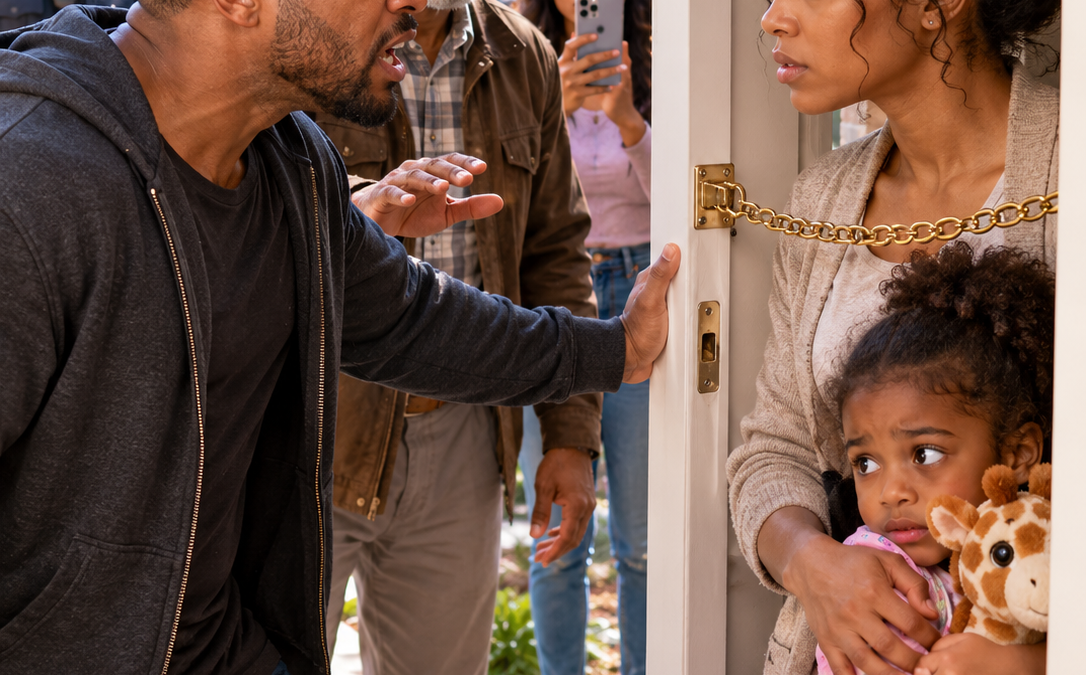
I put the chain on my front door.
I’d never used it before. I didn’t even know whether it worked.
Then I sat in the armchair across from her until one in the morning, watching her sleep with her mother’s hospital bracelet around her wrist.
And listening to every car that drove through the parking lot.
On Saturday, September 26, at five minutes to eleven in the morning, my father’s pickup truck pulled into the visitor parking space in front of my building.
I was sitting on the floor with Da, helping her put together a puzzle of farm animals.
I saw the truck through the front window.
A white Silverado with a dent in the tailgate.
My father climbed out of the driver’s side. Paige got out of the back wearing oversized sunglasses and white sneakers.
And my brother got out of the passenger side.
He walked straight up the sidewalk toward my door without waiting for either of them.
Something was wrong with the way he walked.
Too fast. A little crooked.
He missed the first step leading up to my porch and caught himself on the railing.
Then he started pounding on my door.
“Desi!” he yelled. “Desi, open the door! I know you’re in there!”
Da dropped her puzzle piece.
It was the cow.
She scrambled backward across the rug and into my lap, and I felt her whole little body go stiff.
“It’s okay, baby,” I said. “It’s okay. Go sit in your spot. Go sit on the couch and hold your giraffe. Aunt Desi’s going to talk to them.”
She went.
She pulled her knees up to her chin in the corner of the couch.
I walked to the door.
I didn’t take the chain off.
I opened it three inches, as far as the chain would allow.
My brother’s face filled the gap.
His eyes were red, wet, and unfocused.
And then the smell came through the crack and hit me in the face.
Beer.
Old, sour beer.
The kind of smell a man carries when he’s been drinking since he woke up.
He was out on bond with a court order that specifically said no alcohol.
“Give me my daughter,” he demanded.
“Justice, you need to leave.”
“I’m not leaving without my daughter.”
He shoved the door.
The chain snapped tight and held, but the whole doorframe shook.
“My lawyer filed,” he said. “You hear me? My lawyer filed papers yesterday. She’s mine. The court says she’s mine.”
“The court hasn’t said anything yet.”
Behind him, my father had come up the steps.
He put a hand on Justice’s shoulder.
“Desi,” my father said. “Open the door, honey. Let’s talk about this like a family.”
Paige stood at the bottom of the steps.
She was holding her phone sideways in front of her face.
A little red dot glowed on the screen.
She was filming.
“Everybody’s going to see this,” Paige called up. “Everybody’s going to see what you’re doing to him.”
I shut the door.
I turned the deadbolt.
Then I took my phone out of my back pocket and called 911.
“My brother is at my door,” I told the dispatcher. “He’s drunk, he’s out on bond, and he’s trying to force his way inside to take a three-year-old child who’s been placed with me by Human Services. He’s not her legal father.”
Justice was pounding on the door again, shouting so loudly the dispatcher could hear him through the phone.
She told me to stay inside, keep the door locked, and remain on the line.
It took the police eleven minutes to get there.
The longest eleven minutes of my life.
Justice kept pounding until I thought his fist must be bleeding.
My father stood outside the door, repeating my name in his calm, reasonable voice.
“Desi. Desi, come on now.”
Paige kept filming.
And Da sat in her corner of the couch with her giraffe pressed over her face.
She didn’t make a sound.
That was the worst part.
That she’d already learned to be quiet when men yelled.
Two Tulsa police officers pulled into the parking lot at 11:08, a man and a woman, and came quickly up the sidewalk.
I watched through the window as they separated everybody.
The woman officer walked Justice down the steps to the bottom of the porch and stood in front of him.
The male officer positioned himself between my father and my front door.
Paige kept filming, even after the officer politely asked her to put her phone down.
She didn’t lower it.
Then the male officer knocked on my door.
I opened it with the chain still attached.
“Ma’am,” he said. “Are you Desiree Bus?”
“Yes.”
“Your brother says you’re keeping his daughter from him.”
“That’s my kid!” Justice shouted from the bottom of the steps. “She’s got my kid in there! I have rights!”
I showed the officer everything through the narrow gap in the doorway.
Miss Hooper’s emergency placement paper from Saturday morning.
The power of attorney Jaylen had signed on Thursday, with the notary’s stamp clearly visible.
And Da’s birth certificate, with its empty line where her father’s name should have been.
He read them.
He frowned.
He studied the documents for a long time.
“Ma’am,” he finally said, “without a custody order from a judge, this kind of thing is usually a civil matter. It’s a family dispute, and I can’t tell from some papers who’s who or whether these are real. Your brother says he’s the father. Your dad’s backing him up.”
“What if you could talk to her mother?” I asked.
“Is the mother here?”
“She’s in the neuro ICU downtown,” I said. “She had a brain bleed a week ago, but she’s awake. She can talk.”
He looked at me.
Then he nodded.
I called Jaylen’s cell phone.
She kept it on the tray table beside her hospital bed.
It rang four times.
Then a woman answered.
One of the ICU nurses.
“This is Desiree Bus,” I said. “Jaylen’s daughter is with me. The police are here. Can Jaylen talk?”
There was a pause.
I heard the nurse say something to somebody.
I heard the steady beeping of hospital equipment.
Then the nurse’s voice came back on.
“She says put it on speaker.”
I pushed the speaker button and held the phone out through the gap in the doorway, between me and the officer.
I held it as high as I could so everybody on that porch could hear.
“This is Jaylen Weatherly.”
Her voice was weak and scratchy from the breathing tube.
But it carried.
It carried all the way down the steps.
“I’m Da’s mom,” she said. “I’m in the neuro ICU. My nurse is standing right here.”
“Ma’am,” the officer said, leaning toward the phone. “Your daughter’s aunt is here, and so is a man named Justice Bus who says he’s the child’s father. Can you tell me who you want your daughter with?”
“He’s not her legal father,” Jaylen said. “He never signed anything. I signed papers on Thursday with a notary. My daughter stays with Desiree. I don’t want Justice or his parents to have her. Please.”
The officer asked the nurse to confirm that she was standing beside the patient, Jaylen Weatherly, in the ICU.
The nurse confirmed it and gave him her name and the name of her unit.
He thanked her.
He thanked Jaylen.
He told her to get some rest.
Then he turned around to face the bottom of the steps.
“Sir,” he said to my brother, “the mother of this child has made her wishes clear. You don’t have any custody order. You need to leave this property right now.”
Justice started screaming.
At first, it wasn’t even words.
It was just sound.
Then the words came.
A lot of them.
Most of them about me.
He lunged toward the steps.
The woman officer put her arm out, and Justice stumbled backward, away from her, down the last step and onto the concrete sidewalk.
He swayed where he stood.
He reached for the metal mailbox post near the curb to keep himself from falling, missed it, and caught it on his second try.
The woman officer stepped closer.
“Sir, have you been drinking today?”
Justice didn’t answer.
He didn’t have to.
She was standing close enough to smell it.
He was on a public sidewalk in front of a building full of families, falling-down drunk and screaming at eleven o’clock in the morning.
“Turn around for me, sir,” the officer said. “You’re under arrest for public intoxication.”
They put him in handcuffs right there on the sidewalk.
The same way they’d put him in handcuffs a week earlier in an emergency room lobby, while his girlfriend was lying on a procedure table with coils being placed inside the arteries of her brain.
He cried when they put him in the back of the cruiser.
He cried and said my name.
Paige had finally lowered her phone.
She stood on the grass with her mouth hanging open, her oversized sunglasses pushed up onto her head.
My father was sitting on the curb.
He’d simply sat down right there beside his truck, as if his legs had stopped working.
He looked older than I’d ever seen him.
Then he looked up at me, standing in my doorway with the security chain still attached.
“Desi,” he said. “Please do something. Call somebody. Help him.”
I looked at my father.
Then I looked at my sister, standing on the grass in her white sneakers, still holding the phone she’d used to film everything.
“Call your favorite daughter,” I said.
And I shut the door.
On Monday, September 28, the district attorney asked the judge to revoke my brother’s bond.
Justice had been arrested for public intoxication just five days after being released under bond conditions that specifically prohibited him from consuming alcohol.
The judge revoked his bond.
Justice is now in the Tulsa County Jail, and he’ll stay there until his criminal case is resolved.
The $5,000 Paige paid the bondsman is gone.
You don’t get the bondsman’s fee back.
The paternity case is moving forward.
There will be a DNA test, and it will establish what everybody already knows.
Jaylen’s legal aid lawyer says the case will almost certainly end with Justice paying child support through the state.
The very thing my father spent three years paying Jaylen to avoid.
Any time Justice gets with Da will be supervised, if he gets any at all.
Jaylen is almost through the dangerous period following the aneurysm.
Her doctors say the arteries in her brain never went into spasm, which is the best news they could have given us.
On Tuesday, she walked to the bathroom with a walker and a physical therapist beside her.
They’ve started using the word rehab.
My parents took out a loan against their house in Sand Springs to pay for Justice’s criminal lawyer.
My aunt told me it was $50,000 borrowed against the brick house they bought in 1991.
Fifty thousand dollars for a lawyer who can defend my brother in front of a judge, but who can’t do anything about the blank line on Da’s birth certificate.
My parents drew that line themselves.
In cash.
In a Walmart parking lot.
One envelope at a time.
Paige deleted her Facebook posts.
All of them.
My mother called me once on Sunday night.
She asked whether Da needed anything.
“No,” I told her. “She’s fine.”
There was a long silence.
Then my mother said, “Okay.”
And hung up.
Da still won’t sleep in the little white house bed.
Every night, she falls asleep on my couch, curled up in the corner, in the exact spot where her car seat sat that first Saturday morning when the police brought her to my door.
She still wears her mother’s hospital bracelet.
It’s much too big for her and slides up and down her little arm.
Every night before she falls asleep, she holds her wrist close to her face and looks at it the same way she’s seen me look at my watch.
I asked her once what she was doing.








