At 18, my divorced parents dropped my 8-year-old sister on me. “The check covers it. We have new families now.” For ten years, they missed every birthday, every fever, every school event. Then they showed up at her graduation demanding the parents’ seats. I said nothing. The principal read her full name. Dad’s face went white. She no longer carried his.
My name is Francis Aosta. I was eighteen years old. My parents had been divorced for three months when they showed up at my apartment together. My father set my eight-year-old sister’s suitcase by the door and put a check in my hand like a tip.
“The check covers it,” he said. “We have new families now.”
My mother kissed Lucy on the head and did not look at me. Then they left in two different cars, going in two different directions.
For ten years, they missed every birthday, every fever, every school night—and one night in an emergency room I still do not like to think about. Nobody asked me. Nobody asked her. Then they walked into her graduation and asked for the parents’ seats. My father pointed at two white chairs on the football field like he had reserved them in 2016.
I said nothing. I did not have to.
What they did not know was that Lucy had already made a decision of her own.
The principal read her full name into the microphone.
My father’s face went white.
She no longer carried his.
If a sister being handed a child like leftover luggage is already sitting heavy in your chest, take one second to like and subscribe. It helps these stories find the people who need them. Drop your city and what time you are listening from. I love knowing where you are.
Now, let me take you back to that Thursday in July.
A Life-Altering Decision
It was July 14, 2016, three o’clock in the afternoon.
I had turned eighteen in April and graduated from high school in June. In six weeks, I was supposed to move into a dorm at Ohio State. The orientation folder was still on the kitchen counter, where I saw it every time I got a glass of water.
We lived in a two-bedroom apartment in Vanelia, just north of Dayton. By we, I mean Lucy and me, mostly. My mother had been in Sarasota, Florida, since the middle of June. She said she was helping Eric’s daughter with a new baby. Eric was the man she had met online the winter before the divorce was final.
Lucy had spent the first two weeks of July at my father’s place in Richmond, Indiana, forty-five minutes west. That was his summer time with her. So, for most of that summer, it had been the two of us.
I didn’t think much about it. I thought it was temporary.
Then a white van pulled into the lot. On the side, in blue letters, was BECKETT HEATING AND AIR. Behind it came a silver rental car with my mother at the wheel.
They got out at the same time.
I hadn’t seen them stand that close to each other since before the divorce.
Lucy came in first, hugging a pillowcase full of stuffed animals, happy the way eight-year-olds are happy when a trip is over. My father came in behind her with her suitcase—not the overnight bag, but the big blue one from the hall closet.
He set it down by the door and didn’t take his hand off the handle right away, like he was deciding something.
Then he let go.
“Franny,” my mother said. “Sit down for a second. Your dad and I need to talk to you.”
I sat at the kitchen table, and for no reason I understood yet, I thought about a stack of papers my mother had me sign at that same table in May, during graduation week. She’d said the landlord wanted another adult on file.
I signed without reading.
I was eighteen. She was my mother. And I had a cap and gown to pick up.
My mother went first.
She was staying in Florida. She and Eric were making it permanent.
New Realities
My father went second. He had moved in with a woman named Crystal in Richmond in June. They were getting married in the fall.
I waited for the next sentence—the one that said where Lucy would live.
“Crystal’s already got an eight-year-old,” my father said. “Two in one house. That’s not fair to anybody.”
Crystal’s daughter was named Kaye. She was eight, the same age as my sister.
“Eric’s place is small,” my mother added. “And his grandkids are there all the time.”
Lucy was in the living room, lining up her stuffed animals on the couch. She could hear everything. I could see her pretending not to.
“I start school in August,” I said.
Nobody answered.
My father reached into his back pocket and took out a checkbook. It wasn’t a personal checkbook. It was the long kind with carbon copies that businesses use.
He wrote fast, like he had practiced.
He tore off the check, folded it in half, and pressed it into my palm.
“The check covers it,” he said. “We have new families now.”
It was for seven hundred dollars.
In the memo line, he had written one word: Lucy.
My mother stood up, walked to the couch, and kissed Lucy on top of the head.
She didn’t look at me.
“You’ve always been so good with her,” she said to the room.
At the door, my father stopped. I must have been staring at him because he frowned.
“Don’t look at me like that, Fran,” he said. “You were always more your mother’s, anyway.”
I didn’t know what he meant by that.
Not yet.
In the upper-left corner of the check, above his signature, it said BECKETT HEATING AND AIR LLC. A business account.
I noticed it the way you notice a stain on a shirt.
I didn’t know yet why it mattered.
Lucy ran out to the parking lot to wave. I watched from the window. The van pulled out first. The rental car followed. At the light on National Road, the van turned right toward the interstate and Indiana.
The rental car turned left toward the airport.
Lucy waved until both of them were gone.
Then she came inside and asked if we could have pancakes for dinner.
We had pancakes for dinner.
Halfway through, she put her fork down.
“Is Mom coming back for my birthday?”
Her birthday was in October. Three months felt like a safe amount of time to promise things in.
“I don’t know,” I said.
“Can you ask her?”
“I’ll ask.”
I texted my mother that night.
She answered the next morning.
We’ll see, baby.
With a little red heart.
That night, I unpacked Lucy’s suitcase.
Stepping Into Parenthood
At the very bottom, folded flat, was her winter coat.
It was July.
Nobody packs a winter coat for a visit.
Around midnight, she knocked on my door. She couldn’t sleep.
“The room feels too big,” she said, even though it was the same room she had slept in all year.
On my desk was a gray sweatshirt with OHIO STATE across the front in scarlet letters. I had bought it in March, the day my acceptance email came. I had never worn it outside the apartment.
I pulled it over Lucy’s head.
It came down to her knees.
I walked her back to bed and pulled up the blanket.
“Are you leaving too?” she asked.
“No.”
She didn’t believe me. I could tell.
So I knocked twice on the wooden bed frame.
Two taps.
“That’s me,” I said. “That means I’m here.”
She reached over and tapped the frame twice.
Then she turned over and fell asleep in my sweatshirt.
I sat on the floor with a seven-hundred-dollar check in my pocket.
I had said one word to her.
No.
It would take me years to add up what that word cost.
The next morning, I called Ohio State. The woman in admissions was kind. She asked if there was a family emergency.
I thought about how to explain it and couldn’t find a version that fit into a phone call, so I just said yes.
Then she asked me a question I hadn’t prepared for.
“Would you like to defer or withdraw?”
Deferring meant one year. I didn’t know if one year would change anything. I didn’t want to promise a school something I might not be able to give it.
“Withdraw,” I said.
The enrollment deposit was not refundable.
The orientation folder went into the kitchen trash.
The sweatshirt stayed on Lucy.
The Deceptive Lease
That same week, I got a job at the front desk of Sorenson Family Dental, twelve minutes from the apartment, for $13.50 an hour.
Dr. Sorenson hired me because I could start Monday. His office manager, Gail Novak, showed me the phones, the scheduling software, and the drawer where she kept emergency granola bars.
She didn’t ask why an eighteen-year-old needed full-time hours and a fixed schedule.
I think she guessed.
On August 1, the rent was due. I called the property manager, Linda Carver, to ask whether my mother had already paid it. I thought maybe she had set up something automatic, some small plan.
There was a pause on the line.
“Your mom took herself off the lease in May, honey,” Linda said. “You signed the renewal.”
She emailed me a copy.
There was my signature.
Dated May 23, 2016.
The lease ran through November 30. Eight hundred sixty dollars a month.
My mother’s name wasn’t on it anywhere.
I read it three times at the kitchen table, the same table where I had signed it.
Then I called my mother.
She picked up on the fourth ring. I could hear a television in the background.
“You had me sign the lease,” I said. “In May.”
She didn’t pretend not to understand.
That was almost worse.
“I knew if I asked, you’d say no,” she said. “And you would’ve been fine. You’re always fine, Franny.”
“I was supposed to be in Columbus.”
“Columbus isn’t going anywhere,” she said. “Honey, I have to go. Eric’s got dinner on.”
They had planned this in May, two months before the suitcase.
My mother had handed me a pen and a stack of papers during graduation week, smiled, and told me it was for the landlord. Then she left for Florida to help with a baby, and I spent June doing a trial run of my own life without knowing it was a trial.
I stopped wondering whether they had panicked that Thursday.
They hadn’t.
They had scheduled it.
And I started wondering what else they had decided without telling me.
Building a Makeshift Home
Lucy started third grade that August at the same elementary school she had gone to since kindergarten. Same district, same bus stop. The school didn’t need to enroll her again. They only needed to know who to call.
Her teacher was Mrs. Karen Doyle.
She took the envelope I handed her, a one-paragraph notarized letter from my mother saying I could make decisions about Lucy’s school and medical care. My mother had left it in the suitcase underneath the winter coat.
Mrs. Doyle read it and slid an index card across the desk.
Emergency Contact.
The first line said PARENT/GUARDIAN.
I held the pen over it for longer than I should have.
I wasn’t either one.
Then I wrote: Francis Aosta.
The next box said RELATIONSHIP.
I wrote: Sister.
“Who do I call first?” Mrs. Doyle asked.
“Me.”
“And second?”
I looked at the empty line.
I didn’t have anyone to put there.
“I’ll get back to you,” I said.
By November, the math had stopped working. Rent, groceries, gas, a phone bill, and a seven-hundred-dollar check that arrived on the first of every month like a clock nobody wound.
When the lease ended, we moved into the left side of a duplex two streets over. Seven hundred twenty-five dollars a month, same school district.
I checked twice.
Across the street lived a widow named Denise Hollander. She was sixty-three.
She came over on moving day with a chicken casserole and stood in our doorway surveying the boxes.
“How old is she?” she asked, nodding at Lucy.
“Nine last month.”
My mother had not come for the birthday. She had sent a text with three balloon emojis.
“I raised three boys,” Denise said. “I can handle one girl for three hours after school.”
That week, I went back to Mrs. Doyle and wrote Denise’s name on the second line.
On Thanksgiving, my mother called on video from a beach. Behind her, Eric’s grandchildren ran in and out of the frame in swimsuits.
She told Lucy she missed her so much.
She told her they would do Christmas.
“We’ll do Christmas, baby,” she said. “I promise.”
Lucy took a red marker and circled the twenty-fifth on the kitchen calendar.
My father sent a text.
Happy Turkey Day. Tell Lucy hi.
No question mark anywhere.
Nothing that needed an answer.
Nobody came for Christmas.
What came in January was an envelope from Beckett Heating and Air.
It wasn’t a card.
The Tax Form Betrayal
On Christmas Eve, Lucy sat by the front window in the sweatshirt until almost ten.
My mother texted at 9:30.
Flights were crazy. So sorry, baby.
On December 27, a Target gift card arrived in the mail.
Fifty dollars.
The little cardboard sleeve said, Merry Christmas. Love, Dad and Crystal.
Crystal’s name came before Lucy’s would have if Lucy’s name had been on it at all.
Lucy used it to buy a night-light shaped like a crescent moon.
She gave me the change.
On January 30, 2017, another envelope came—a plain business envelope with a plastic window and the same blue logo in the corner.
I opened it at the kitchen counter, expecting some late note, maybe a second apology gift.
It was a tax form.
1099-MISC at the top.
PAYER: BECKETT HEATING AND AIR LLC.
Under that:
RECIPIENT: FRANCIS AOSTA.
My address.
My Social Security number typed out in full. He’d had it since I was a baby.
In Box 7, labeled NONEMPLOYEE COMPENSATION, it said $3,500.
Five checks.
August through December.
Seven hundred dollars each.
I didn’t know what the form meant.
I just knew it had my name on it and that nobody had asked me first.
The next day, I brought it to work.
At lunch, I set it on Gail’s desk. She put on her reading glasses, read it once, and then read it again more slowly.
When she looked up, her face had changed.
“Honey,” she said, “he’s not paying support. He’s paying a contractor. And he’s deducting you.”
She explained it gently, the way you explain a bad X-ray.
My father’s business was reporting those checks as payments for services, as if I were a subcontractor he had hired. That way, the money came out of the company’s profits and he paid less tax.
Which meant I was supposed to report it as self-employment income.
Which meant I owed self-employment tax on the money he sent to feed my sister.
Gail ran the numbers on her calculator.
Around $495.
I was eighteen years old.
I would have to file taxes as a small business.
I called my father from the break room.
“Oh, that,” he said.
I could hear a radio behind him and the sound of a truck door.
“That’s just how the accountant sets it up. It’s a business account, Fran. Don’t make it a thing.”
“I’ll owe taxes on it.”
“It’s a couple hundred bucks. You’ll be fine.”
A pause.
“The check covers it.”
He hung up first.
In February, I took the form to a free tax clinic at the public library. A retired accountant with a cardigan and a coffee mug sat with me at a folding table and looked at it for a long time.
“You could fight this,” he said. “File a statement saying it isn’t income. It’s support. But then his business would have to answer for it.”
He tapped the logo.
“People don’t like being made to answer for things. Especially people who write checks.”
I thought about the first of the month. About rent. About what happened in our house when a check didn’t come.
I thought about a man who could decide any month he wanted that he’d done enough.
“How much do I owe?” I asked.
He told me.
I paid the $495 in April out of the savings I had started for a car.
It was the first real decision I made about my father.
I chose the rent over the fight.
I’m still not sure it was the wrong call.
Then I drove to Walgreens and bought a spiral notebook with a green cover.
Uncovering the Name Secret
On the first page, I wrote:
August 1, 2016 — $700.
Lucy.
Under it, every check since.
Date. Amount. What he had written in the memo line.
When the next one came, I added it.
And the next.
I told myself I was keeping it for tax season.
That wasn’t the whole reason.
Somebody had to keep an honest record of what was happening in that apartment, and it was clearly not going to be anyone named Beckett.
I kept that notebook in a kitchen drawer for years.
I never imagined Lucy would read it.
The next year and a half went the way things go when you are too tired to notice them going.
Lucy finished third grade and then fourth. Denise taught her to make pie crust with ice water and to cheat at gin rummy. I learned how to schedule cleanings, verify insurance, and calm a man having a panic attack about a root canal.
The checks came on the first.
My father’s texts came on holidays.
My mother’s calls got farther apart until they were basically seasonal.
In July of 2018, Denise’s air conditioner died.
She called the closest heating and cooling company in the phone book. The closest one was on the other side of Vanelia, near the airport.
My father never moved his shop to Indiana.
He had just moved his life.
Every weekday, he drove forty-five miles each way to work in the town where his daughter lived.
He passed within four miles of our front door five days a week.
Lucy was ten.
She was sitting on our front steps with a popsicle when the white van pulled up across the street.
She was off the step before I could say anything.
Barefoot across the hot asphalt.
“Dad!”
The man who climbed out of the van was maybe twenty-five, in a gray company polo, holding a toolbox.
He looked at her, then over at me, confused.
“Sorry, kiddo,” he said. “I just do installs.”
Lucy walked back slowly.
She sat down on the step next to me.
The popsicle was melting down her wrist, and she didn’t seem to notice.
Denise came across the street a few minutes later while the technician worked. She looked at Lucy, then at me, and lowered her voice.
“I’ve seen those vans on this road before,” she said. “More than once.”
I hadn’t known that.
I wished I still didn’t.
Lucy watched the van for a long time.
The name on the side.
Then she looked at me.
“Why is his name on the van?” she asked. “But not on you?”
I had never told her.
There had never been a reason to.
A Quest for Identity
When I was born in 1998, my parents weren’t married.
My father was twenty-two. My mother was twenty.
At the hospital, the nurse brought over the birth certificate paperwork, and my father wouldn’t sign it.
My mother told me the story once when I was a teenager as if it were funny.
He had said he would sign when he was sure.
They got married in 2000.
He never went back and did the paperwork.
So my birth certificate still has a blank line where a father’s name should be.
I got my mother’s maiden name.
Aosta.
When Lucy was born in 2007, they were married. Nobody had to sign anything special. She came home from the hospital as Lucy Ray Beckett.
Ray after Ray, which was what everyone called my father.
When I was twelve, I asked him why he never fixed my name.
He was watching a game.
“Paperwork for what?” he said without looking up. “You know who your dad is.”
That afternoon on the steps, with the van across the street, I finally understood what he had said at our door two years earlier.
You were always more your mother’s anyway.
It hadn’t been a mood.
It had been the paperwork.
And there was one more piece.
My mother gave up Aosta when she married him. Then she gave up Beckett when she married Eric.
She was Tamara Linkfist now.
Out of all of us, I was the only one still carrying the name she started with.
That night, Lucy came into my room in the sweatshirt. The cuffs were frayed where she chewed them when she was nervous.
She sat on the end of my bed.
“Do I have to keep it?” she asked.
“His name?”
“It’s your name, Luce.”
“It’s on a van.”
I didn’t try to talk her into anything.
I didn’t want to be one more adult making decisions about her life while she stood in the next room pretending not to listen.
“You don’t have to decide anything tonight,” I said.
She thought about it for a while.
“Okay,” she said. “Later.”
It took her seven and a half years to get to later.
The Failed Dance Promise
In the winter of 2019, Lucy was eleven and in fifth grade.
She came home with a pink flyer folded into quarters in her backpack.
SWEETHEART DANCE.
Friday, February 8.
Elementary school gym.
Fifteen dollars per pair.
It was for fathers and daughters, the flyer said.
Or a special adult in small print at the bottom.
But everybody knew what it was for.
She didn’t text him herself anymore. When she did, she got heart reactions instead of answers, so she asked me to do it.
I sent him a picture of the flyer.
He answered in four minutes.
Wouldn’t miss it. Tell her to save me a dance.
Lucy read it four times.
I watched her do it.
Then she asked if she could get a dress.
I found a navy-blue one at Kohl’s on the clearance rack for twenty-four dollars.
Denise spent two afternoons in her living room teaching Lucy a box step, counting out loud—one, two, three; one, two, three—while Lucy stepped on her feet and apologized.
On the eighth, Lucy was dressed by 6:30.
At 6:55, I texted him.
On your way?
Delivered.
Not read.
“He’ll meet us there,” Lucy said.
We drove to the school.
She went into the gym and put her coat on the folding chair next to hers so nobody would take it.
I stayed in the car in the parking lot.
I thought if he pulled in, he should find her.
Not me.
7:15.
7:30.
Through the gym windows, I could see fathers in ties spinning girls around.
At 7:45, I checked my phone again.
Nothing.
At eight, one of the teachers came out and knocked on my window.
“She’s asking for you,” she said quietly.
I went in wearing my work scrubs.
Lucy was sitting next to the empty chair with her coat on it.
“He’s probably stuck on 70,” she said.
“Probably,” I said.
We danced.
She led because she knew the box step and I didn’t.
Around us, there were fathers, one uncle, one grandfather, and me.
The coat stayed on the chair all night.
The next morning, I was scrolling through Facebook with my coffee, and there it was.
A photo posted by Crystal.
My father in a tie.
Next to him, Kaye in a sparkly silver dress, holding a corsage.
Behind them, a banner for Richmond Elementary School’s father-daughter dance.
It was the same night.
The same hour.
The caption said:
Date night with my number one girl.
Followed by a red heart.
I took a screenshot.
I don’t fully know why.
My hands just did it.
Then I realized Lucy was standing behind me, holding a bowl of cereal.
She looked at the screen for a long time.
She didn’t cry.
She put the bowl down on the counter.
“Kaye’s the same age as me,” she said.
“Yes.”
She was quiet for another few seconds.
When she spoke again, her voice was steady.
“From now on, don’t tell him about my stuff,” she said. “Just tell me after.”
I promised her.
I did one thing first, though.
After she went to her room, I texted him.
You were at Kaye’s dance.
He answered that afternoon.
Crystal asked first. Lucy’s got you. She’s fine.
I read that sentence many times over the years.
Lucy’s got you.
He meant it as a compliment.
He meant it as a reason.
In his mind, the fact that I showed up was proof that he didn’t have to.
I didn’t answer.
I kept the promise I’d made to Lucy for seven months.
I broke it once, at two in the morning in an emergency room.
It was the only time I ever did.
The Medical Emergency
In August of 2019, when I was twenty-one, I started the dental hygiene program at Sinclair Community College in Dayton.
It had taken me three years of night classes to finish the prerequisites.
I bought my instrument kit with a student loan—$1,300 in a hard blue case that still had the plastic seal on it.
I worked Saturdays at the front desk, and Denise covered Lucy’s afternoons.
Lucy started sixth grade at the middle school.
For three weeks, I was a student again.
I learned the numbers of every tooth in the human mouth. I came home and quizzed Lucy on them at dinner.
She hated it and learned them anyway.
On Thursday, September 12, at about nine at night, I found her on the bathroom floor holding the right side of her stomach.
I had worked in a medical office long enough to know that side.
At Dayton Children’s, I handed the registration clerk our insurance card.
It was on my father’s company plan.
It had always been on his company plan.
It was one of the few things the checks were supposed to mean.
The clerk typed.
Then she typed again.
“I’m sorry,” she said. “This card terminated January 1.”
She turned the screen a little so I could see it.
My father’s coverage was active.
His plan had changed in January.
Lucy was no longer on it.
He hadn’t told me.
I don’t think it occurred to him that he should.
Then she looked at my mother’s notarized letter, three years old and soft at the folds.
“This isn’t a court document,” she said. “Do you have anything else?”
I didn’t.
The surgeon came in at eleven.
Appendicitis.
They were going to operate right away as an emergency.
The paperwork could be sorted out after.
Before they wheeled her back, I took Lucy’s hand and tapped the back of it twice.
She was pale and sweating and scared.
She tapped back twice.
At 11:04 p.m., I called my father.
Voicemail.
I called my mother.
Voicemail.
I called both of them again at 11:30.
And at midnight.
I texted between calls.
Between eleven at night and two in the morning, I called nine times.
Nobody picked up.
At 1:40 a.m., the surgeon came out.
The appendix had been close to rupturing.
Lucy was fine.
She was in recovery.
I could see her soon.
I sat down in a plastic chair and put my face in my hands.
And for a while, I didn’t do anything at all.
At 6:40 a.m., my phone lit up.
Saw the calls. Is she okay? Crystal’s got a thing with Kaye today. Let me know what the bill is.
Lucy woke up about an hour later, groggy, with a tube taped to the back of her hand.
The first thing she asked was not how she was.
“Did they call?”
I had a choice.
I could tell her the traffic story.
I had told her so many traffic stories.
“Dad texted this morning,” I said.
“What did he say?”
I read it to her.
All of it.
Crystal’s got a thing with Kaye today.
She listened.
Then she said, “Okay.”
And closed her eyes and went back to sleep.
My mother called at noon. I could hear waves behind her and a boat engine.
“Oh, baby,” she said. “I’m so glad she’s okay. Is she okay?”
I let my father know what the bill was.
He never paid any of it.
Legal Guardianship
Before discharge, a hospital social worker sat down with me in a small room with a box of tissues on the table.
She was polite and very direct.
“Do you have legal custody?”
“No.”
“You should,” she said. “Next time, a letter might not be enough.”
So, in October, I filed for legal custody of my sister at the Montgomery County Juvenile Court.
The court needed our parents’ written consent.
I mailed one set of forms to Richmond and one to Sarasota.
Both came back signed in six days.
No phone calls.
No questions.
Nobody asked where she would live or what she needed or how she was sleeping after surgery.
My father’s copy had a yellow sticky note on the front page in his blocky handwriting.
Easier this way. R.
I applied for Medicaid for Lucy.
It covered her retroactively and took care of most of the hospital bill.
The rest—$1,180—I paid off over ten months.
What I couldn’t pay off was time.
Two weeks of Lucy recovering at home.
Two weeks of missed clinicals.
A hospital bill in the mail and a program that didn’t bend.
I withdrew from Sinclair.
The blue instrument case went into the hall closet with the seal still on.
In December, a judge granted me legal custody.
The hearing took eleven minutes.
At the clerk’s window, a woman handed me the order and said, “Congratulations.”
Nobody had ever said that word to me about Lucy before.
It sounded strange.
Like something said at a baby shower.
That night, Lucy was sitting at the kitchen table with her homework spread out. She read the order twice, then looked up.
“Does that mean he’s not my dad anymore?”
I didn’t know how to answer her.
I still think about how many ways I could have gotten it wrong.
“I don’t know, Luce,” I said. “I just know I’m the one they call.”
If someone other than your parents was the one who showed up for you, write their name in the comments.
They deserve to be counted.
The Notebook Records
On March 3, 2020, my father had a son.
I found out from Crystal’s Facebook.
His name was Brody.
The next check came on April 1.
It was for four hundred dollars.
Inside the envelope was a note on company letterhead.
Business is slow plus new baby. Doing what I can. R.
Two weeks before that, on March 17, the state of Ohio had shut down non-emergency dental care because of the pandemic.
Our office closed.
I was furloughed.
We lived on unemployment, the four-hundred-dollar check, and whatever Denise left on our steps.
She was sixty-six and we were all scared, so she would set the grocery bags down, knock twice, and walk back across the street before we opened the door.
Lucy was twelve and stuck in the house all day.
In the second week of April, she decided to clean out the kitchen drawer that nobody ever cleaned.
At the back of it, she found four window envelopes held together with a rubber band and a green spiral notebook.
I came in from the laundry room and she was sitting on the kitchen floor with everything spread around her.
She had one of the forms in her hand.
She was reading it the way she read things for school, with her finger under the words.
“Nonemployee compensation,” she read aloud.
She looked up.
“What’s a contractor?”
I thought about lying.
I had lied to her about Christmas.
About flights.
About traffic on 70.
She was twelve.
She had earned the truth.
So I sat down on the floor next to her and told her.
The business account.
The tax form.
Gail’s calculator.
The $495 I paid the year she was nine.
She was quiet for a long time.
“So I was a business expense,” she said.
I didn’t have a better word for it.
Neither did she.
Then she did something I didn’t expect.
She held out her hand for my phone.
“I want to ask him,” she said. “Will you stay?”
I stayed.
She put it on speaker and set it on the floor between us.
He picked up on the second ring, which surprised both of us.
“Hey, kiddo.”
“Did you put Francis on a tax form for me?”
There was a pause.
I could hear a baby crying somewhere behind him.
“Who told you that?” he said. “That’s grown-up stuff, Luce. It’s just how the business works.”
“Am I a business?”
“Put your sister on.”
Lucy looked at me.
I shook my head.
I didn’t reach for the phone.
She pressed the red button and hung up.
Then she picked up the green notebook, took it to her room, and closed the door.
For two days, she didn’t give it back.
I didn’t ask for it.
On the third morning, it was on the kitchen table next to my coffee.
Along the right edge of every page, in purple gel pen, she had drawn a new column.
At the top of it, she had written one word:
CAME.
In the margins of my columns of numbers, I had noted things over the years.
Her birthdays.
The dance.
The surgery.
Her fourth-grade science fair.
Her first band concert.
Next to each one, in purple, in the neat handwriting of a sixth grader, she had written the same thing.
No.
No.
No.
No.
All the way down the page.
Two more tax envelopes came after that.
January 2021.
And January 2022.
By then, the IRS had changed the name of the form to 1099-NEC.
The government changed the form.
My father didn’t change anything.
The last check came in January of 2022.
Four hundred dollars.
The note was short.
Last one. She’s old enough now. Good luck.
Our Lucy was fourteen.
Symbols of Abandonment
She was in eighth grade.
I counted everything that night.
From August of 2016 to January of 2022, there were sixty-six checks.
$39,300 total.
Spread over the years he’d been gone at that point, it came to less than six hundred dollars a month.
Spread over the years that were still coming, it was going to be a lot less.
Under the last line, Lucy wrote END in purple and underlined it twice.
That same month, there was a parent-teacher conference for her eighth-grade English class.
I signed in at the table by the door.
When I sat down, her teacher reached across the desk to shake my hand.
“Mom,” she said warmly. “She’s doing great.”
I opened my mouth to correct her.
I had corrected people a hundred times by then.
Sister. Guardian. It’s complicated.
Lucy got there first.
“She is,” Lucy said.
The teacher didn’t blink.
She moved right on to the essay about Of Mice and Men.
The sign-in sheet on the table by the door said:
PARENT: FRANCIS AOSTA.
In the car afterward, Lucy was quiet until we turned onto our street.
“When I turn eighteen,” she said, “can I decide anything I want?”
“Almost anything.”
She nodded, looking out the window.
“Good,” she said.
In the fall of 2022, Lucy started ninth grade at Stillwater Valley High School.
She played clarinet in the marching band.
That same fall, the school put up a new scoreboard at the football stadium.
Across the top, in white letters on blue, it said:
BECKETT HEATING AND AIR
PROUD SUPPORTER OF SPARTAN ATHLETICS
The booster program listed the sponsors by level.
My father’s company was at the six-thousand-dollar-a-year tier.
Since his last check, he had sent Lucy nothing.
But he was paying six thousand dollars a year to have his name hanging over her head every Friday night.
At homecoming that October, the band was halfway through its halftime show when the announcer’s voice came over the speakers.
“And a big thank-you to our scoreboard sponsor, Beckett Heating and Air.”
Lucy was on the forty-yard line, marching.
Playing.
She didn’t miss a note.
“He’s at every game now,” she told me in the car. “Kind of.”
He never came to a single one.
In April of 2023, Lucy turned fifteen and a half and got her temporary driving permit.
We took her picture at the BMV and waited while they printed the card.
She held it in both hands and stared at it.
LUCY RAY BECKETT.
“It’s him,” she said.
Twice.
She put it in her wallet face down.
That May, I finished what I had started in 2019.
Claiming a New Name
I had gone back to Sinclair in the fall of 2021, when Lucy was old enough to be home by herself after school.
I opened the blue instrument case and broke the seal.
Two years later, at twenty-five, I graduated from the dental hygiene program.
The pinning ceremony was in a small auditorium on campus. Each graduate got two guest seats with names taped to the backs.
I didn’t send those tickets to anyone in Florida.
I didn’t send them to anyone in Indiana.
Lucy sat in one.
Denise sat in the other.
When the program director said my name, Lucy stood up in the middle of the row.
“That’s my sister!”
A few people laughed.
The director smiled and waited for her to sit down.
Lucy did not sit down until I had walked all the way across the stage.
Two days later, my mother texted me.
Congrats. Saw it on FB.
That was how she found out.
In July, I passed my licensing exam and became a registered dental hygienist.
It was the first raise of my life that actually changed the grocery list.
That night, eating takeout on the couch, Lucy said something I didn’t pay much attention to at the time.
“At mine,” she said, “I’m doing the seats.”
I laughed.
I thought she meant she’d seat Denise in the front row.
I didn’t ask what she meant.
Lucy turned eighteen on Friday, October 24, 2025.
We went to the diner on National Road where we had eaten her birthday dinner every year since she was nine.
She ordered the same thing she always ordered.
Chocolate-chip pancakes, even though it was dinnertime.
At 6:15, her phone buzzed.
My father.
Happy bday kiddo 🎉
She turned the phone face down on the table without answering.
My mother’s card arrived six days later, on October 30.
There was a twenty-dollar bill inside.
In ten years, it was the third card that had a twenty in it.
But that was later.
At the diner, Lucy pushed her plate aside and folded her hands on the table like she was about to negotiate.
“You said later,” she said.
“It’s later.”
I knew right away what she meant.
Or I thought I did.
“Can I borrow something of yours?” she asked.
“For good?”
I said yes before she finished the question.
I’m not going to tell you exactly what she asked for yet.
Partly because, at that table, I only understood half of it.
In January of 2026, Lucy filed the paperwork herself at the probate court downtown.
The Final Graduation
She paid the filing fee with her paychecks from Kroger, where she worked the register three evenings a week.
The court required a notice to be printed in a local legal newspaper, in small type on a page nobody reads unless they’re looking for it.
Nobody we knew was looking for it.
The hearing was set for Thursday, February 19.
I had six patients booked that day.
“I’ll move them,” I told her.
“No,” she said. “It’s a Thursday. You work Thursdays. Denise is driving me.”
“Luce, I want to be there.”
“I know,” she said. “That’s why.”
I didn’t understand that.
I let it go.
She was eighteen, and I had promised her a long time ago that she could decide things.
That Thursday, I cleaned teeth from eight to four and checked my phone between every patient.
There was nothing.
When I got home, Lucy and Denise were sitting at our kitchen table drinking tea like two women who had just gotten away with something.
Denise had a manila folder in her lap.
She patted it.
“Don’t look at me,” Denise said. “I’ve been sworn to secrecy, and at seventy-two, I take that seriously.”
In late January, before the hearing, Lucy’s acceptance email from Ohio State had come.
It was addressed to Lucy Beckett because that was the name she had applied under in November.
She read it to me over the phone while I sat in the parking lot at work.
I cried so hard I had to wait ten minutes before my next patient.
In March, she changed everything else.
Social Security.
The BMV.
Her school records.
In the counseling office with Mrs. Beth Kowalic, who had been her counselor since freshman year, I went with her to that appointment.
Mrs. Kowalic slid a printout across the desk and smiled.
“Your records are all updated, Lucy,” she said. “Congratulations.”
In the parking lot, Lucy showed me her new state ID.
She held it with her thumb pressed flat across the middle of the name line.
“What’s under your thumb?” I asked.
“Graduation,” she said.
And put it back in her wallet.
In April, she confirmed her enrollment at Ohio State.
The school I had called in July of 2016 to say I wasn’t coming.
The first week of April, the school announced the top ten students in the Class of 2026.
There were 286 graduates.
Lucy was number four.
Each of the top ten got two reserved seats on the field for graduation, in the front row directly in front of the stage.
The school sent home a form.
Lucy filled it out at our kitchen table while I was making dinner.
When she was done, she handed it to me to read before she turned it in.
RESERVED GUEST ONE: FRANCIS AOSTA — PARENT/GUARDIAN.
RESERVED GUEST TWO: DENISE HOLLANDER.
I read it, handed it back, and turned around to stir the sauce so she wouldn’t see my face.
A couple of weeks later, around April 20, I came into the kitchen and saw two envelopes on the table.
Stamped.
Addressed.
When Lucy saw me looking, she slid them under her chemistry textbook.
I assumed they were thank-you notes for teachers.
They weren’t.
On Monday, April 27, I was eating lunch in the break room at work when my phone buzzed.
It was my father.
Got Lucy’s card. Crystal and I will be there. Kaye’s is the week after, so it works. Make sure we’re in the parent seats, not the bleachers.
He had found the graduation page on the school website.
He had read the part about reserved honor seating.
He had decided, without asking anyone, that it was his.
The Seating Dispute
That night, I put my phone on the table in front of Lucy and waited.
She didn’t pretend.
She told me she had mailed two cards.
One to Richmond.
One to Sarasota.
Each card had the date, the time, the stadium, and one sentence.
I’m fourth in my class, and I’d like you to be there.
She had signed each one:
Lucy.
Nothing else.
“Why?” I asked.
She thought about it before she answered.
She always did that when the answer mattered.
“I want them to hear it once,” she said. “From somebody who isn’t you.”
“Hear what?”
“You’ll hear it too,” she said.
One week later, on Monday, May 4, my father called the school to confirm his seats.
The woman at the front desk told him Lucy was eighteen and that the school couldn’t discuss her records without her written consent.
Then, while she was typing, she said something she probably wasn’t supposed to say.
“I’m not finding a Lucy Beckett.”
She stopped.
“I’m sorry, sir. I can’t discuss any student.”
I know all this because he called me from his truck ten minutes later.
“They said they don’t have a Lucy Beckett,” he said. “What did you do?”
“Ask her.”
“I don’t need to ask her.”
I could hear his turn signal clicking.
“She’s my daughter. She has my name. I don’t need permission.”
“Okay,” I said.
“I’ll sort it out Saturday.”
He hung up.
The next morning, my mother texted.
Landing Friday night. Your father says there are special seats.
I didn’t answer either of them.
Rehearsal was on Thursday, May 14, in the stadium.
Every graduate filled out a small index card with their name spelled phonetically so the principal would pronounce it correctly.
Lucy filled hers out on her knee in the bleachers, then slid it into the box her cap came in and closed the lid.
The principal, Mr. Alan Crowley, was walking the rows with a clipboard.
I knew him from four years of signing forms in his office.
He stopped when he got to me.
“I’ll get it right, Miss Aosta,” he said. “Don’t worry.”
“Get what right?”
He only smiled and kept walking.
The night before graduation, Lucy stood in the living room steaming her gown on a hanger hooked over the closet door.
I sat on the couch pretending to read.
“What did you do the night before yours?” she asked.
“Your pinning?”
“Studied for my boards.”
“Of course you did.”
She turned the steamer off.
“Tomorrow, you don’t have to do anything. You don’t have to fix anything or sign anything or talk to anybody.”
“You just sit?”
“Luce—”
“Promise me,” she said. “You just sit.”
I had spent ten years being the person who handled things.
I didn’t know how to do the other thing.
“I promise,” I said.
On Saturday, May 16, 2026, I got to the stadium at 9:15 in the morning.
The Declaration at Graduation
The scoreboard was the first thing you saw from the parking lot.
BECKETT HEATING AND AIR in white on blue.
Forty feet tall.
On the field, there were rows of white folding chairs for the graduates facing the stage. In front of them was one row of reserved chairs for honor families.
Two chairs for each graduate.
Each pair had a laminated placard zip-tied to the back.
Ours said:
HONOR GRADUATE #4
F. AOSTA / D. HOLLANDER
A volunteer handed me a program.
I opened it to the honors page.
Number four:
LUCY F. AOSTA — THE OHIO STATE UNIVERSITY.
F.
Her middle name was Ray.
It had been Ray on every form I had ever signed.
I read the line three times.
Before I could make sense of it, I heard my father laugh behind me.
He was walking across the grass with Crystal on one side and Kaye on the other.
Kaye was graduating the next Saturday.
Brody, who was six, was holding his mother’s hand and staring up at the scoreboard.
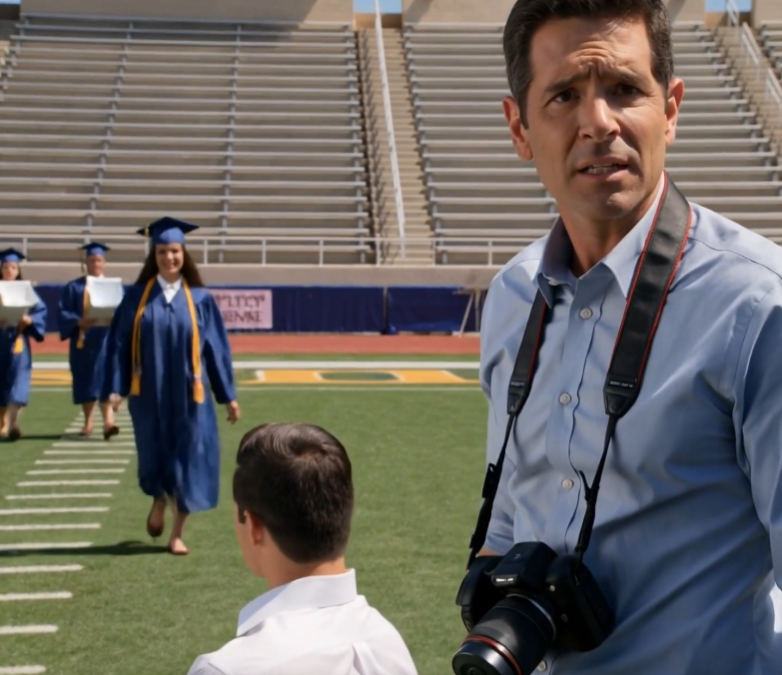
My father had a big camera on a strap around his neck.
He looked like a man who had come to an event he was sponsoring.
He looked at the row of reserved chairs.
Then he pointed at ours.
“Those are the parent seats,” he said. “That’s us.”
He bent down and read the placard.
“F. Aosta.”
He straightened up and looked at me.
“That’s you. You’re her sister.”
Mrs. Kowalic was already walking over with a clipboard.
She had clearly seen men like my father before.
“Good morning,” she said. “Those seats belong to the guests Lucy listed. Sir, general seating is open in Section C.”
“I’m her father.”
“Then you’re very welcome in Section C.”
“My company,” he said, pointing up at the scoreboard, “is on that scoreboard.”
She followed his finger.
Then she looked back at him.
“It’s a very nice scoreboard,” she said.
That was when my mother came across the grass from the parking lot in big sunglasses, a little out of breath.
“Ray,” she said. “What’s going on? Are these ours?”
For a minute, the two of them argued in low voices about which one of them should get which chair, like people who had practiced being polite to each other in public.
I said nothing.
I had promised.
I sat down in the chair with my name on it and folded my hands in my lap.
Denise sat down in the other one.
My father flipped open his program and ran his finger down the B’s.
Beckett.
He went through them twice.
“They left her out,” he said. “She’s not even in here.”
“Ray,” Crystal said quietly. “Sit down.”
Kaye looked at the placard on my chair.
Then she looked at me.
She didn’t say anything.
They went up into Section C, third row, behind the honor seats.
My mother sat two seats down from them with an empty seat in between.
The band started to play.
The graduates came out of the tunnel in two lines.
Lucy was near the front with the gold honor cords around her neck.
As she passed our row, she looked at the two white chairs.
At me.
At Denise.
She nodded once.
Before I tell you what happened when the honor roll was read, what do you think Lucy did with those two seats?
Tell me your guess in the comments.
Mr. Crowley stepped up to the podium and welcomed everyone.
He said that at Stillwater Valley, every graduation began the same way.
Before the diplomas.
Before the speeches.
The school recognized its top ten graduates, one at a time, by name, along with the college each one would attend.
I found out later from Kaye that my father had his camera up from the very first name.
He was waiting for the Beckett.
“Number one,” Mr. Crowley said.
A boy going to Purdue walked across the stage to accept his medal.
Families cheered.
Number two, a girl going to the University of Cincinnati.
Number three, someone going to Miami University.
I don’t remember who.
My heart was beating so hard I couldn’t hear anything but the speakers and the blood in my ears.
“Number four.”
He looked down at the card in his hand.
The card she had written in the bleachers and closed inside her cap box.
He read it exactly the way she had spelled it.
“Lucy Francis Aosta. The Ohio State University.”
For a second, the stadium was very quiet.
It was the regular quiet between names.
But it didn’t feel regular to me.
Francis.
My name.
In the middle of hers.
Out loud through a microphone in front of a thousand people.
And Ohio State in the same sentence.
The place I had called on July 15, 2016, to say I wasn’t coming.
I couldn’t have spoken if I’d tried.
Denise found my hand and held it tight.
I turned around in my chair.
In the third row of Section C, my father was half standing.
The camera had dropped to his chest.
His face had gone completely white.
The color of the chairs on the field.
Crystal wasn’t looking at the stage.
She was looking at him.
Two seats down, my mother had both hands pressed over her mouth.
My father had been waiting for his name.
He heard mine instead.
Aosta.
The name my mother gave me because he wouldn’t give me his.
The name she had given up herself.
The name that had been on every school form, every hospital form, every custody paper, and every tax document in my sister’s life for ten years.
Lucy had taken the name he refused to give me.
And then she had taken mine.
On the stage, she shook Mr. Crowley’s hand.
He put the medal around her neck.
She turned to face the field.
She didn’t look at Section C.
Not once.
She looked at me.
Then she raised her hand and tapped her chest twice.
Two taps.
That’s me. I’m here.
I tapped my knee twice.
I don’t think she could see it from the stage.
It didn’t matter.
She knew.
The honor roll finished.
Then the diplomas began in alphabetical order.
Two hundred eighty-five more names.
Somewhere in the B’s, I turned around again.
My father wasn’t in Section C anymore.
He was standing by the chain-link fence at the far end of the field, alone, arms folded, directly underneath the scoreboard.
His name was forty feet tall above him.
It just wasn’t on her.
Denise leaned close to me.
“I was at the hearing,” she said softly.
I looked at her.
“The judge asked her why she wanted to change her name. She said her sister raised her, and she wanted her name to say so.”
She squeezed my hand again.
“She said you’d try to talk her out of the middle part,” Denise said. “So she didn’t ask.”
She was right.
I would have.
For ten years, I had written my name on forms that were meant for her parents.
Permission slips.
Emergency cards.
Custody papers.
Consent for surgery.
I never once thought she was keeping track.
She had written my name on exactly one form.
And she made sure a judge signed it.
The graduates threw their caps.
The band played the recessional.
People came down out of the bleachers and flooded onto the grass.
When Lucy found us, she wrapped both arms around me and didn’t say anything for a long time.
Becoming Family
Over her shoulder, I could see the gate at the edge of the field.
My father was waiting there.
Crystal stood a step behind him, holding Brody’s hand.
Kaye was next to her.
My mother came across the grass a little later with her car keys already in her hand.
My father looked at Lucy like he was trying to recognize her.
“When did you do this?” he asked.
“February nineteenth,” Lucy said. “It was a Thursday.”
He shook his head like a man who had just been handed the wrong bill.
“I’m your father,” he said. “That’s my name.”
Lucy didn’t raise her voice.
She has never needed to.
“You gave me your name,” she said. “You gave Francis a tax form.”
Crystal frowned.
“A what?”
Kaye had spent the last two summers answering phones at his office.
She answered before anyone else could.
“A 1099?” she said slowly. “That’s what we send the contractors.”
For a second, nobody said anything.
“It was the business account,” my father said. “That’s how it works.”
Crystal looked at him the way you look at a receipt for something you don’t remember buying.
He turned toward Lucy and lifted the camera.
“Let’s just get one picture,” he said. “Come on. One.”
Lucy looked at the camera.
Then at him.
“Thank you for coming,” she said. “I wanted you to hear it.”
Then she stepped back and stood next to me.
She didn’t take the picture.
My father looked at me like this was my doing.
It wasn’t.
For once in his life, nothing about this had been decided by the adults.
My mother took off her sunglasses.
Her eyes were wet.
“Aosta,” she said. “That’s my name.”
“It was,” I said. “You gave it to me because he wouldn’t give me his. Then you left it here.”
She looked at the grass for a long moment.
“I should have made him sign,” she said.
“You should have stayed.”
She didn’t answer that.
She nodded once and walked back across the parking lot to her rental car.
The last I saw of her that day was her taillights turning left out of the lot.
My father stood at the gate a little longer.
Then Crystal said his name quietly, and they walked away.
Brody looked back over his shoulder at the scoreboard.
In the car, Lucy held the medal in her lap and turned it over and over.
“Was that mean?” she asked.
“What I said to him?”
I thought about it honestly because she deserved an honest answer.
“No,” I said. “It was true. Those aren’t the same thing.”
She nodded and leaned her head against the window.
Denise, in the back seat, reached forward and patted her shoulder twice.
Some of you have asked me who really earns the word parent.
Is it the person who’s related to you?
Or the person who stays?
I’d like to hear what you think in the comments.
Four days later, on Wednesday, May 20, an envelope came with the blue Beckett logo in the corner.
Inside was a check for five thousand dollars.
PAY TO THE ORDER OF: LUCY BECKETT.
In the memo line:
COLLEGE.
There was no note.
Lucy turned it over in her hands.
Then she set it on the counter and left it there overnight.
On Thursday, she mailed it back.
She stuck a yellow sticky note to the front of it.
The same kind he had used.
Lucy Beckett doesn’t live here anymore. Put this toward Brody’s college and go to his things.
That Saturday night, after her own graduation in Richmond, Kaye sent Lucy a message.
Lucy showed it to me.
He left early today. Mom asked him about the 1099 thing in the car on the way home. I’m sorry for all of it.
Lucy wrote back:
Not your fault. Congratulations.
Then she took the green notebook out of the kitchen drawer, sat at the table, and wrote something in it.
She didn’t show me.
On Sunday, May 31, we were at the kitchen table again.
Lucy had her laptop open to BuckeyeLink, the Ohio State student portal.
She was registering for her orientation date in June.
Then she clicked on emergency contacts.
She typed my name.
Francis Aosta.
My phone number.
There was a drop-down menu for relationship.
She clicked it and looked at the options for a while.
She picked:
PARENT/GUARDIAN.
“They don’t have a box for both,” she said.
Behind her, on the living room floor, there was a cardboard box with COLUMBUS written on the side in marker.
On top of everything else in it, folded, was a gray sweatshirt.
The cuffs were frayed.
The scarlet letters were cracked from ten years in the wash.
“I bought that the day I got in,” I said.
“I know,” Lucy said. “It’s going this time.”
That night, when I went into my room, the green notebook was sitting on my pillow.
I opened it to the last page with writing on it.
Under the purple END she had written when she was fourteen, there was one new line in the same purple pen.
May 16, 2026.
CAME: YES.
EVERY TIME.
L.
My name is Francis Aosta.
I was eighteen years old when I became somebody’s family.
It took her ten years to put it in writing.








