At 16, my family left me stranded at a train station for laughing at the wrong moment. Mom said, “We’ll come back when you’ve learned your place.” They never did. I spent that night on a bench. By morning, I’d made one decision: I would never beg them again. Twenty years later, they finally found me. Dad started to smile. Then he saw what I was wearing. The smile disappeared.
My name is Vera Evans. I am 36 years old.
When I was 16, my family got off a train in Cleveland at 1:45 in the morning, walked me to the parking lot, and left me there. My mother did not yell. She put my bag in the trunk instead of handing it to me, leaned out the window, and said, “We’ll come back when you’ve learned your place.”
Then the glass went up.
My father drove. My little brother stared at me through the back windshield until they turned the corner. Home was twelve miles away. I had $6.40.
I called the house once. A machine picked up. No one called back. I spent the night on a wooden bench and made one decision: I would never beg them again.
Twenty years later, they found me.
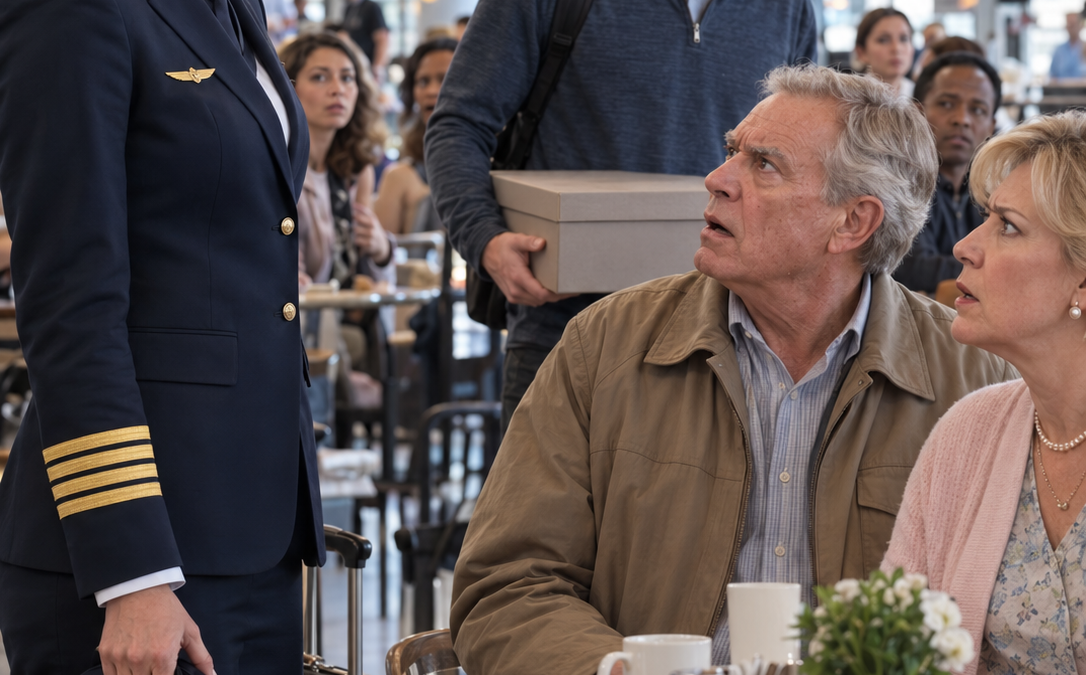
My father stood up smiling like two decades had been a long weekend. Then he looked at what I was wearing, and the smile died. My mother still didn’t understand.
He did.
They had left a girl they expected to wait. They found a woman who had already stopped asking.
If your own family ever told you to learn your place, drop “I learned it anyway” in the comments. I read every single one. Hit like if you want to know what my father saw on my sleeve. Subscribe. The story is just beginning.
It began with a laugh on a train platform.
But the laugh began with the train.
The trip was for my brother.
Phân cảnh 2: The Night of Abandonment
Most things were.
Kyle turned thirteen on April 2, 2006, and for his birthday he asked for a train ride. Not Niagara Falls. The train.
My parents gave him both over spring break: three days at the Falls and two long rides on the Lake Shore Limited, because when Kyle asked for something, the only real question in our house was how to make it bigger.
That spring, he had already moved on from trains to airplanes. A private flight school outside Cleveland had accepted him into its youth program, with lessons starting in June. The welcome packet came with a glossy folder, a brochure with a smiling instructor on the cover, and a pair of gold plastic wings that said JUNIOR PILOT across the middle.
He wore those wings to breakfast. He wore them at the Falls under his rain poncho. He wore them the entire ride home, pinned crooked to his T-shirt.
Somewhere past Erie, my mother took her sleeping pill with a bottle of water, the way she did every night, then pulled her cardigan over her shoulders like a blanket. My father worked a crossword in the seat across the aisle.
I sat by the window with my backpack on my lap. I didn’t put it on the floor. I hadn’t put it down in three days.
Kyle leaned over the armrest.
“Quiz. What does a captain wear on his sleeve?”
“Kyle, it’s one in the morning.”
“Four stripes. First officers get three, and the captain always sits on the left.”
He poked my arm.
“Say it back.”
“Four stripes. Left seat.”
“Again.”
I said it again. He was thirteen. I was sixteen. It was easier than arguing.
He made me say it twice more before the train began to slow.
We pulled into Cleveland at 1:45 in the morning. The platform was cold and nearly empty. A handful of passengers stepped down with us, including a retired couple from Toledo whom my mother had met in the café car somewhere in western New York.
The pill hadn’t put her to sleep yet. It had only made her friendlier. She walked beside the woman from Toledo with her arm hooked through her elbow as though they had known each other for years.
My father carried two suitcases and the duffel bag. I had my backpack. Kyle had his wings.
“He starts lessons in June,” my mother told them. “Real airplanes. Private instruction.”
“Oh, that’s wonderful,” the woman said.
“It isn’t cheap.” My mother lowered her voice the way she did at church when she wanted to be overheard. “Thirty-one thousand dollars we don’t have. Wayne cashed out part of his retirement. But that’s what you do for your kids. You sacrifice.”
My father was standing right next to me.
I remember that clearly because I felt him turn.
He wasn’t looking at my mother or at the couple from Toledo. He was looking at my backpack. The front mesh pocket had come half unzipped, and the corner of a white envelope was sticking out of it, blue bank logo and all.
Then somebody behind me snorted, soft and quick.
And I laughed.
It wasn’t a big laugh. Two seconds, maybe. But it was out loud, and it landed in the exact silence after the word sacrifice.
The man from Toledo cleared his throat. His wife looked down at her shoes.
My mother looked only at me.
She said good night to the couple. She said it warmly. She told them to drive safely. Then she walked the four of us across the lot to our car, which had been sitting there since Friday morning under a thin film of lake mist.
It was thirty-eight degrees. I could see my breath.
My father opened the trunk and put the suitcases in. My mother took the duffel bag from his hand—the one with my clothes in it—and set it in the trunk herself.
Then she closed the lid.
Not hard.
She didn’t slam things. She didn’t yell.
She never had to.
“You laughed,” she said quietly. “Now you can walk.”
I thought it was the beginning of a lecture.
Kyle understood faster than I did. He came around the side of the car, pulled the plastic wings off his shirt, and pushed them into my hand. He didn’t look at me when he did it.
Then he climbed into the back seat.
My mother got into the passenger side. My father got behind the wheel. The engine turned over.
My mother’s window came down a few inches, and she leaned toward the gap.
“We’ll come back when you’ve learned your place.”
The glass went up.
My father drove.
He didn’t look at me once.
Kyle twisted around in his seat and stared at me through the back windshield, one hand flat against the glass, until the car turned onto the Shoreway and the taillights were gone.
I stood there with the wings in my fist.
Phân cảnh 3: Waiting at the Station
Home was twelve miles away. I knew exactly how long the drive took: twenty minutes with no traffic, and at two in the morning there was none.
I went inside to wait.
Twenty minutes, I figured. Thirty if she wanted to make a point.
The Cleveland Amtrak station was really just one room: a ticket counter, a row of vending machines, a pay phone by the restrooms, and wooden benches facing a wall of windows that looked out toward the lake.
At that hour, the only other person in it was the ticket agent, a heavyset man in a brown cardigan working a crossword with a pencil he kept licking.
I chose the bench closest to the windows. It had seven wooden slats and a small brass plaque from a railroad club I had never heard of.
I know how many slats it had because I counted them more than once.
At 2:20, the agent looked up.
“Someone coming for you, hon?”
“Yes, sir.”
He nodded and went back to his crossword.
At 2:40, I took inventory because it gave my hands something to do. I had $6.40 in my jeans, a gray hoodie, a hairbrush, a paperback for English class with a bus transfer stuck inside as a bookmark, a Christmas card from my Aunt Lorraine—my mother’s older sister—with a little brown wren on the front, and the envelope from the bank.
Aunt Lorraine had mailed the card in December with a fifty-dollar bill and a note that said, Buy something that’s just yours.
I had spent the fifty. I had kept the card.
And I had kept the bank envelope.
I didn’t open it. I didn’t need to. I had read it enough times in three days to see the numbers with my eyes closed.
At three, the agent asked again.
“Still coming?”
“Yes, sir.”
At 3:10, I stopped lying to him. I didn’t say anything. I just stood up.
At 3:12, I walked to the pay phone.
A local call was fifty cents. I fed in two quarters and dialed our house.
$6.40 became $5.90.
I remember doing that math while the phone rang because it was easier than doing the other kind.
One ring.
Two.
Then a click, followed by my mother’s voice, bright and recorded in our kitchen the summer before.
“You’ve reached the Evans family. We’re probably out having fun, so leave us a message.”
The beep sounded.
I had planned what I would say.
I didn’t say it.
What came out was smaller.
“Mom, it’s me. I’m sorry. I’m still at the station. Please come get me.”
There was a sign beside the ticket counter with the station’s phone number on it. I read the number into the phone slowly. Then I read it again so no one could say they had missed it.
Then I hung up.
I went back to the bench and sat where I could see the phone behind the counter. I watched it the way you watch a pot you’ve been told not to watch.
It didn’t ring.
Not once.
Sometime after four, I stopped watching the phone and started watching the windows.
The lake was black, and the sky above it was only a little less black. Every so often, a set of lights crossed it—red and white, blinking, coming in low over the water toward the little airport down the shore or passing overhead on the way to somewhere farther.
I didn’t know anything about airplanes except what Kyle had forced me to repeat.
I only knew that the lights were moving.
And I wasn’t.
I started counting them.
I don’t know when the rule appeared in my head. I only know that at some point I was thinking it as plainly as a sentence written on a chalkboard.
If I get to ten, they’ll come.
One.
Two.
The heater near the door clicked on and off.
Three.
The agent went to the restroom and came back.
Four.
Five.
My feet had gone numb inside my sneakers, so I tucked them underneath me on the bench.
Six.
Seven.
A long gap.
Eight.
Nine.
Then the sky over the lake turned the color of dishwater. The lights grew harder to see, and then I couldn’t see them at all.
I never got to ten.
I have never decided whether that was bad luck or mercy.
At five, the agent put down his pencil and looked at me longer than he had all night.
“Nobody called for you, hon,” he said. “I’d have heard it.”
“I know,” I said. “Thank you.”
The early eastbound train was due just before six, and people started coming in. A man with a garment bag. Two college kids asleep on their feet.
Phân cảnh 4: Finding Help with Donna
At 5:40, a woman in a navy diner uniform and a winter coat came through the door with a younger woman pulling a rolling suitcase.
The younger woman was the passenger.
The older one was the ride.
She walked her sister-in-law out to the platform, came back inside, and stopped halfway to the exit.
She was looking at me.
She was about fifty, with reading glasses pushed up into graying hair and a plastic name tag still clipped to her uniform.
DONNA.
She went to the vending machine, fed it some quarters, came back with coffee in a paper cup, and held it out.
I didn’t take it right away.
“I’m not asking what happened,” she said. “I’m asking if you’ve eaten.”
I shook my head.
“I work a seven o’clock shift at a diner in Lakewood. Pancakes are on me. You can sit at the counter where I can see you, and nobody has to explain anything to anybody.”
She set the coffee on the bench beside me.
“Or you can stay here. Your call.”
I looked past her at the pay phone.
I had used it once.
I thought about using it again. I thought about my mother’s recorded voice telling me they were probably out having fun, and about how long I had watched a phone that never rang.
I picked up the coffee.
By the time the sun cleared the lake, I had made one decision.
I would never beg them again.
The Clifton Grill had red vinyl stools, a pie case with a crack in the glass, and syrup bottles that stuck to your fingers no matter how many times they were wiped.
Donna sat me at the far end of the counter, poured me an orange juice I hadn’t asked for, and called in a short stack without writing it down.
She had one rule, and she told it to me before the plate came.
“You eat first. You talk second. Or you don’t talk. That’s allowed, too.”
I ate first.
When the plate was nearly empty, she leaned against the counter with a coffee pot in her hand.
She didn’t ask me anything.
She told me something instead.
When she was seven, her mother had left her at a bowling alley on the west side. Not overnight. Just an hour. Her mother had gone to the bar across the street and forgotten her.
“I still remember the song on the jukebox,” Donna said. “Isn’t that stupid? Forty-some years, and I could sing you every word.”
She didn’t sing it.
She refilled somebody’s cup and came back.
“I’m going to have to call someone,” she said. “Your folks or the police or the county. You’re sixteen. I’m a waitress. I can’t just keep you. You can tell them where I am.”
“Just don’t ask them for anything.”
She looked at me over her glasses for a long moment.
Then she nodded as if I had said something that made sense.
I gave her the number.
She called from the phone by the register. I watched her face while it rang, and I knew from the way her shoulders changed which of my parents had picked up.
It was my father.
It was always my father who answered.
The call was short. Donna did most of the talking. She told him where I was, who she was, and that I was fed and safe.
Then she listened for a while, and the pen she was using on the back of a guest check stopped moving.
When she hung up, she came back and stood in front of me.
“He was very polite,” she said. “He said you could stay with me if that’s what you wanted. He said it would probably do you good.”
She paused.
“And he said you called the house last night and told them you were fine.”
I set my fork down.
“I didn’t say I was fine.”
“Okay.”
“I said, ‘Please come get me.’”
“Okay.”
She folded the guest check in half and slid it into her apron pocket.
I decided my father was lying to make himself feel better. It seemed like the kind of small, soft lie he told all the time.
I was half right.
Donna made a second call that morning, this one to the county, and the next few days passed in a series of people with clipboards. A caseworker came to Donna’s small house in Lakewood, looked in the refrigerator, checked the lock on the spare room, and asked me questions in a tone designed not to frighten me.
A school counselor made some phone calls. Someone from the county spoke to my parents.
Nobody at our house argued.
Nobody asked for me back.
On Wednesday, Donna drove me to Parma to pick up my things.
They were waiting on the front porch.
Phân cảnh 5: Starting a New Life
Three black trash bags—the heavy kind meant for yard waste—were lined up against the railing.
My mother stood behind the screen door with her arms folded. She didn’t open it.
I could see Kyle in the upstairs window.
He didn’t wave.
Neither did I.
Donna loaded the bags into her trunk without a word. I stood at the bottom of the porch steps because I didn’t know where else to stand.
“Your Aunt Lorraine doesn’t want to hear from you either,” my mother said through the screen. “I asked.”
Then she closed the inside door.
Every bag was double-knotted at the top.
My mother double-knotted things she didn’t expect to open again.
About a week later, a form arrived at Donna’s house. It was my enrollment transfer for Lakewood High School, and it had come back from Parma with my mother’s signature on the parent line.
Neat.
Blue.
Careful.
There was nothing clipped to it. Not a sticky note. Not a single line.
I started at Lakewood High on April 24. Tenth grade. A new locker. A new bus route.
Donna’s spare room had a narrow bed and a window that faced the neighbor’s garage. I put Kyle’s plastic wings on the windowsill because I didn’t know what else to do with them.
I taped Aunt Lorraine’s Christmas card to the inside of the closet door with the little brown wren facing out.
Donna saw it one night when she brought in clean towels.
“Your mom said your aunt doesn’t want to hear from you.”
“Yes.”
“Did your aunt say that?”
I didn’t answer.
“Nobody gets to hand you a list of who loves you, kiddo,” Donna said.
She set the towels on the bed.
My birthday was in February.
If Aunt Lorraine sent a card, my mother had lied.
If she didn’t, my mother had told the truth.
It seemed like a very simple test.
Before I tell you what came that February, I have to tell you what was in the envelope.
My mother’s mother was named Hazel Brandt.
Phân cảnh 6: The Secret Bank Account
She was the only person in my family who ever took me anywhere by myself.
When I was fourteen, she took me to lunch at a cafeteria in Seven Hills that served Salisbury steak and Jell-O in little glass bowls. She paid in exact change, the way she paid for everything.
Afterward, sitting in her car, she opened the glove box, took out a tin of peppermints, gave me two, and told me she had opened an account in my name.
“For college,” she said. “It isn’t a fortune. It’s enough to start.”
I didn’t know what to say.
Nobody had ever saved anything for me before.
“There’s something else,” she said, and her voice went dry the way it did whenever she talked about her own children. “I put your father’s name on it as the custodian, not your mother’s. Your father is the steady one.”
She pressed the lid back onto the peppermint tin.
“Don’t tell her I said that.”
Grandma Hazel died in March of 2005, at seventy-nine, of a heart that simply stopped.
At the funeral, my mother cried in a way that looked right from the pews. My father held her elbow. Aunt Lorraine drove in from Erie and hugged me so hard my ribs hurt.
A year later, I found out how steady my father was.
It was Wednesday, April 5, 2006, two days before the trip.
I got home from school before anyone else, as I usually did, and brought in the mail. Most of it was catalogs.
One envelope was from Lake Erie Savings, and it was addressed to:
WAYNE R. EVANS
CUSTODIAN FOR VERA L. EVANS
My name was on it.
So I opened it.
It was a statement. One page.
At the top was the name of the account holder, which was me.
Below that was a single transaction dated March.
Withdrawal: $31,000.
And under that, in the same plain type, were the words I still sometimes see when I close my eyes on a long flight.
Balance: $0.00.
At the bottom of the page, a line said the account had been closed at the custodian’s request.
I stood in our kitchen with my backpack still on and read it four times.
Then I folded it in thirds, slid it back into its envelope, and zipped it into the front pocket of my backpack.
I told myself I would ask my father about it after the trip, when my mother wasn’t around.
I told myself there was an explanation.
Two days later, we got on a train to Niagara Falls to celebrate Kyle’s flight lessons.
Then, on a platform in Cleveland, my mother told two strangers that my father had cashed out his retirement for my brother.
Because that was what you did for your kids.
You sacrificed.
I wasn’t laughing at my mother.
I was laughing at the word.
You might ask why I didn’t say anything.
Phân cảnh 7: Survival and Growth
Why didn’t I pull the envelope out right there on the platform and hand it to her?
Because I was sixteen, and I still believed there was a version of the story in which my father was on my side.
During that first year at Donna’s, I built that version carefully.
My mother had found out about the account and wanted the money for Kyle. She had pushed my father until he signed. The retirement story was hers, invented for her church friends. My father had gone along because he always went along.
He was weak, not cruel.
He was the steady one.
He just didn’t know how to stand up to her.
It was a comfortable story.
It let me keep one parent.
One Sunday that summer, Donna found me at her kitchen table with the statement flattened out in front of me. She read it over my shoulder without asking, which was the only rude thing I ever saw her do.
Then she sat down across from me.
“You want to go ask him?” she said. “I’ll drive you.”
“No.”
“He’s your father. You’re allowed to ask him a question.”
“Asking is begging,” I said. “I don’t do that anymore.”
Donna looked at me the way she looked at customers who sent their eggs back twice.
Then she got up, took a clear plastic sleeve out of the drawer where she kept her tax papers, and handed it to me.
I slid the statement inside.
That was where it stayed.
February came.
On the morning of February 11, 2007—my seventeenth birthday—Donna made pancakes before her shift and stuck a single birthday candle into the top one. She sang badly and made me blow it out.
Then she went to work, and I went to school.
Every afternoon that week, I checked her mailbox before I did anything else.
Nothing came from Erie.
No card.
No wren.
Nothing.
So my mother had told the truth about one thing, I thought.
Aunt Lorraine had let me go, too.
I took the Christmas card down from the closet door.
I didn’t throw it away.
I put it in the back of a book.
Kyle’s wings stayed on the windowsill. At some point, one corner had broken off. Maybe it happened the night I held them too tightly in the parking lot.
Some nights I wondered why he had given them to me.
Maybe it was an apology.
Maybe he just didn’t want to carry them into the car where our mother could see his face.
I decided I didn’t need to know.
I believed my mother had talked my father into it.
I believed that for twenty years.
It was the most generous thing I ever believed about my father.
If you’ve ever made excuses for the parent who seemed like the gentle one, tell me in the comments. I made mine for twenty years.
Now let me tell you what I did with those years.
Stan Kubak came into the Clifton Grill every morning at 6:15.
Phân cảnh 8: Becoming a Captain
He ordered two eggs over medium, rye toast, and whatever pie had survived the night before.
Stan ran the line crew at the FBO at Burke Lakefront Airport, which, if you’ve never been to Cleveland, sits right on the water a short way down the shore from the train station.
He had watched me do homework at the end of the counter for two years before he said a word about it.
I graduated from Lakewood High in June of 2008.
There were a few hundred people in the bleachers, and one of them was clapping for me.
Donna had taken the afternoon off. She brought a disposable camera and a sign she had made from the lid of a pizza box.
The following Monday, Stan put a job application on the counter next to my plate.
“Line service,” he said. “Fueling, towing, washing airplanes nobody you know will ever sit in. Show up at five. Don’t whine about the cold and you’ve got a job.”
I was eighteen.
I showed up at five.
I didn’t whine about the cold.
Not even in January, when the wind off the lake came straight through two pairs of gloves.
That August, one of the instructors who rented airplanes out of Stan’s hangar took me up in a little Cessna for free because Stan asked him to.
We climbed out over the water, and the instructor banked left so I could see the shoreline.
And there it was.
The station.
A low brown rectangle beside the Shoreway with a parking lot next to it, no bigger than a postage stamp.
From two thousand feet, the bench was too small to see.
That was the first thing I loved about flying.
I enrolled at Kent State that fall in the aviation program with a Pell Grant, a part-time job, and a stack of student-loan paperwork I signed without letting myself add up the total.
I worked the line at Burke every summer and every break. I drove a fifteen-year-old Corolla that Donna’s cousin sold me for four hundred dollars and a promise to change the oil.
The certificates came slowly, the way they do when you’re paying for them one lesson at a time.
Private pilot in 2009.
Instrument rating in 2010.
Commercial in 2011.
Flight instructor certificate in 2012, right after graduation.
I spent the next two years teaching other people’s kids to fly, building hours in the right seat of a trainer while my students tried to kill me in small, polite ways.
Some habits came with me from that bench.
I counted before a check ride, before a crosswind landing, before I answered anything that mattered.
I counted to nine in my head.
Never ten.
It gave me something to hold on to.
The other habit was stranger.
I never let a phone ring four times.
Not my cell phone. Not the phone at the FBO. Not the one in the flight-school office.
By the third ring, I picked it up. If I couldn’t pick it up, I silenced it.
I didn’t think about why.
I just did it.
Every February 11, wherever I was, Donna made pancakes and put a candle in the top one. When I was living on campus, she drove them to Kent in a foil pan.
And every year, I checked the mail anyway.
Every year, nothing came from Erie.
In the spring of 2014, I reached a thousand flight hours. As a graduate of an approved aviation degree program, that was the number I needed to qualify for my airline transport pilot certificate.
In June, I was hired as a first officer at a regional airline based in Chicago.
I put on a uniform shirt with three gold stripes on each shoulder, packed the Corolla, and drove west.
There was no one in Parma to tell.
The years after that went faster, the way years do once they finally belong to you.
I upgraded to captain at the regional airline in 2018.
I was twenty-eight.
In 2019, I got engaged to a good man who taught high school chemistry, and we got as far as the guest list before it ended.
“They’re your parents,” he said, sitting at my kitchen table with a pen. “They should be at the wedding.”
“They were at a train station once,” I said.
That was enough.
He didn’t understand.
I didn’t expect him to.
We gave the ring back that fall.
In 2020, I made the last payment on my student loans.
I sat in my car in the crew parking lot and looked at the confirmation on my phone for a long time.
I had borrowed almost exactly $31,000.
I didn’t do anything with that fact.
I just noticed it.
In March 2021, I moved to Blue Harbor Airlines, a midsized carrier based at Chicago Midway.
Changing airlines means starting over at the bottom of the seniority list, so I went back to the right seat and three stripes.
I didn’t mind.
The airplanes were bigger.
So were the routes.
People sometimes asked why I had never changed my last name, since I never talked about the family it came from.
I told them it was on my pilot certificate and I didn’t feel like doing the paperwork.
That wasn’t the reason.
The reason was Aunt Lorraine.
If she ever looked for me, even once, I wanted her to be able to find me.
She never did.
That was what I believed.
In October 2025, at thirty-five, I upgraded to captain at Blue Harbor.
The morning of my first trip in the left seat, I put on my jacket in the crew room and glanced down at my sleeve.
For one second, I heard a thirteen-year-old boy in a dark train car.
Four stripes.
Left seat.
Say it back.
Three months later, my brother bought a ticket on my airplane.
It was Tuesday, January 13, 2026.
The early flight from Columbus to Midway.
Phân cảnh 9: Reconnecting with Her Brother
A full Airbus A220.
Nothing about it was unusual.
I did my walk-around in the dark with a flashlight, briefed the crew, and didn’t look at the passenger list because captains almost never do.
After pushback, I made the usual announcement.
“Good morning, folks. This is your captain, Vera Evans. We’ve got about an hour and ten minutes to Chicago this morning, with smooth air most of the way.”
After we landed and taxied in, I stood at the cockpit door the way I always do, saying goodbye as people filed off.
“Thank you. Have a good day. Watch your step.”
A man stopped in front of me.
He was in his thirties, a little soft around the middle, wearing a quarter-zip with a company logo and carrying a laptop bag over one shoulder.
He was gripping his boarding pass so tightly it had folded in half.
Seat 14C.
He had my father’s jaw and my mother’s eyes.
And he was looking at my sleeve.
“V,” he said.
Nobody had called me that in twenty years.
The line behind him was starting to bunch up. A woman with a toddler on her hip was waiting.
I kept my face exactly where it was.
“Watch your step, sir,” I said.
He opened his mouth.
Then he closed it and walked up the jet bridge.
I finished saying goodbye.
I did the paperwork.
I did the postflight.
My hands didn’t shake until I was alone in the back of the crew van on the way to the hotel.
Then they shook so badly I had to sit on them.
Three weeks later, on February 3, a letter arrived at my house in Oak Lawn.
The address was handwritten in the slanted print of someone who didn’t write by hand much anymore.
It took me a minute to understand how he had found me.
The FAA keeps a public registry of pilots, and unless you opt out, your home address is listed in it.
I had never opted out.
It hadn’t seemed important.
The letter was one page.
V,
I’m not asking you for anything. I know I don’t have the right. I just needed you to know I saw you and I’m glad you’re okay.
More than okay.
I told Mom and Dad you work for Blue Harbor.
That’s all I told them.
Kyle
There was a phone number under his name.
I read the line in the middle three times.
That’s all I told them.
I didn’t understand why he had written it that way.
As if it mattered.
As if it were something he had decided.
I sent two words to the number.
Got it.
Then I logged into the FAA website and removed my address from the registry.
It took four minutes.
I should have done it years ago.
Kyle didn’t write again for eighteen days.
Nothing.
Then, on Saturday, February 21, my phone lit up while I was standing in a grocery store.
Mom and Dad are selling the house. They’re moving to Florida at the end of May. I was up there today helping clean out the garage.
I found a shoebox in one of Mom’s boxes.
It has 20 birthday cards in it from Aunt Lorraine.
They’re addressed to you.
I stood in the cereal aisle for a long time.
Twenty cards.
One for every February since I left.
I didn’t answer him that day.
I didn’t know how.
A week later, on February 28, a different number sent me a message.
Hi, sweetheart. It’s Mom. Kyle says you’re with the airlines now. We would love to see you before we move. We’re having a little going-away party. Call me.
I found out later that she had taken my number from Kyle’s phone while he was in the shower.
I didn’t call her.
I didn’t answer her at all for three weeks.
I waited until my April schedule was awarded, because pilots bid for their schedules a month in advance, and I needed to know whether I would have a trip through Cleveland.
On March 20, I found out I did.
Phân cảnh 10: The Confrontation in Cleveland
I sent one message to both of them.
Cleveland Hopkins. April 10. 2:55 to 3:30. Café by ticketing.
Kyle, bring the box.
My mother replied with three heart emojis.
Kyle took longer.
When his message came, it was four words.
You picked the 10th.
I wrote back with two.
I did.
My mother didn’t notice the date.
Neither did my father.
Only Kyle did.
The night before, April 9, I packed my flight bag the way I packed it before every trip, with one difference.
In the side pocket behind my headset, I put a clear plastic sleeve with a bank statement inside it.
And in the small zippered pouch where I kept my spare epaulets, I put a pair of gold plastic wings with one corner broken off.
My uniform hung on the back of the closet door, pressed, the jacket over the shirt.
I looked at it for a while before I went to bed.
I told myself I was going to Cleveland for twenty birthday cards.
I told myself I didn’t need anything else from the people who would be sitting at that table.
I told myself that if my father said he was sorry, it wouldn’t change anything.
It was the first lie I had told myself in years.
The first leg on April 10 was Midway to Cleveland, and it was the most ordinary flight I flew all year.
Light chop over Indiana.
A tailwind.
My first officer that day was Nate Gunderson, who had two kids, a boat he couldn’t afford, and a habit of narrating the weather like a sportscaster.
He flew that leg.
I watched the lake come up blue and flat off the left side, and I didn’t look for the station.
I knew where it was.
We parked at the gate at 2:40.
Our departure back to Midway was at 4:15.
Ninety-five minutes.
Nate pulled off his headset, stretched, and asked if I wanted to grab some food.
“I have to meet some people landside,” I said.
He looked at me for a second.
Something in my voice, maybe.
“Want company?”
“No. I only need thirty-five minutes.”
I badged out through the crew exit at 2:50.
The café was on the ticketing level near the escalators, a coffee place with a dozen small tables and a glass case of muffins.
I came around the corner and saw them before they saw me.
They were sitting at a table by the window.
Just the two of them.
Kyle’s chair was empty.
My mother had the same highlighted hair, cut shorter now, a little too blonde for her face. She was wearing a pastel cardigan and fresh lipstick, as if she were going somewhere afterward that mattered more.
My father was wearing a tan windbreaker.
Not a similar one.
The same one.
I would have known it anywhere.
The last time I had seen it, it had been behind the wheel of a car pulling away from me at two in the morning, twenty years ago to the day.
It was faded now, soft at the cuffs.
He looked older than I had prepared myself for. Sixty-four. Thinner in the face, heavier in the middle, his hair almost entirely gray.
He was stirring a coffee.
He wasn’t drinking it.
My mother saw me first.
She half rose from her chair and waved with her whole arm, the way she used to wave at Kyle’s baseball games.
“There she is!”
Two people at the next table turned around to look.
My father set down his spoon and stood up.
He was smiling.
It was the smile I remembered. The easy, warm one he wore at church and at parent-teacher night. The one that told everyone in the room he was the reasonable one.
From where he stood across the café, he could see a young woman in a navy uniform pulling a rolling bag.
He had been told I worked for the airlines.
I know now what he thought he was looking at because my mother told me a minute later.
He opened his arms a little.
Not all the way.
Enough.
I kept walking.
At about twenty feet, I watched his eyes drop to my sleeve.
It took about four seconds.
I’ve thought about those four seconds many times.
I think in the first second, he saw the gold.
In the second, he counted.
In the third, his eyes went to the wings above my breast pocket.
And in the fourth, they went to the hat under my arm—the one with the gold braid on the brim.
The smile didn’t fade.
It simply stopped, like a light switched off in a room.
His arms came down.
He sat back down slowly, the way you sit when your knees have made the decision for you.
My mother didn’t notice.
Phân cảnh 11: Uncovering the Lies
She was already talking.
“Oh my gosh, look at you. Look at her, Wayne. You look so professional.”
She reached out and touched my sleeve the way you would touch a dress in a store.
“I thought you’d be in one of those little scarves, you know, with the cart.”
I set my hat on the table, pulled out the chair across from them, and sat down.
My father was staring at the four gold stripes on my cuff.
“Four,” he said.
His voice was barely there.
My mother looked at him.
“For what?”
He didn’t answer her.
My mother didn’t know what she was looking at.
My father knew exactly.
He had spent three years driving my brother to flight lessons and quizzing him at the dinner table. He knew what four stripes meant.
He had paid for someone else to wear them.
My mother recovered first.
She always did.
“Well,” she said, smoothing her cardigan. “Kyle said you work on the planes.”
“I do.”
“Doing what, honey?”
“I fly them.”
She blinked at me.
I watched understanding travel across her face in stages, like a slow elevator.
Then she laughed a little too loudly and glanced at the next table to see whether they had heard.
“Well, we always said you were stubborn.”
We.
As if she had been there.
As if she had driven to Kent in the snow or sat in the bleachers with a pizza-box sign.
I let it go.
I had thirty-five minutes, and I wasn’t going to spend them correcting her pronouns.
My father hadn’t said another word.
He had folded his hands on the table, and his eyes kept drifting toward the flight bag on the chair beside me.
Not my face.
The bag.
My mother talked.
She talked about the house, which had sold in two weeks, and about the condo in Sarasota with a pool and a view of a golf course. She talked about her niece and about the ladies from church who were helping with her going-away party.
She asked if I was married.
I said no.
“Well, you have time,” she said in a voice that suggested I didn’t.
Then she leaned forward and lowered her voice.
The church voice.
The one meant to be overheard.
“I want you to know something,” she said. “Your father drove down to that station every night for a week looking for you. Every single night.”
I looked at my father.
In my head, I counted.
One.
Two.
Three.
The espresso machine hissed behind the counter.
Four.
Five.
Six.
A child was crying near the escalators.
Seven.
Eight.
Nine.
“Did he?” I said.
It wasn’t a question, and nobody treated it like one.
My father looked down at his coffee.
He could have agreed with her.
It would have been easy.
He had spent his whole life letting her tell stories that made them both look good.
He couldn’t even do that.
“And then you ran off with that waitress,” my mother went on. “What were we supposed to do? The county said you were fine. You’d made your choice.”
She sighed.
“Anyway, that’s all water under the bridge. We’re here now.”
She reached into her purse and took out her phone.
The camera was already open.
“I’m putting together a slideshow for the party,” she said. “May second. The church ladies, some of the neighbors. I’d love a picture of the three of us—or four, once Kyle gets here. You in your uniform. People are going to die.”
“And the other thing,” my father said quietly.
My mother gave him a look, then turned back to me with her brightest face.
“Kyle’s applying to your airline. The training program, the one where they teach you from scratch. The deadline is April thirtieth.”
“He’s had such a hard time, honey, ever since the flight school didn’t work out.”
She leaned closer.
“If you could just put in a word. You’re a captain. They’d listen to you.”
She said captain as if she had just learned the word.
Because she had.
I didn’t answer.
“We don’t need to dig up old business,” my father said to her in the same quiet voice. “Sharon, let’s keep it simple.”
It was the first full sentence he had spoken since I sat down.
It wasn’t to me.
It was about me.
And it was a warning.
I didn’t understand yet what he was warning her away from.
I glanced at the clock above the pastry case.
3:09.
Fourteen minutes.
Nobody had said sorry.
Nobody had asked where I slept that night, what I ate, or how I got to school that Monday.
Nobody had asked about the bench.
My mother set her phone on the table, screen up, camera still open.
Then her eyes filled with tears, suddenly and completely, the way they used to at funerals.
“You know what hurt the most?” she said. “All these years. Twenty years, Vera. And you never once called us.”
At the next table, somebody stopped talking.
My father set his cup down on its saucer very carefully, the way you set something down when you don’t want it to make a sound.
That was when I understood that one of them knew better.
I didn’t raise my voice.
I didn’t need to.
I had been saying these words to myself for twenty years.
I just said them out loud for the first time.
“I called once.”
My mother stared at me.
“At 3:12 in the morning. Two quarters in the pay phone by the restrooms. The machine picked up on the fourth ring.”
I looked at her.
“‘You’ve reached the Evans family. We’re probably out having fun, so leave us a message.’”
My mother’s face went still.
She knew her own voice.
“I said, ‘Mom, it’s me. I’m sorry. I’m still at the station. Please come get me.’ And I left the number for the ticket counter twice.”
“There was no message,” my mother said.
She said it the way you would say the sky was blue.
“I checked the machine that morning. There was nothing on it.”
“Sharon,” my father said. “Let’s not do this here.”
“There was nothing on it. Wayne, you were there.”
“There was a message,” someone said behind me.
I turned around.
Kyle was standing three feet from the table, breathing like he had run all the way from the parking garage.
He had a shoebox under one arm.
His quarter-zip was on inside out.
“Traffic on 71,” he said to no one in particular.
Then he looked at our mother.
“There was a message, Mom.”
“Kyle, sit down.”
“I was on the stairs.”
His voice cracked on the word stairs, and he waited for it to steady.
“You were out cold. You took your pill on the train. Dad was in the kitchen with a beer. I couldn’t sleep. The phone rang four times, and it was her voice on the machine.”
He looked at my father.
“He stood there and listened to the whole thing. Then he played it again.”
Kyle swallowed.
“Then he pushed delete.”
Nobody moved.
At the next table, a man in a golf shirt turned a page of his newspaper very slowly, as if he were afraid the paper would make a sound.
My mother turned in her chair and looked at my father.
For the first time since I had sat down, she didn’t look like she was performing for anyone.
“You told me she called,” she said. “That morning. You said she called and told you she was staying with a friend. You said she told you not to come.”
My father didn’t look at her.
He was looking at the table.
“She would’ve come home,” he said.
His voice was low and very even, the voice of a man who had rehearsed this in his head for years and hoped he would never have to use it.
“She’d have come home and made it about the money. Everything would have come apart. Kyle had one shot, Sharon. One. I wasn’t going to let her take it.”
My mother stared at him.
“What money?”
He didn’t answer.
“What money, Wayne? The lessons? That was your 401(k). You told me you took it out of your 401(k).”
That was the moment.
I have gone back to it many times since.
The moment I understood that my mother—the woman who put my clothes in trash bags and double-knotted them, who told my aunt I didn’t want her, who signed my transfer form without a word—had not known.
She had never known.
The story I had built at Donna’s kitchen table, the one in which she pushed and he went along, the one that let me keep one parent, came apart in about three seconds.
Phân cảnh 12: Breaking Free from the Past
I unzipped the side pocket of my flight bag, took out the plastic sleeve, and set it on the table between their coffee cups.
My mother picked it up.
I watched her read the top line.
Then the line beneath it.
Then the one beneath that.
Lake Erie Savings.
Wayne R. Evans, custodian for Vera L. Evans.
Withdrawal, March 2006: $31,000.
Balance: $0.00.
Account closed at custodian’s request.
“Mom did this,” she said slowly. “Mom opened an account for you.”
“Hazel wanted it for the grandkids,” my father said.
“Grandma Hazel wrote one name on that account,” I said. “Mine. And she put yours on it because she told me you were the steady one.”
My father closed his eyes.
My mother set the statement down very gently, as if it might tear.
Her hand was shaking.
She reached for something to hold on to, and the nearest thing was the shoebox Kyle had set on the table.
Her hand stopped on the lid.
A single letter was written on the end of the box in black marker, in round, careful handwriting.
V.
It was her handwriting.
Kyle lifted the lid.
The cards stood on end, packed tightly, the way you file something you intend to keep.
Twenty envelopes in different colors.
All of them were addressed in the same hand to Vera Evans, in care of the house in Parma, with a return address in Erie, Pennsylvania.
The postmarks began in February 2007 and ended in February 2026.
Every one of them had been slit open along the top with a letter opener.
Clean cuts.
I took out the first one.
Inside was a birthday card with a wren on it, like the Christmas card I had kept in the back of a book for nineteen years.
There was a note in Aunt Lorraine’s handwriting and a paper clip at the fold where something had once been attached.
That something was gone.
“They all have the clips,” Kyle said quietly. “None of them have the money. Fifty dollars in every one. I checked.”
Twenty cards.
One thousand dollars.
My mother didn’t deny it.
For a long time, she didn’t say anything at all.
When she finally spoke, her voice wasn’t the church voice anymore.
It was smaller.
Harder.
“Lorraine always thought she was better than me. Mom always thought she was better than me.”
She stared at the box.
“She didn’t get to be your mother, too.”
I opened the 2007 card and read the one line I could manage before my eyes gave out.
Wherever you are, you’re still ours.
I put the card back into its envelope.
I put the envelope back into the box.
I put the lid back on.
My father reached into his windbreaker.
For a second, I thought he was reaching for a tissue.
It was a checkbook and a pen.
“Let me make this right,” he said.
He was already writing.
“Thirty-one thousand. More if you want. With interest. Whatever you think is fair.”
I watched the pen move.
I thought about the Pell Grant and the Corolla and the line crew at five in the morning in January.
I thought about the last loan payment I had made while sitting in a parking lot in 2020.
I thought about how many times I had counted to nine.
“I don’t need it, Dad,” I said.
His pen stopped in the middle of the word thousand.
“That’s the part you never planned for.”
Then Nate walked up behind me carrying a paper bag from the food court.
“Sorry to interrupt,” he said.
He glanced at the table, at the shoebox, at my father’s checkbook, and kept his face perfectly professional.
“Captain Evans, full flight. They want to start boarding at 3:40.”
“Thanks, Nate. I’m coming.”
My mother looked at Nate and then at me, and I watched her finally understand what the word captain meant.
It meant that a grown man had walked across an airport to find me because 136 people could not leave Cleveland without me.
I stood up.
I unzipped the small pouch on my flight bag, took out the plastic wings with the broken corner, and held them out to my brother.
He stared at them.
Then he took them.
“I laughed first, V,” he said. “On the platform. That was me. I snorted, and then you laughed, and she only saw you. I never said anything.”
His voice gave out.
He waited for it to come back.
“I gave you those because they were the only thing I had.”
“You were thirteen,” I said.
He looked down at the wings.
“Apply on your own. Don’t use my name. If you’re ready, they’ll see it.”
He nodded.
He didn’t try to say anything else.
My mother picked her phone up from the table.
The camera was still open.
“Just one picture,” she said. “Please. Just one.”
“No.”
I picked up my hat and put it on.
I tucked the shoebox under my arm.
My father spoke without looking up from the unfinished check.
“What do I tell people?”
I thought about it.
Then I gave him an honest answer.
“Tell them I learned my place, Dad.”
I looked at him.
“It’s the left seat.”
I didn’t look back.
One hundred thirty-six people were waiting at the gate, and not one of them needed me to be sorry.
We pushed back at 4:12, three minutes early.
I flew the leg home.
On the runway, with the checklist complete and the takeoff clearance still in my headset, I put my hand on the thrust levers.
“Set takeoff thrust,” I said.
It wasn’t until we were climbing through five thousand feet, with the lake spread out silver beneath the left wing, that I realized I hadn’t counted.
Not to nine.
Not to anything.
Phân cảnh 13: Closure and Independence
The next morning, I looked up the phone number that went with the return address on twenty envelopes.
I called it.
It rang twice.
A woman said, “Hello.”
Her voice was older than I remembered and exactly the same.
“Aunt Lorraine,” I said. “It’s Vera.”
There was a long silence on the line.
Then a sound I won’t describe, because it belongs to her.
The following Saturday, April 18, Aunt Lorraine drove an hour and forty-five minutes from Erie, and the three of us sat at the counter of the Clifton Grill.
Donna had been retired for two years, but the owner let her behind the counter anyway.
She poured the coffee.
She made the pancakes.
She put a candle in the top one, even though it was April.
Aunt Lorraine was sixty-eight. She had the shoebox open in front of her, and she touched the envelopes one at a time as if she were counting them.
“I wrote every year,” she said. “Every February. Your mother told me you were living in Arizona. She said you’d changed your number and didn’t want to be found. She said she would forward them.”
She pressed her lips together.
“I thought you just didn’t want me.”
“She told me you didn’t want me,” I said. “I kept the name so you could find me.”
Aunt Lorraine put her hand over mine on the counter and didn’t take it away.
Donna turned around and busied herself with the coffee maker for longer than any coffee maker needs.
Six days later, an envelope came from my father.
It came through Kyle, who forwarded it to me without opening it.
Inside was a check for $31,000, signed and nothing else.
No letter.
I put it in a new envelope and mailed it back to Parma uncashed.
I didn’t include a note either.
It seemed fair.
On April 27, Kyle texted me.
Submitted. Didn’t use your name.
I wrote back one word.
Good.
On May 2, my mother had her going-away party.
That night, Aunt Lorraine sent me a screenshot of a post on my mother’s Facebook page.
A photo of the sheet cake.
A photo of the condo brochure.
And a line of text at the top.
So proud of our daughter, the captain.
Forty-one people had liked it.
I looked at it once.
I didn’t comment.
I didn’t correct it.
It didn’t belong to me.
They were closing on the house the last week of May and driving to Florida after that.
I didn’t ask for the new address.
Nobody offered it.
On Sunday, May 10—Mother’s Day—I flew into Cleveland on my day off and picked Donna up in a rental car.
She asked where we were going.
I told her she would know when we got there.
The station hadn’t changed much.
The benches were the same.
The pay phone was gone, leaving a pale rectangle on the wall where it used to hang.
In daylight, the lake was blue and ordinary.
We sat down on the bench by the windows.
Seven slats.
The brass plaque was still there.
I gave Donna a card.
It was a Mother’s Day card, and it was the first one I had ever bought and meant.
She read it, put it in her purse, and didn’t say anything for a while.
Which was how I knew.
Out over the water, a small plane came in low toward Burke, its landing lights on even in the sunshine.
I watched it all the way down.
I didn’t count.
“You waiting on somebody?” Donna asked.
“No, ma’am,” I said. “Not anymore.”
For the first time in twenty years, I sat on that bench and waited for no one.
If you’re still waiting on a bench somewhere for an apology, a call, or a card, I hope you get up.
And if this story found you at the right time, stay with me.
There are more.








