9 Trustees Voted to Void My $14M Bonus—So I Quit. COO Stopped Me: “I Need You to Start a Fire.”
The official severance document landed in my company inbox at 7:52 on a gray Tuesday morning, bearing the digital seals of all nine voting trustees of Cascade Bridge Capital.
The language was clipped and deliberate, the kind of prose corporate attorneys spend entire careers perfecting so that it reads like reason rather than robbery. After conducting a comprehensive performance review of the Pacific Northwest Infrastructure Acceleration Initiative, the compensation trustees had formally reclassified the qualifying threshold of my contractual milestone award.
My $14 million project completion bonus had been voided.
In its place, the board had authorized a discretionary recognition payment of $600.
Six hundred dollars.
For three and a half years of my professional life, I had driven through mountain passes in ice storms, managed seven simultaneous construction crews across four Pacific coast states, and rebuilt a failing infrastructure portfolio that was hemorrhaging money when I arrived. I had turned it into one of the most profitable regional infrastructure programs in the firm’s thirty-year history.
And the nine trustees who had assembled in a private session on Thursday afternoon had decided that my contribution to their bottom line was worth exactly $600.
I am fifty-three years old. I have spent twenty-seven years as a civil engineer and construction program director, and I have been on enough job sites in enough bad weather to know the difference between an honest mistake and deliberate theft.
That document was theft.
They assumed I would swallow it. They assumed that a man in his early fifties, with a mortgage in Bellevue and two kids in college, would have no realistic alternative but to absorb the humiliation, mutter to himself in the parking garage, and return to his desk by nine o’clock.
They had miscalculated.
When you have spent nearly three decades managing multimillion-dollar infrastructure contracts, you understand something about measured responses. A man who slams his fist on a desk or fires off a furious email to the board gives corporate attorneys exactly the pretext they need. They classify you as unstable, escalate the matter to HR, summon building security, and then spend the next eighteen months of litigation calling your behavior erratic.
I did not slam my fist on anything.
I printed the document, signed a single line of formal resignation with the same pen I used to sign construction milestone certificates, placed it inside a manila folder, and walked out of my office with my personal briefcase.
I was nine steps from the elevator bank when I heard rapid footsteps behind me on the polished concrete floor.
“Doug.”
The voice was low and urgent.
“Doug, stop. Please.”
I turned.
Robert Finch, the president and chief operating officer of Cascade Bridge Capital, was crossing the open floor toward me in his shirtsleeves, his jacket still in his hand. His face carried the kind of expression a man wears when something has gone badly wrong and he knows it.
Finch was not a dishonest man. He was, however, a cautious one, which in a firm like ours amounted to much the same thing.
“My resignation is on my desk,” I said.
“I know.”
He lowered his voice, glancing over both shoulders toward the glass-walled offices.
“Walk with me. Not here.”
We rode the elevator to the underground parking structure. Finch led me to a corner near the loading dock, away from the security cameras, where the hum of the ventilation system masked our conversation.
“The vote was orchestrated,” Finch said, speaking quietly and quickly. “Bernard Stokes engineered it. You know how the trust structure works. I hold operational authority, but I hold no voting stake. The nine compensation trustees hold that authority, and Stokes has had four of them in his pocket since the Tacoma refinancing two years ago. He’s been building this for months.”
“Bernard Stokes has been running an extraction,” I said. “And you knew.”
“I suspected.” Finch’s jaw tightened. “I didn’t have proof. And here’s what I need you to understand, Doug. If you walk out of this building quietly today, Stokes wins in a way that no one will ever untangle. He reassigns your accounts, buries the project financials and reclassification memos, and by the time any external auditor arrives, the trail is cold. I can’t stop him from the inside. But you can.”
“How?”
“Because Oliver Crane knows,” Finch said. “And Oliver wants to meet with you today.”
Oliver Crane was the name that appeared at the top of Cascade Bridge Capital’s corporate charter and on almost nothing else. In three and a half years at the firm, I had encountered his name on founding documents and annual reports, but I had never been in the same room with him.
He was the kind of principal who built institutions and then disappeared into them, leaving operating executives to run the day-to-day business while he managed relationships at an altitude most people never reached.
Finch drove us himself, heading north toward Medina and pulling up to a low stone house set behind a stand of Douglas firs overlooking Lake Washington.
Inside, in a study lined with architectural drawings and framed aerial photographs of bridges and transit corridors, sat a man of about seventy in a linen shirt and khaki trousers.
Oliver Crane looked less like the controlling principal of a $2 billion infrastructure firm than a retired professor. His eyes, though, were precise and steady in the way of someone who had spent decades reading financial instruments and the men who manipulated them.
“Sit down, Doug,” he said.
I remained standing.
“Mr. Crane, nine trustees voided $14 million of earned milestone compensation this morning and offered me $600. If Cascade Bridge Capital intends to continue that position, I need to hear it from the principal owner.”
Crane looked at me for a moment, then nodded once, as if acknowledging something he had expected.
“Sit down,” he repeated.
This time, I sat.
“Bernard Stokes has been siphoning funds from this firm for four years,” Crane said without preamble. “He routes fictitious subcontract billings through a vendor network he controls, suppresses reported net margins, and distributes the difference into personal holding accounts. I’ve known something was wrong for roughly eighteen months. I didn’t have documentation sufficient to move against him legally, and his proxy control of the compensation trustees meant that any internal challenge I launched would be buried in committee before it reached a vote.”
Finch opened a folder on the side table.
“Bernard restructured the trust voting proxies in 2023. Four of the nine trustees signed standing proxy agreements, giving his office discretionary voting authority. He used that proxy block to void your bonus without a legitimate quorum.”
“What he doesn’t know,” Crane continued, “is that I’ve been building a forensic case with an outside accounting firm for the last eight months. And what I need now is a catalyst. Something public enough and damaging enough to the firm’s client relationships that the remaining five trustees demand an independent governance review before they understand what Stokes is hiding.”
He leaned forward.
“I need you to go back in there. Not quietly. I need you to create exactly the kind of disruption that forces our largest infrastructure client to put our accounts on hold and demand a performance audit. When that audit opens, our forensic team has the access they need.”
“You’re asking me to be the fire you set to flush him out.”
“I’m asking you to do it on paper,” Crane said.
He opened a portfolio containing a binding agreement.
“Independent auditors examine every transaction in the Pacific Northwest program. Your milestone records remain under your custody. No noncompete provisions apply to your departure. And when the fraud is confirmed and my legal team secures the clawback, your $14 million goes into an escrow account designated by your counsel.”
I read every clause.
I had spent twenty-seven years reading contracts in field trailers. I knew what actionable language looked like.
Everything Crane had laid out was specific, measurable, and signed under his personal authority rather than the company letterhead that Stokes could reach.
At 7:15 the following morning, I picked up the pen and signed it.
The weekly operational leadership meeting at Cascade Bridge Capital assembled in the main conference room on the eighteenth floor every Wednesday at nine o’clock. It was a standing gathering, mandatory for all regional directors and program leads, typically running ninety minutes with Stokes presiding from the head of the table.
The room had floor-to-ceiling windows along the south wall overlooking Elliott Bay, and the view was designed to impress. Everything about the room was designed to impress.
Bernard Stokes was fifty-eight, broad-shouldered, with the kind of silver hair and unhurried confidence that boardrooms tend to mistake for competence. He wore his authority the way some men wear expensive watches, conspicuously and constantly.
To his immediate right sat Andrew Pard, thirty-four years old, whom Stokes had maneuvered into the role of regional program director for the Pacific Northwest despite having no background in civil engineering, no professional licensure, and no record of managing a project more complex than a regional sales territory.
Pard leaned back in his chair with the practiced ease of someone who had never had to earn his seat at the table.
I pushed open the conference room doors at 9:11, eleven minutes into the meeting. The doors were heavy glass framed in steel, and they opened with enough force that the sound carried across the room and snapped every head in my direction.
Stokes stopped mid-sentence.
“Douglas,” he said, his tone settling into that particular register of controlled condescension men in his position used to remind everyone in a room who held the authority. “This session is already in progress. If you have transition items regarding the Pacific Northwest accounts, submit them through the project management portal.”
I walked down the center of the room.
I had worked on construction sites where the wrong move at the wrong moment could take a man’s life. I had learned long ago that there was a quality of stillness a person could carry into a room that communicated more than any raised voice.
I carried it now.
In my hand was a sealed legal envelope. I stopped four feet from the table and looked directly at Stokes.
“I’m not here with transition items, Bernard,” I said. “I’m here to formally resign, effective immediately, and to do it here, in front of the people who built this program with me.”
The room went absolutely quiet.
Stokes’s expression tightened at the corners.
“Personal matters are handled through Human Resources,” he said. “This is neither the time nor the forum.”
“Is that where you convened last Thursday afternoon?” I asked, making sure my voice carried to every corner of the room. “In a private session without notifying affected parties, using proxy voting authority that may not have constituted a legal quorum under our charter bylaws? Is that where nine trustees determined that three and a half years of directing the single most profitable infrastructure program in this firm’s history, $127 million in verified net proceeds delivered ahead of schedule, was worth an honorarium of $600?”
Murmurs broke out across the table.
I could see Aaron Doyle, my senior bridge design lead, set his jaw hard. Next to him, Priya Nambiar, who had run our geotechnical compliance team through fourteen months of federal permitting reviews, straightened in her chair with an expression I recognized.
It was the look of someone who had just understood something important.
“Director Holt,” Stokes said, using my last name now, which was always a tell. “You are out of order. Security can escort you.”
“Let’s talk about Andrew Pard’s group,” I said.
I tossed the envelope down the center of the table. It came to rest directly in front of Pard, who recoiled from it as though it were a court summons, which, in a manner of speaking, it was.
“The Pacific Northwest Infrastructure Initiative generated $127 million in net proceeds. My program team received an average milestone payment of $600 per person. Meanwhile, the business development unit under Andrew Pard, which missed its contract acquisition targets by thirty-five percent and logged under $3 million in billable activity, received average performance awards of $45,000 per person.”
Pard’s face went the color of old concrete.
“Either this firm’s leadership cannot read a balance sheet,” I continued, my voice level and clear, “or Cascade Bridge Capital has become an organization that strips the people who build things to reward the people who are close to the right office. I will not lend my professional license to a firm that operates on those terms. I resign, and I urge every licensed engineer in this room to examine their project files carefully before those credentials are attached to financial reports they have never reviewed.”
The room erupted.
Stokes drove his palm flat against the conference table.
“Remove him from this floor. Now.”
Robert Finch stood.
When Finch stood and spoke, rooms listened, because Finch almost never raised his voice.
“Sit down, Bernard.”
The room froze.
Finch moved toward the head of the room, his presence measured and deliberate.
“Under Section 11 of our corporate operating agreement, the chief operating officer holds exclusive transition authority over program directors named as key personnel under federal infrastructure contracts. Douglas Holt is the designated lead program director on four active municipal and federal corridor agreements totaling $190 million, each carrying mandatory transition and continuity covenants. I am exercising that authority now. Doug’s departure is subject to a mandatory ten-business-day transition and file verification period.”
“You have no standing to override a board decision,” Stokes snapped.
“The operating agreement does not require board approval for key personnel transition protocols,” Finch replied evenly. “It requires the chief operating officer’s signature, which is mine. Doug, you will complete your program file certification before any transfer of accounts. Your access credentials remain active through the transition period, and your fiduciary obligations to our federal clients remain in force.”
I looked at Finch with precisely the degree of visible frustration we had rehearsed.
“Ten business days, Robert. After that, I take my certifications, and every licensed obligation leaves with me. And I genuinely hope the numbers in those archived files match what was submitted to the Federal Highway Administration, because I’ve been in this business long enough to know what the consequences look like when they don’t.”
I walked out of the room.
My phone rang before I reached the stairwell.
The caller ID read Kevin Marsh, director of program delivery for the Pacific Northwest Federal Corridor Authority.
“Doug.” Marsh’s voice was measured but direct. “I’m hearing that you submitted a resignation this morning. I need to know what’s happening with the I-90 corridor program.”
“Kevin, I’ve submitted a formal resignation,” I said. “I’m completing a mandatory ten-day transition protocol under our operating agreement.”
“Listen to me carefully,” Marsh said. “Our contract with Cascade Bridge Capital, under Section 9.7, designates you as the named program director with personal certification authority. If you’re not in that role, we have a material compliance issue. I’m instructing our contracting office to hold the $28 million Phase 3 disbursement in suspense until we receive written confirmation of continuity of oversight. If we don’t receive that confirmation within forty-eight hours, we’ll issue a formal cure notice and begin cure-default proceedings.”
I ended the call, logged the timestamp, and forwarded the encrypted recording to Finch and to the forensic accounting firm Crane had retained, Harmon Audit Partners, based in Portland.
By Thursday, a careful quiet had settled over the engineering floor.
Stokes had positioned compliance staff near the elevators and stairwells, but I had done nothing wrong, and I was not going to behave as though I had.
At 9:40 that morning, Aaron Doyle and Priya Nambiar appeared in my office doorway.
“Doug,” Aaron said, “HR issued a reorganization memo this morning. They’re dissolving the Pacific Northwest engineering unit. Priya and I are being reassigned to Pard’s group.”
“Pard sent an email demanding administrative access to all vendor reconciliation files for the I-90 and SR-520 bridge subprojects,” Priya said. “He said Stokes authorized him to take custody of our subcontractor certification records.”
“Did you give him anything?” I asked.
“No,” Priya said. “The certification files are bound to your engineering license. But there’s something else. Last night, while I was archiving the procurement records, I found something that doesn’t add up.”
She connected a drive to my offline workstation and pulled up scanned purchase orders.
Four separate invoices from the second and third quarters of the last fiscal year. Total value: $4.1 million.
They were billed as high-tensile anchor-bolt assemblies and specialized bridge-bearing pads for the SR-520 Phase 2 footings, charged against our construction materials budget.
“And?” I asked.
“None of it was ever delivered,” Priya said. “I checked our certified materials manifests, which are required by our federal contract. Zero corresponding delivery records. Zero factory compliance certificates. The invoices were paid to a company called Ridgeline Procurement Solutions Incorporated, in Olympia, Washington.”
Aaron leaned forward.
“Ridgeline was registered twenty-eight months ago. The registered agent is a person named Colette Pard. Andrew Pard’s wife. She teaches kindergarten in Kirkland, Doug. She’s billing Cascade Bridge Capital four million dollars for structural bridge components.”
Priya tapped the screen.
“And here’s what keeps me up at night. The SR-520 Phase 2 footings were certified to federal standards on the basis of those material specifications. If those anchor-bolt assemblies were never installed, and we used an alternative that was never inspected, we have a structural certification problem that could follow every licensed engineer on this project for the rest of their careers.”
I looked at both of them, two engineers who had poured themselves into the most demanding work of their professional lives.
“You did exactly the right thing,” I said. “Keep your heads down. Don’t respond to Pard’s access request. Document every single change on the encrypted backup drive. Make copies of every invoice and manifest discrepancy, and give them to Finch’s assistant by noon. Harmon Audit Partners needs them today.”
They had barely left when I heard a knock at my open door.
Bernard Stokes stepped inside wearing a charcoal suit and an expression of deliberate reasonableness, the kind men with his temperament deployed when they believed they still held the advantage.
“Close the door, Bernard,” I said.
He did.
He sat across from my desk, adjusted his cuffs, and adopted the posture of a man extending a generous professional courtesy.
“Doug, the events of the past forty-eight hours have been disruptive for everyone. I understand that the compensation committee’s decision felt punitive. In hindsight, the communication could have been handled with more care. That’s on us.”
He slid a document across my desk.
“What I’m offering you now is a transition to Grade 9 senior program executive, base compensation of $720,000 annually, and a private retention payment from my office of $450,000, wired to an account of your designation within thirty days. No committee reviews. No waiting periods. Just a clean resolution.”
I looked at the document.
Four hundred and fifty thousand dollars to go silent, surrender the project files, let Pard take credit for work he could not describe in technical terms, and walk away from a fraudulent materials certification that was literally embedded in a publicly used bridge structure.
“Bernard,” I said quietly, “does this $450,000 come from Cascade Bridge Capital’s operating accounts, or is it wired out of Ridgeline Procurement Solutions in Olympia?”
The shift in Stokes’s face was complete and instantaneous.
The color left him the way it leaves a man who has just realized the ground beneath him is not solid.
“What did you say?”
His voice dropped.
“Ridgeline Procurement Solutions,” I repeated at the same volume I had been using. “Sole registered agent, Colette Pard. $4.1 million in fictitious structural hardware billings charged against my program budget. Certified anchor assemblies that were never manufactured, never delivered, and never installed in a federally inspected bridge structure.”
I held his gaze.
“Did you honestly believe that a licensed civil engineer running a federal highway contract wouldn’t audit his own materials manifests?”
Stokes rose from his chair, planting both hands on my desk.
His composure was gone entirely.
“You’re going to destroy yourself, Holt. I’ve operated in this industry for twenty-two years. You’re nothing but a field engineer who got lucky on one program. I’ll have your license referred to the state engineering board by the end of the day tomorrow. I’ll see to it that you can’t sign a permit in this state or any adjacent state for the next decade.”
“Is that a threat, Bernard?” I asked.
“It’s a fact,” he said, leaning in. “You were useful to me when you were delivering margins and not asking questions. That usefulness is over. Take the $450,000, sign the transfer authorization, and go quietly, or I bury you.”
“Thank you, Bernard,” I said. “That’s exactly what I needed.”
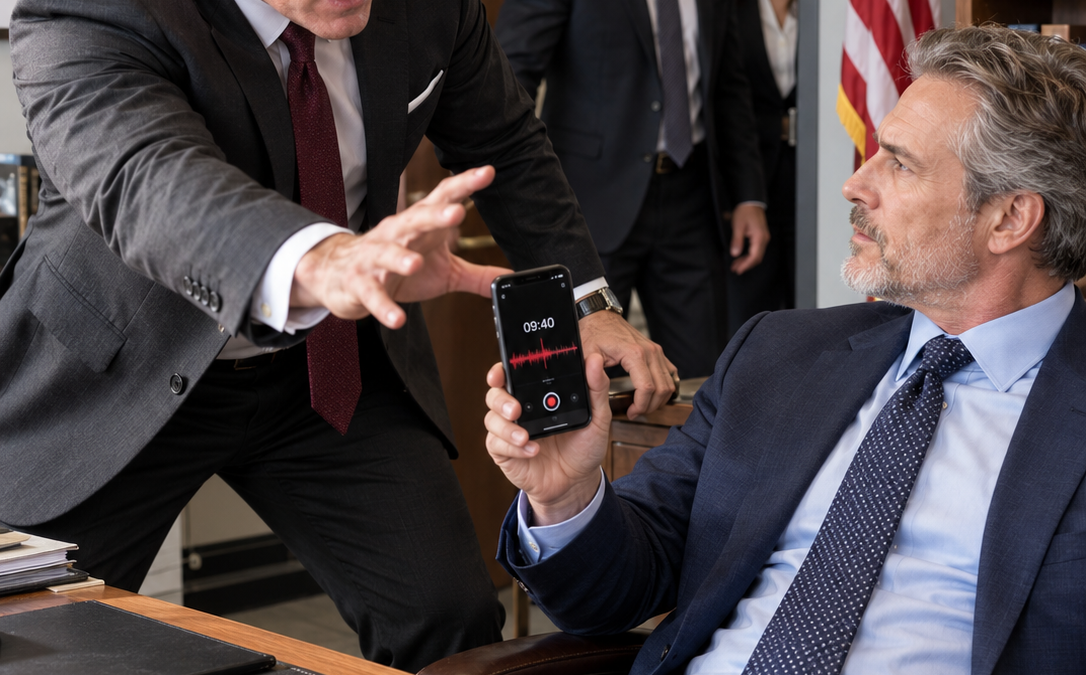
I lifted my phone from where it had been sitting facedown beside my keyboard, turned it toward him, and showed him the screen.
The recording application had been running for nine minutes and forty seconds. The timestamp and upload confirmation to Harmon Audit Partners were already visible.
“Everything since you closed that door,” I said.
Stokes reached across the desk for the phone.
I leaned back, and he overextended, stumbling against the side of my desk and catching himself on the bookcase.
When he righted himself, the door behind him was already opening.
Robert Finch stood in the doorway with two forensic investigators from Harmon Audit Partners and two compliance officers from the Washington State Attorney General’s Office, holding sealed administrative subpoenas.
“Bernard Stokes,” Finch said, “your operational access has been suspended. There’s a meeting of principals being convened on the twenty-fourth floor.”
The extraordinary governance session that convened at two o’clock that Thursday afternoon on the twenty-fourth floor of Cascade Bridge Capital was the most consequential meeting in the firm’s history, though it lasted less than two hours.
Oliver Crane sat at the head of the table, and his presence in the room changed the atmosphere in a way I had not anticipated until I saw it.
There is a specific kind of authority that belongs to a founder. Not the authority of a title, but the authority of someone who built the thing from nothing and understands every load-bearing element.
The nine compensation trustees who had met in private days earlier were now seated along one side of the table, looking considerably less composed than they had during that earlier session.
To Crane’s right sat Finch, alongside Eleanor Harmon, the managing partner of Harmon Audit Partners, who had placed two forensic binders and a set of digital evidence exhibits on the table.
Bernard Stokes sat at the far end, isolated, his laptop and phone already surrendered to the compliance officers.
I sat beside Finch and said nothing.
“This session is called to order,” Crane said.
His voice was quiet, and it carried completely.
“The agenda covers three matters. First, a review of fraudulent misrepresentation of project net margins in the Pacific Northwest Infrastructure Initiative. Second, a review of the unauthorized use of proxy voting authority to void contracted milestone compensation. Third, the question of individual trustee liability for each of those actions.”
Eleanor Harmon opened her primary binder and addressed the room without theater.
“Over the past seventy-two hours, Harmon Audit Partners conducted an emergency forensic review of Cascade Bridge Capital procurement records covering four fiscal years. We identified twenty-two irregular transactions totaling $31.4 million. Payments were processed to Ridgeline Procurement Solutions, a vendor incorporated twenty-eight months ago whose registered agent has no background in construction materials supply.”
She turned a page.
“Subpoenaed delivery records confirm that zero corresponding physical materials were ever received or installed. Federal contract materials manifests do not align with the invoice specifications. Eighty-seven percent of disbursed funds were transferred to personal investment accounts held in the name of Bernard Stokes through a series of intermediary LLCs.”
The room was completely still.
“Additionally,” Harmon continued, “the net proceeds of the Pacific Northwest Infrastructure Initiative were reported to the compensation trustees as $71 million, triggering a reclassification of the milestone bonus threshold. Federal program disbursement records, cross-referenced with certified municipal treasury accounts, confirm actual net proceeds of $127 million. The milestone threshold triggering Director Holt’s contractual $14 million bonus was exceeded seven months ago. The reporting discrepancy was manufactured.”
Crane turned to the nine trustees.
“Four of you hold proxy voting agreements with Bernard Stokes’s office that gave him discretionary authority over your compensation committee votes. You used that authority to strip $14 million from a program director who built the most profitable infrastructure initiative in this firm’s history. Did any of you independently verify the net margin figures with our federal contracting office before you voted?”
No one answered.
A trustee named Harold Beckett, who represented a Pacific Northwest Real Estate Investment Trust, finally spoke.
“We relied on the summary figures provided by Mr. Stokes’s office. We had no reason to believe they were fabricated.”
“The business judgment rule is not a license for willful blindness,” Crane said. “And for two of you, it doesn’t apply at all.”
He nodded to Harmon.
Harmon clicked to a new exhibit.
“Trustees Gordon Yei and Patricia H. Halstead received off-market equity positions in a commercial real estate venture controlled by a Stokes affiliate on March 8 and March 22 of last year, within sixty days of signing the proxy voting agreements. The timing and structure of those transfers indicate a quid pro quo arrangement.”
Yei and Halstead sat without moving.
“Gordon Yei and Patricia Halstead,” Crane said, “your trustee positions are terminated for cause, effective now. Your interests in Cascade Bridge Capital are frozen pending referral to the Washington State Attorney General and the U.S. Attorney’s Office for securities fraud and conspiracy charges.”
Neither of them spoke.
“The remaining seven trustees will forfeit their annual compensation for the current year. Your voting authority is suspended pending a full governance restructuring under independent oversight.”
Crane looked at Stokes.
“Bernard Stokes, you are terminated for cause. Cascade Bridge Capital will exercise clawback rights under applicable federal contractor regulations and state securities law to recover every dollar of compensation paid to you over the past four years. The accounts of Ridgeline Procurement Solutions are already frozen by court order. Federal compliance officers are outside to process your departure.”
Stokes was escorted from the room without speaking.
Crane addressed the seven remaining trustees.
“We have one remaining action. A resolution to formally rescind the compensation committee vote of last Thursday, certify the Pacific Northwest program net proceeds at $127 million, and deposit $14 million of earned milestone compensation into an independent escrow account designated by Douglas Holt’s legal counsel. I move to approve.”
Finch seconded immediately.
Every hand at the table went up.
Crane looked at me.
“Come with me.”
His corner office on the twenty-fourth floor faced east toward the Cascades, and in the late afternoon, the mountains caught the remaining light in a way that made them look closer than they were.
Crane opened a portfolio on his desk and turned it toward me.
“Three and a half percent of the parent equity, Doug,” he said. “Current valuation puts that at approximately $70 million. Full operational authority over our infrastructure division. A seat at the principals’ table.”
I looked at the document.
The numbers were real, and the authority it described was real.
Three and a half years ago, an offer like that would have taken my breath away.
I pushed it back across the desk.
Crane studied my face.
“You’re serious.”
“Yes.”
“You just exposed a $31 million fraud, preserved a $190 million federal client relationship, and secured your earned compensation,” Crane said. “The equity stake is legitimate, and the authority is genuine. What possible objection do you have?”
“I’ve been thinking about the timeline,” I said. “You identified irregularities eighteen months ago. Robert knew something was wrong before that. And neither of you moved against Stokes until a fifty-three-year-old field engineer walked into a governance crisis carrying a legal contract and a willingness to stake his professional license on an outcome that benefited your firm considerably more than it benefited him.”
Crane said nothing.
“You managed this,” I continued. “You identified what Stokes was doing, determined that a frontal legal challenge would fail because of the proxy structure, and waited for the moment when his fraud would reach someone with clean hands and nothing to lose. You needed a catalyst who was credible to federal clients and expendable enough to absorb the risk of a public confrontation.”
I looked directly at him.
“I was selected for that role by Robert before I ever walked into a room with you. The partnership offer is real, but accepting it makes me part of the machinery that decided it was acceptable to wait while a man like Stokes operated because the cost of exposure was being paid by someone outside the principal structure.”
The room was quiet for a long moment.
“I’ve given twenty-seven years to building things that stand,” I said. “I’ve signed my name to structural certifications that I’ll be professionally responsible for until I retire. I’m not willing to attach that career to a firm where the principals calculated how long they could tolerate fraud before finding a convenient engineer to detonate it.”
Crane held my gaze for what felt like a full minute.
Then something in his expression changed.
Not defensiveness. Not wounded pride. Something more like the recognition a man experiences when he hears something true that he has not been willing to say himself.
“What will you do?” he asked.
“I’ll complete a thorough, certified handover of every federal program file. I’ll ensure that the materials certification discrepancy on the SR-520 Phase 2 footings is disclosed to the Federal Highway Administration and independently inspected. I’m not walking away from a structural issue that has my license attached to it. But when that work is done, I’m done with Cascade Bridge Capital.”
Crane stood and extended his hand.
I shook it.
“You’re an exceptional engineer,” he said. “And a rare man.”
Robert Finch was waiting near the elevator.
“You actually turned it down,” Finch said.
“Six hundred dollars is a useful number,” I told him. “It has a way of clarifying things.”
Finch reached into his jacket and produced a business card.
“This is Margaret Conroy. She’s the founding principal of Meridian Civil Partners, an independent infrastructure firm based in Denver. She runs a genuine engineering company. No trust proxy structures, no compensation committees that answer to anyone but the project ledger. She’s been watching the I-90 work for two years. Call her.”
I put the card in my field jacket pocket and took the elevator down.
Six weeks later, the Pacific Northwest Federal Corridor Authority completed its compliance review.
Kevin Marsh formally suspended Cascade Bridge Capital’s preferred vendor status pending resolution of the materials certification issue and announced a competitive rebid for the next phase of the I-90 expansion, requiring program directors with certified hands-on experience on the existing network.
I had called Margaret Conroy three days after leaving Cascade Bridge Capital.
She had picked up on the second ring and said, “I was wondering how long it would take you.”
Meridian Civil Partners submitted a proposal.
Aaron Doyle and Priya Nambiar joined me as technical leads, along with four senior engineers from the Pacific Northwest team who had spent years doing the actual work.
Our agreement with Meridian was structured on a table in a conference room in Denver, with no theater and no ambiguity.
My title was principal program director. Compensation was tied directly to verified federal milestone certifications.
And before we signed anything, I established four contractual terms that became the foundation of our practice.
Bonus structures would be governed by mathematical formulas defined before contract execution. Client agreements would name individual program contributors by license. Personnel transitions would require thirty days’ written notice to federal clients. And frontline engineers would receive certified compensation schedules before the first survey stake was driven.
In federal court, Bernard Stokes entered a guilty plea to wire fraud, conspiracy, and federal contractor fraud and was sentenced to nine years.
Andrew Pard received a lifetime ban from serving as an officer or director of any federally contracted firm. Ridgeline Procurement Solutions was dissolved, and its assets were seized.
Gordon Yei and Patricia Halstead each entered plea agreements on securities charges.
Four months after the governance meeting, the escrow account settled.
I was sitting at the kitchen table on a Saturday morning in late autumn when the confirmation came through on my phone.
My wife, Diane, was across the table with her coffee, looking at me over the rim of her mug.
“Is that it?” she asked.
“That’s it,” I said.
She reached across the table and squeezed my hand.
Behind her, through the window, the trees had turned to their fall colors, the maples along our fence line burning orange and red in the morning light.
On the wall of my home office, I had framed the severance document from Cascade Bridge Capital.
The one that said $600.
Diane had asked me once why I kept it there, next to my engineering license and the photograph of the I-90 bridge deck my team had built.
“Because it stopped being an insult the day I walked out,” I had told her. “That document is the reason I stopped being the engineer they could use and started being the engineer I meant to be.”
Six hundred dollars had bought me twenty-seven years of professional reputation back.
That was the best return I had ever calculated on any project in my career.
I folded the confirmation, put down my coffee, and looked out at the yard, where the light was clean and the morning was quiet, and everything I had built over a lifetime of honest work was still standing exactly where I had left it.
Cho đến nay, cuộc hội thoại này có hữu ích với bạn không?








