At my son’s engagement dinner, his fiancée pointed at my wife in her wheelchair and mocked her, “She’s not classy enough to sit here.” I held my wife’s hand and said nothing… until the $12,000 bill arrived. I stood up, smiled, and said, “Enjoy it.” Her face went pale.
“I really wanted you to be happy about this.”
“I am happy. Just promise me one thing. Take care of her, and make absolutely certain she takes care of you right back.”
Evelyn was in the back doorway when I came inside. She had heard enough through the screen door to know. She pressed one hand flat against her chest, and her eyes went bright in that particular way of hers, the way that belongs to mothers who have been quietly waiting for something and will not admit how long they have been waiting.
I crossed the yard and crouched beside her wheelchair. That was something I had learned over the past four years, since her stroke: to get down to her level instead of standing over her, so we were face-to-face the way we had always been.
The stroke had taken things from Evelyn. It had taken the ease of walking, some of the strength in her left hand, and certain quiet things she missed on still afternoons. It had not touched her sharpness. It had not touched her warmth. It had not touched the way she could look straight through me whenever she needed to.
“Our boy is getting married.”
She reached out and cupped my face in both hands. Her fingers were cool from the sweet tea glass she’d been holding.
“Is she good to him?”
“I don’t know yet. We’re having coffee with her this week. Then we’ll find out.”
She kissed my forehead, certain and unhurried, and I felt that thing I always felt beside her: a steady readiness that made everything else manageable.
That evening, after dinner, I sat at the kitchen table with a yellow legal pad and started making notes. Evelyn rolled herself in from the living room.
“What are you scheming over there?”
“I’m booking La Maison. Private dining room, October eighteenth, thirty guests. Three-course dinner. Proper champagne for the toast.”
She stopped her chair beside the table and looked at my notes with an expression I recognized, the one that meant she was already calculating.
“Grant Whitmore, that is real money.”
“It is the right amount of money for the occasion.”
“The right amount?” She folded her arms. “And how much exactly is the right amount?”
“Around five thousand.”
She breathed out through her nose in that way of hers that isn’t quite a sigh and isn’t quite a laugh.
“You have never, in forty-three years, spent five thousand dollars on a single dinner.”
“I’ve never had this particular reason before.”
“In all seriousness,” she said, her voice going gentle the way it did when she was done teasing and starting to mean it, “why La Maison? You’ve always said expensive restaurants are for people who need somewhere expensive to be seen.”
“But this isn’t about the restaurant. It’s about the gesture. A father gets a handful of moments like this, Evelyn. I want to look back and know I showed up for this one correctly.”
She was quiet for a beat, turning that over. Then her expression softened into something true.
“You’re a good man, Grant Whitmore.”
“I’m trying to be.”
She laughed then, full and warm and open, the kind of laugh that used to fill classrooms when she was still teaching, the kind that made any room feel more alive the moment it entered.
I held that sound the way I had always held it, the way you hold things you know are worth keeping.
I called La Maison the following morning.
It is a restaurant I have known for years, the kind of place where the maître d’ greets you by name because he remembers what kind of man you are, not because of anything printed on a reservation screen. I booked the private room, chose the three-course set menu, confirmed one bottle of champagne for the toast, and had written confirmation from the event coordinator, a woman named Joelle, in my email before noon.
At breakfast the next morning, I told Evelyn it was done. She wrapped both hands around her coffee mug.
“I hope she deserves it, this Sienna.”
“We’ll see.”
“The way Cameron described her…” She turned her mug slowly. “Everything he said was right. Too perfectly right. When a man is truly in love, he stumbles over himself. He forgets a word. He starts a sentence and can’t find the end of it.”
She looked at me over the rims of her reading glasses.
“Cameron did not lose the end of a single sentence.”
I set down my pen. I had noticed the same thing and had not said so.
“We’ll know more after coffee,” I said.
She picked up her mug and nodded once, slowly.
“I suppose,” she said, “we’re about to open the first page and find out.”
Cameron chose a café in Chicago’s River North neighborhood. Floor-to-ceiling windows, dark reclaimed wood, the kind of place where the coffee costs twelve dollars and arrives with a small geometric design pressed into the foam. He said it was a good midpoint between our suburb and Sienna’s downtown apartment. I agreed because I wanted to see how a woman behaved in a room she hadn’t arranged herself.
Sienna Caldwell arrived four minutes early.
She was tall, impeccably put together in a way that suggested considerable effort made to look effortless, and she moved through the door with the particular confidence of someone who has spent years walking into rooms and deciding she belonged there before anyone confirmed it.
She shook my hand before she sat down, firm, brief, professional, and then her eyes made one quick, efficient pass around the café, the way an appraiser surveys a property, taking inventory, assigning value, moving on.
Cameron stood and pulled her chair out, and they settled into each other the way couples do in the early stages, still showing you the best version of what they are together, still performing for an audience.
“It is so wonderful to finally meet you both,” Sienna said, folding her hands on the table. Her smile was warm, precise. “Cameron talks about you constantly.”
“We hope he’s been kind about it,” Evelyn said, leaning forward with that particular brightness she used when she was paying very careful attention and did not want anyone to know.
“Only wonderful things.”
Sienna turned to me with the ease of someone who has given many first impressions.
“He tells me you spent your entire career in industrial maintenance. That must have been such meaningful work. The real backbone of everything, keeping things running behind the scenes.”
She had a gift for this: a compliment with a floor beneath it.
“Thirty years,” I said. “You learn a great deal about how things are built when your job is understanding why they break.”
“Absolutely.” She pivoted without a pause. “I just think it’s remarkable, people who’ve worked with their hands their whole lives and found such genuine contentment in the simpler things. That quality is becoming quite rare.”
I picked up my coffee mug and said nothing.
Cameron cleared his throat.
“Sienna’s firm just closed a major deal in the West Loop. Mixed-use development, commercial and residential. Tell them about it, babe.”
She didn’t need the prompting.
For the next several minutes, Sienna talked square footage, investor return structures, and the intricacies of Chicago’s zoning approval process, which requires developers to navigate both the city planning department and the local alderman’s office before breaking ground on any project over a certain threshold.
It was genuinely impressive. She was clearly skilled at her work.
Evelyn asked polite, well-placed questions in that way she had, the way that sounds like small talk and is actually a form of deep listening you cannot interrupt.
I watched Sienna’s eyes during the parts of the conversation where she wasn’t speaking. What I saw there was not curiosity about us. It was inventory.
“Mr. Whitmore,” she said when a natural pause opened between topics, “do you and Mrs. Whitmore have any longer-term plans for the house? It’s such a lovely area. Many people start to think about right-sizing at some point. Fewer stairs, something a bit more manageable day to day.”
I set my cup down with a small, deliberate sound.
“My wife and I built that house,” I said. “I put in the hardwood floors myself, one room at a time over two summers. We raised Cameron in it. We plan to die in it.”
Something moved across Sienna’s face, there and gone, quick as a cloud shadow. She recovered without a visible seam.
“Of course. It’s a wonderful asset regardless. Whatever you eventually decide is entirely your own business, naturally.”
Under the table, Evelyn’s hand found my knee and pressed once, firmly.
I had been receiving that signal for forty-three years. It meant, I see it too. We will talk about this later.
Cameron stepped in with the careful ease of someone who has learned to change a subject before it becomes weather.
“Dad, tell Sienna about the La Maison dinner. He’s putting together a real event. Private room, proper dinner, the whole thing.”
Sienna turned to me with a softer expression.
“You really don’t need to go to all that trouble on our account.”
“The arrangements are already made,” I said. “We’re looking forward to it.”
The rest of the hour passed pleasantly enough on the surface. Sienna asked about Cameron’s childhood, his favorite family trips, his early jobs, the things a person asks when they are cataloguing the life they are marrying into. She was skilled at it. She laughed at the right moments and touched Cameron’s arm in a way that looked natural.
When she excused herself, Cameron leaned across the table with the expression of a man who is hoping and bracing at the same time.
“So,” he said, “what do you honestly think?”
“She’s very accomplished,” I said.
He heard what I had not said. His jaw tightened slightly.
“Dad, she changed her outfit twice this morning because she was nervous. She asked me if there was anything you didn’t like, topics to avoid, things she should know. She practiced.”
His voice dropped to something real, something underneath the defensiveness.
“She’s trying, Dad. She genuinely is.”
That detail landed somewhere in my chest.
“She didn’t need to do any of that.”
“I know. But she did.”
He held my eyes.
“Please just give her a real chance.”
“I’m giving her this afternoon,” I said. “I’ll give her every afternoon that follows. You have my word.”
On the drive home, the late September sun pressed through the passenger window and lay across Evelyn’s hands in her lap. She kept her thoughts to herself for the first twenty miles, looking out at the suburbs passing behind the glass, the strip malls, the gas stations, the particular flatness of the Illinois landscape that you stop seeing only after you’ve lived in it long enough.
“She’s very intelligent,” Evelyn said finally.
“Yes.”
“And prepared. Extremely prepared.”
“Yes.”
“But, Grant…” She turned to face me directly. “She looked at that café the way you look at a listing, not the way you look at a room where you’re sitting down to meet someone’s family.”
I kept both hands on the wheel.
“She’s in real estate. People in real estate think about square footage the way carpenters think about door frames. It may be habit.”
“Grant.”
Her voice went patient in the way it does when she thinks I am being deliberately slow.
“It was what she said. ‘Whatever you eventually decide to do with it down the road.’ As if she had already mapped the road and we were just a mile marker on it.”
I pulled into our driveway and cut the engine.
The neighborhood had gone quiet in the early evening, the particular quiet that settles on things at the end of a day that held more than it appeared to.
I sat for a moment.
“We’ll keep watching,” I said.
Evelyn nodded once.
Then, very softly, “I just hope Cameron is watching too.”
I got out and walked around to her door, and when she took my hand, I held it a beat longer than necessary, the way you hold on to someone when you want to say, without any words at all, I know. I hear you. We will be careful.
What I did not say aloud, not yet, not until I was more certain, was the thing that had already settled quietly into the back of my mind during that hour in the café.
I had spent thirty years learning how things break.
I knew the early signs.
I was paying attention.
Ten days after the phone reservation, I drove into the city to handle the contract and deposit in person. There are certain arrangements that deserve more than a wire transfer. A firm handshake, a signed agreement, and a look in someone’s eyes. Those things still matter to me.
La Maison’s private entrance on West Erie Street opens at eleven for appointments. Jean-Pierre, the maître d’ who has presided over that front room for the better part of twelve years, was already at the door when I came up the steps.
“Mr. Whitmore.” He took my hand with both of his. “Always good to see you. How is Mrs. Whitmore keeping?”
“She’s well, Jean-Pierre. Thank you for asking.”
“Please give her our regards. Joelle is waiting for you in the side office.”
Joelle Marchand was La Maison’s events coordinator, sharp and organized, with the particular calm of someone who has managed every variety of family occasion and learned that the details always outlast the drama.
She had the contract already printed, the floor plan spread open beside it, and two cups of coffee on the table.
“Mr. Whitmore, congratulations on the occasion. Shall we walk through everything before you sign?”
“Please.”
“Thirty guests. The Winslow Room. October eighteenth. Three-course set menu. The roasted lamb and the sea bass for the main, the chocolate torte for dessert. One bottle of Veuve Clicquot for the toast, tableside.”
“That’s correct.”
“Seating, round tables, eight per table, with a head table for the immediate family and the couple.”
“Arrival at six-thirty. Dinner service at seven.”
“Perfect. Any dietary restrictions I should note?”
“One vegetarian at the head table.”
“I’ll mark the seating chart. And the bar service?”
“Wine with dinner, the champagne for the toast. Nothing beyond that.”
She made her note without comment.
We went through two more pages: the parking validation arrangement, the music policy for private rooms, and the overtime clause if the event ran past the allotted four hours.
I initialed each section. When I signed the last page, I wrote the deposit check and passed it across.
Joelle folded it into the contract envelope, set her pen down, and looked at me across the table.
“There is something I want to tell you directly,” she said, “before you leave.”
The way she said it, measured and deliberate, made me set my coffee cup down.
“Yes?”
“Shortly after your coffee meeting last week, we received a call from a woman who introduced herself as Sienna Caldwell. She said she was your son’s fiancée and that she wanted to discuss some changes to the event profile.”
Joelle kept her voice even, factual.
“A larger guest count, menu upgrades, a floral arrangement package, and additional photography services. She had specifics for all of it.”
I held very still.
“What did you tell her?”
“That the reservation is in your name, and any modification requires your written authorization.”
“And?”
“She said she understood and that she would…” Joelle glanced at the notepad to her left. “‘Handle it.’”
Handle it.
The same two words, slightly rearranged, I had heard a version of them last week at the café, buried inside perfectly pleasant conversation. I had filed them away and told myself I might be reading too much into things.
“Has she contacted this office again since then?”
“No. Not yet.”
I looked at Joelle for a moment. She was not uncomfortable, which told me she had handled situations like this before, situations where the person paying for an event and the person running it were not entirely the same person.
“Joelle, I need one thing from you,” I said. “Every contact this office receives regarding this event—phone, email, walk-in, it doesn’t matter—I want it logged immediately and sent to me within the same business day. No changes are to be made to anything without my written approval. Guest count, menu, flowers, photography, place cards. Nothing.”
“Absolutely, Mr. Whitmore. That is how it will be handled.”
“I appreciate it.”
I stood and buttoned my jacket.
“The dinner is going to be a good one. I just need it to remain mine.”
Walking out of La Maison and back into the October wind off the lake, I turned what Joelle had told me over in my mind.
Sienna had called the restaurant before our coffee meeting. She had already been making plans, cataloguing additions while she was practicing her outfit and asking what topics to avoid.
The picture was not complicated. It was simply becoming clearer.
I stopped at the hardware store on the way home and bought weatherstripping for the back door, which I had been putting off since summer. I have always done my best thinking when my hands are occupied.
By the time I finished the door and washed up at the kitchen sink, the thought had arrived fully.
She intends to reshape this dinner before it happens.
The question was how much she believed she could move before I noticed.
That evening, I came into the living room where Evelyn was reading and sat in my chair across from her.
“You have that face,” she said without looking up from her book.
“What face?”
“The one you wore in 2003 when you suspected the supplier was double-billing and spent two weeks gathering paperwork before you said a single word to anyone.”
She turned a page.
“Something happened today.”
“I’m still putting the pieces in order.”
She finally looked up.
“Grant, I have been your wife for forty-three years. You can put the pieces in order while you talk to me.”
So I told her.
Not everything, just the shape of it.
Sienna had called La Maison before our coffee meeting. She had specifications. She had been told no and said she’d handle it.
Evelyn set the book face down on the side table and looked at me carefully.
“What are you going to do?”
“I’ve already done it. Joelle is logging everything. Nothing changes without my signature.”
“And Cameron?”
“Not yet.”
She absorbed that.
“Then you’re waiting to see what she does next.”
“Yes. Because one phone call could be a misunderstanding.”
“Yes. But you don’t think it is.”
I looked at my wife across the living room, this woman who had never once needed me to spell things out for her.
“No,” I said. “I don’t.”
She nodded once, slowly.
“Then we wait,” she said. “And we watch.”
The Friday evening before the dinner, I found Evelyn in the bedroom with three blouses spread across the comforter and an expression on her face that I had seen precisely twice before in our marriage. Once before our son’s high school graduation, and once before the retirement ceremony where her students had surprised her with a scrapbook they’d been making in secret since March.
It was the expression of a woman steeling herself for an evening that mattered.
“The blue one,” I said from the doorway.
She looked over her shoulder.
“You haven’t even crossed the threshold.”
“I don’t need to. You’ve worn the blue one to every occasion where you wanted to feel like yourself. It’s always been the blue one.”
She turned back to the bed, studied the three options for another moment, then reached for the blue blouse.
“One of these days, I’m going to pick a different one just to prove you wrong.”
“You’d be disappointed all evening, and you know it.”
She laughed, a real one, not the polite kind, and let me come in to help with the buttons at the back. Her left hand still couldn’t manage the small ones without frustration, and we had long ago built a system around it that required no commentary and no apology.
I did the top three. She did the rest.
“Tell me honestly how you’re feeling about tomorrow,” she said, watching us both in the mirror.
“Glad it’s finally here. Ready to see Cameron happy.”
“Grant.” Her voice was gentle but firm. “That’s your public answer. Give me the real one.”
I met her eyes in the mirror.
“I’m watching. I’ve been watching since the café. Tomorrow, I’ll see what’s actually there. And if what’s actually there isn’t good, then I’ll have information I didn’t have before.”
She turned in the wheelchair to face me directly.
“I need to ask you something, and I need an honest answer.”
“Always.”
“If she does something tomorrow, says something, treats someone poorly, makes you feel the way I suspect she might make you feel, are you going to let it show? Because if you react in the moment, Grant, you hand her something. You become the difficult father-in-law, and she becomes the woman who had to deal with him.”
“I’ve seen that play out, Evelyn. I—”
“I’m serious. I watched you in ’94 with that contractor. I watched you in 2007 with the Little League coach. Both times you were right. Both times it still cost you something.”
I exhaled slowly.
“You’re telling me to sit on my hands.”
“I’m telling you that whatever happens tomorrow, let it be witnessed, not reacted to. There’s a difference.”
I held her gaze for a long beat.
“You have my word,” I said. “Whatever plays out, it plays out without my interference.”
She nodded, satisfied in the particular way Evelyn gets satisfied. Not relieved, just confirmed.
She reached for her earrings on the dresser, the small pearl ones she wore when she wanted to look elegant without appearing to try, and worked them in while I straightened my collar in the mirror beside her.
We ate dinner early, the pasta she’d been making from the same recipe since our apartment on the North Side, a glass of Chianti each.
We talked about Cameron at eight years old, convinced he’d found a Native American arrowhead in a Wisconsin Dells parking lot and carrying it in his pocket for three weeks. The way he used to set his alarm for Saturday cartoons and fall back asleep with the remote still warm in his hand. The way he called every Sunday evening through his twenties, not because we asked him to, just because it was what he did.
“He’s going to be fine,” Evelyn said, turning her wineglass by the stem. “Whatever this woman turns out to be, Cameron is going to be fine. He’s got a good center of gravity.”
“He got that from his mother.”
She raised an eyebrow.
“He got his stubbornness from someone in this room, and I am looking directly at that person.”
I did the dishes. Evelyn went to read.
I checked the parking situation near La Maison one more time, verified the original menu confirmation from Joelle, and counted my handwritten guest list twice.
Thirty names. Good people. Everything in order.
At ten-thirty, when the house had gone quiet and Evelyn’s bedroom light had gone dark, I sat down at my study desk to do one final check of my email before bed.
There was a message from La Maison.
The subject line read: Event Confirmation Update—Whitmore, October 18th.
It had come from a general inbox rather than Joelle’s direct address, the kind of message that gets processed by a junior coordinator on a weekend shift who doesn’t pull the account notes before hitting send.
I opened the attachment.
Forty-eight guests confirmed. Three main-course selections replaced with premium alternatives. A full floral arrangement package added.
And at the bottom of the page, in the notes field, four words that sent a cold, deliberate current straight through my chest.
Per host’s additional request.
Per host’s additional request.
I sat at that desk for a long time, my jaw tight enough to ache.
Eighteen extra people. Upgraded dishes across the board. Flowers I had not ordered.
All of it listed as though it had come from me.
All of it done after Joelle had told Sienna directly, clearly, in professional language, that nothing changes without my written approval.
I picked up my phone.
I stared at Cameron’s name.
Then I put the phone face down on the desk.
I thought about what Evelyn had said four hours earlier.
Let it be witnessed, not reacted to.
I thought about the way she had looked at me when she said it, not with fear, but with the specific, measured certainty of a woman who has watched her husband move through the world for forty-three years and knows exactly where he is most likely to go wrong.
I closed the laptop without replying to the email.
I went to the closet in our bedroom and took out the dark suit that I had worn to every significant evening for the past fifteen years. I hung it on the bathroom door, laid out my good shoes beneath it, and set my alarm for seven.
Then I sat on the edge of the bed in the dark and listened to Evelyn breathe, that steady, even sound that had been the last thing I heard before sleep for four decades.
And I thought about the twelve hours ahead.
About the forty-eight people who would fill a room I had designed for thirty.
About a woman who had heard the word no and simply located a different door.
In the morning, I put on the dark suit. Evelyn had always said it made me look like a man who meant business.
She didn’t know that tonight, for the first time, that was precisely why I was wearing it.
La Maison on a Saturday evening smells like money that has decided it doesn’t need to announce itself. Warm bread and good butter, candles that cost more than most people’s light fixtures, and beneath it all, that particular hush of a room designed to feel effortless.
Jean-Pierre met us at the private entrance at a quarter past six, before the guests arrived, which I had requested. He shook my hand and held the door wide so Evelyn could come through without navigating the lip in the threshold. He had already had it fitted with a small ramp, I noticed without saying anything, and he did not mention it either.
That is the mark of a professional who actually pays attention.
“The Winslow Room is ready,” he said. “We’ve done some additional configuration to accommodate the updated guest count.”
I looked at him steadily.
“Fifty-two confirmed as of this morning,” he said, in the same measured tone Joelle used when she wanted to give me information without editorializing. “Additional round tables, reconfiguration of the service corridor. We’ve managed it.”
“Thank you, Jean-Pierre.”
He nodded once and led us back.
The Winslow Room seats thirty comfortably and forty with some creative geometry. What I walked into was a room professionally rearranged for more people than it was designed to hold, done well enough that you had to look carefully to see the seams.
Tables I had not requested. Chairs pulled from another room. A linen color on two added tables that was close to, but not exactly matching, the original setup. And at the far wall, a floral arrangement running the length of the credenza. White lilies, eucalyptus, something I didn’t recognize that probably cost four hundred dollars.
Flowers I had not ordered and had not seen on any confirmation I had approved.
Evelyn came alongside me and took it all in.
“It’s beautiful,” she said.
And she meant it. Evelyn has always been capable of finding something genuine in a situation, even when the situation is not what it was supposed to be.
“Whoever arranged those flowers has a good eye.”
“They do,” I agreed.
I excused myself, found Joelle near the service entrance, and asked her one question.
“Is the itemized invoice going to be ready at the end of the evening, or do I need to request it now?”
“I’ll have it prepared and at the host station before ten,” she said. “Including the authorization timestamps for every addition.”
“That’s exactly what I need.”
I went back to Evelyn, straightened my cuffs, and began greeting guests.
They came in steadily between six-thirty and seven. The thirty people I had invited, and then, woven among them, faces I didn’t recognize. Friends of Cameron’s from the office. Acquaintances of Sienna’s, more likely. A woman who introduced herself as Sienna’s college roommate and kissed both my cheeks as though we had known each other for years. A couple in their late thirties who said they’d heard so much about the family and meant it as a compliment, though they couldn’t have said what specifically they’d heard.
Cameron arrived at six-forty with the slightly polished look of a man who has been told everything is fine and has decided to believe it.
He hugged his mother carefully. Not delicately, which she hates, but thoughtfully, which she doesn’t.
He shook my hand and held it a moment longer than necessary.
“You look good, Dad.”
“So do you.”
“Sienna is just parking. She’ll be right in.”
He glanced around the room.
“This looks amazing.”
“It does.”
He caught something in my tone, a flicker across his face quickly smoothed.
Then the doors opened, and Sienna came in.
She was good at entrances. I’ll say that plainly because it’s true.
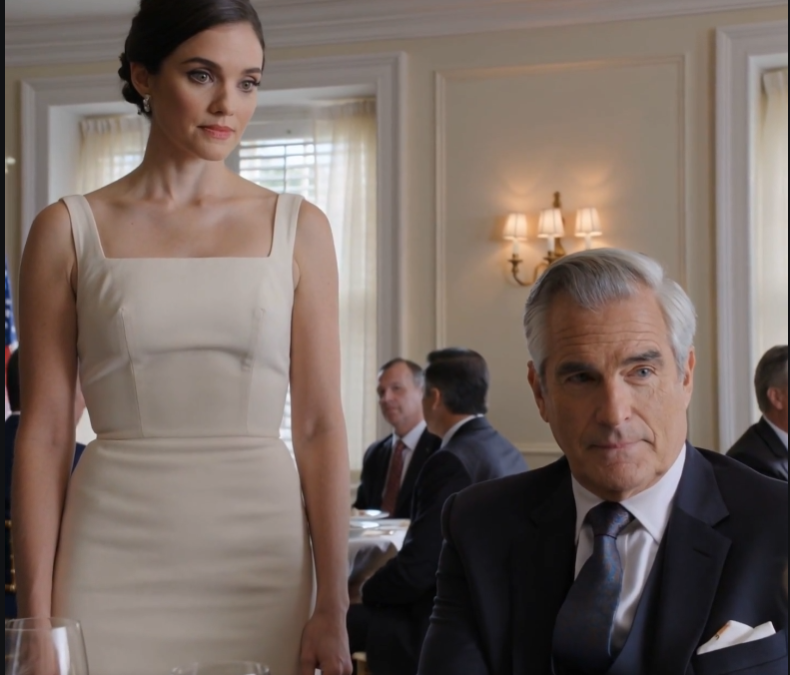
She had the kind of confidence that enters a room before the person does. A slight lift of the chin, a pace that suggested she had timed her arrival and found it satisfactory. Cream-colored dress, hair up, moving through the room with the specific geometry of someone who wants to be seen graciously greeting people before reaching the person she actually came to see.
She was performing.
I don’t mean that as an insult. I mean that she understood the architecture of a social occasion and had decided to treat this one as a stage.
She found Cameron first, touched his arm, said something in his ear that made him smile. Then she moved through the room, a particular warmth for Cameron’s colleagues, a slightly cooler friendliness for guests she hadn’t placed yet.
She had calibrated levels, and she was running them precisely.
She reached Evelyn and me about twelve minutes in.
“Grant.”
She took my hand in both of hers, the same gesture Jean-Pierre had used at the door, though on him it read like warmth and on her it read like she had learned the gesture from a book.
“Thank you for all of this. The room is wonderful.”
“I’m glad you think so.”
She turned to Evelyn.
For a fraction of a second, not even a full second, something moved behind her eyes. An adjustment. A recalibration.
“Evelyn, you look lovely.”
“Thank you, dear. Congratulations again.”
Sienna held the smile for exactly the right amount of time, then turned to scan the room the way a director scans a set.
That was when she saw the head table.
The head table had been set the way I specified in the original seating chart. Evelyn and I on the left, Cameron and Sienna at center, Cameron’s nearest friends on the right, with a gentle curve that kept the couple visible from every angle of the room.
Joelle had suggested it. I had agreed. It was practical, and it was handsome.
What Sienna saw was that Evelyn’s wheelchair was positioned at the head table in a way that would appear in every photograph taken of the couple that evening.
I saw her see it.
She crossed the room to Cameron, who was talking with two colleagues, and touched his elbow.
He shook his head once. No.
She said something else.
He looked at the floor in the way Cameron has looked at the floor since he was seven years old and being asked to do something he didn’t want to do but wasn’t going to fight about.
She came back toward the head table, and when she reached Evelyn, she didn’t slow down.
She positioned herself between Evelyn and the nearby cluster of guests and said, in the particular tone of a woman who believes she is managing a logistical problem rather than a human being, “I was thinking your mother might be more comfortable at one of the side tables. There’s a lovely spot near the window where she’d have a better view of the room, and it would be easier for people to come visit her there. Tonight has a lot of moving parts, and the head table is going to be the center of most of the photography.”
She had constructed it to sound considerate.
There was a whole layer of managerial graciousness on the surface of it that I suspected she had assembled in the twelve seconds between the head table and where Evelyn was sitting.
Evelyn looked up at her.
“I’m fine right where I am, thank you.”
She said it with a gentleness that made something tighten behind my sternum.
“Of course. I just thought—”
“She’s fine.”
My voice was quiet, not sharp. I had promised Evelyn. But it had a quality that I have learned to use carefully, because once it’s in a room, it doesn’t leave quickly.
“She’s right where she should be.”
Sienna held my gaze for one beat. Then she turned to take in the room, the guests, the light, the composition she was already building in her mind, and said to no one in particular, but with a volume the three people nearest us would have no trouble hearing, “Not everyone is suited to be at the center of photos like these.”
The room didn’t stop.
That was the worst part.
People kept talking, kept laughing, kept reaching across tables for the breadbasket, because that is what people do when they don’t know whether to acknowledge something or pretend they didn’t hear it.
The ambient noise of fifty-two people covered the moment like water closing over a stone.
I felt Evelyn’s hand find my knee under the table.
Not gripping, just placing itself there. The gesture of a woman saying, I heard that. I need a moment. Please don’t move.
I covered her hand with mine.
I did not move.
Across the room, something shifted. A ripple of quiet near two women who had been standing close enough to catch the words, the kind of quiet that spreads when people aren’t sure what they just witnessed.
One of them, a woman I recognized as a former colleague of Evelyn’s from her teaching years, met my eyes for just a moment.
Her expression said everything she was too polite to say aloud.
Sienna turned back to Cameron with the smooth pivot of someone who considers the matter settled.
I watched her take his arm.
I watched him let her.
I looked toward the far end of the room, where a young member of the waitstaff was reviewing a clipboard near the service door. I caught his eye. He came over immediately.
“The final bill this evening,” I said, keeping my voice level enough that only he could hear. “Is it still in my name?”
“Yes, sir. Mr. Whitmore, of course.”
“Good.”
I gave him a brief nod.
“Thank you.”
He moved off without another word.
Evelyn’s hand was still beneath mine.
Around us, the room had settled back into its rhythm, the particular hum of fifty-two people who have chosen not to acknowledge an uncomfortable moment and are collectively very good at it.
I sat in the room I had built for thirty.
I looked at the flowers I hadn’t ordered, the chairs that had come from another room, the updated menu printed on heavy stock that still had my name at the top as host.
And I thought, She doesn’t know.
She had called the restaurant before our coffee meeting. She had bypassed the coordinator. She had added twenty-two guests and upgraded every course and ordered the flowers and written it all as per host’s additional request.
And she was standing twenty feet away with her hand on my son’s arm, already planning the photographs, already certain the evening was going exactly the way she intended.
She didn’t know.
That was the thing.
She had counted on, from the beginning, the idea that I was a man who could be factored out of the equation before anyone noticed.
I poured myself a glass of water.
The dinner service was beginning. The first course was coming out.
I had all evening.
The dinner itself was very good.
That is worth saying, because it would be easy to remember that evening only as the thing that happened at the beginning and the thing that happened at the end, and to forget that for two and a half hours in between, fifty-two people ate an excellent meal.
The lamb was as good as I had planned it to be. The wine moved around the tables at a pace that kept the room warm without tipping it toward careless. Cameron gave a short toast, gracious, a little nervous, exactly himself, and Sienna received it with the practiced ease of someone who had been rehearsing how to look in that moment since before the engagement was official.
She was good at it. I grant her that.
I ate. I spoke to the people nearest me. I asked Evelyn’s former colleague how retirement had treated her and listened to the answer. I congratulated a man I’d known since Cameron’s Little League years on his daughter’s acceptance to Northwestern.
I did all the things a man does at a dinner he has hosted, because that is what I was.
Evelyn was fine. That is also worth saying.
She talked and laughed and held her wineglass by the stem the way she always does. And if there was a careful steadiness behind her eyes that I recognized from the nights she worked hardest to protect people from her own discomfort, well, that was between her and me.
At nine-forty-five, the dessert plates were cleared.
At ten-ten, Joelle appeared at the edge of the room with a leather folder in her hands. She crossed to where I was sitting, placed the folder on the table at my right, and said quietly, “As requested, Mr. Whitmore. Full itemization with timestamps.”
“Thank you, Joelle.”
I opened the folder.
The number at the bottom of the first page was $12,400.
I did not change my expression.
I had seen the number coming since October first, when the email arrived at ten-thirty at night with its four careful words at the bottom of the attachment.
The number was not a surprise. It was simply the thing arriving at the shape I had already understood it would take.
I closed the folder.
Across the table, Sienna had seen Joelle deliver it. I watched her register the folder, register that it had come to me, and make the small adjustment behind her eyes that she always made when she needed to reset her approach.
She said something to the woman on her left. I couldn’t hear it, but the woman laughed. Then she reached over and touched Cameron’s hand and nodded toward me.
Cameron looked at me.
I gave him a neutral smile.
He looked back at his plate.
A moment later, Sienna pushed her chair back and came around the table.
“Can I take a look?” she asked, gesturing toward the folder.
Her tone was light, proprietary in a way she probably didn’t notice she was projecting.
“Let me see what the help brought over.”
“Of course.”
She opened it.
I watched her read.
The lightness in her expression didn’t change exactly, but something behind it stiffened slightly, a small recalculation happening in real time as she absorbed the number.
“That’s the full invoice?” she said.
“It is.”
She closed the folder and set it down with a confidence that told me she had already decided how this part went.
She was going to push it back toward me.
She had always been going to push it back toward me.
I was the host. That was how evenings like this worked in the world she had organized in her head.
She smiled, the particular smile of someone who is being gracious about something they consider already settled, and slid the folder across the table toward me.
“I think that’s probably yours,” she said.
I looked at the folder.
I looked at her.
Then I reached into the inside pocket of my jacket and took out the three pages I had folded there before leaving the house that morning.
I unfolded them and laid them on the table, one beside the other.
The first was the original reservation confirmation. Thirty guests. Three-course set menu. One bottle of champagne. Wine service. Dated three weeks prior. Signed by me.
The second was the deposit receipt and the itemized contract, the one I had signed in Joelle’s office, with every course specified and the guest count circled in pen.
The third was the email from Joelle, dated the day after Sienna’s first unauthorized call, the one confirming that no changes to the event would be processed without my written authorization.
I placed my hand flat on top of them.
“I’m happy to pay for what I agreed to,” I said.
My voice was even. Not cold. Even, which is different.
“The thirty guests I invited, the menu I selected, the champagne I ordered for the toast. That comes to somewhere around fifty-four hundred dollars, and I’ll pay it right now without any discussion.”
Sienna’s expression had gone very still.
“The remaining balance,” I said, “covers twenty-two additional guests, three menu upgrades, a full floral package, additional photography services, and premium bar add-ons that were never part of my agreement.”
I touched the edge of the authorization email.
“All of it added without my written approval, and all of it logged with timestamps. That portion I won’t be paying.”
The table had gone quiet.
Not the whole room. Not yet.
But the six people seated nearest us had stopped their conversations.
I could feel it without looking, the way you feel a change in the air before the weather turns.
“Grant.” Cameron’s voice came from across the table, low. “Maybe this isn’t the—”
“Cameron.”
I looked at my son steadily.
“I’m not making a scene. I’m settling a check.”
Sienna recovered quickly. I’ll say that for her, too.
She recovered quickly.
“I think there’s been a misunderstanding about the arrangements,” she said, keeping her voice at a low, controlled register. Reasonable. Very reasonable. “I made a few adjustments to make the evening special. I didn’t think it would be an issue.”
“You were told directly by the events coordinator that nothing would be changed without my written approval.”
“I called the main line, not the coordinator’s.”
“That is not a different office,” I said. “That’s the same restaurant.”
Her jaw tightened just once.
Then she straightened.
“I’ll take care of it,” she said.
She said it the way she always said it, as though the problem were logistical rather than what it actually was.
She picked up her clutch from beside her chair, removed her card, and signaled to the young waiter who had been standing at a respectful distance since Joelle delivered the folder.
He brought the payment terminal.
She inserted the card.
The terminal sat on the table between us for a moment.
Then it emitted the small, flat tone that everyone in the room knows and nobody ever wants to hear.
Declined.
She didn’t move immediately.
She kept her eyes on the terminal as though expecting it to change its mind.
“Would you like to try another card?” the waiter asked, with the professional blankness of someone who has been trained to make this moment as painless as possible for everyone.
Sienna’s hand was very still on the table.
The composure she had maintained for four hours, the gracious arrivals, the calibrated warmth, the photograph-ready smile, had developed something behind it that I could see even from where I was sitting.
A fracture line.
Faint. Controlled.
But there.
“There must be an error,” she said.
“Of course,” the waiter said. “Would you like me to run it again?”
She glanced across at Cameron.
That glance told me everything I had suspected and not yet been entirely certain of.
Cameron started to reach for his wallet.
“Sit down, son,” I said.
He stopped and looked at me, shocked.
“The portion I agreed to pay, I’m going to pay right now.”
I opened the folder, removed the itemized invoice, and handed it to Joelle, who had appeared at the edge of the exchange with the quiet readiness of someone who had seen this particular moment coming since October third.
“Please calculate the original invoice amount. Thirty guests, the set menu, champagne service, and run that to my card. The remainder can be settled separately.”
“Of course, Mr. Whitmore.”
I looked at Sienna.
She was watching me with an expression I had not seen on her face before.
Not anger. Not embarrassment. Not quite.
Something more considered than either of those.
The particular look of someone who has been making calculations about a situation and has just discovered the numbers were wrong.
“The evening was beautiful,” I said.
It was true.
“I hope you enjoyed it.”
And that was the first time I said something at that dinner that she didn’t have an answer for.
The guests left the way people always leave after something has shifted in a room without anyone naming it. Quickly, with more warmth than the evening called for, as if the brightness of their goodbyes could somehow smooth over what they’d witnessed at the head table.
Handshakes held a beat too long. Conversations at the door ran in careful circles that never quite touched the subject. Three separate people thanked me with a sincerity that had nothing to do with the food, and I received each one the same way I’d received the evening itself.
Steadily, without showing my hand.
Evelyn’s former colleague Margaret was among the last to say goodnight. She took my hand in both of hers, held it a moment, then leaned down to Evelyn’s level.
“You looked beautiful tonight, Ev. You always do.”
Evelyn reached up and squeezed her hand, and they smiled at each other the way women who have known each other for thirty years do, without needing to explain the thing they’re both already thinking.
By ten-fifty, the Winslow Room held only family.
Sienna was at the far end of the table with her phone face up on the linen, composing something I couldn’t see. She had angled herself slightly away from the room, the particular posture of someone who has decided to place herself outside a conversation without appearing to have left it.
I had been watching that technique all evening, and I recognized it for what it was: a performance of disengagement that was itself a form of engagement.
Cameron stood near the window with his hands in his pockets, jacket still on, looking out at the street.
I had just finished helping Evelyn with her coat when he came across the room to us.
“Dad.”
He stopped a few feet back.
“Can we talk?”
Not a question.
“Help your mother to the car first,” I said.
He did it without protest, which told me more than his tone had.
When he came back two minutes later, Joelle had finished clearing the last of the service items.
We were alone.
Cameron sat at the head table, not his seat from dinner, but mine, and studied the tablecloth before he spoke.
“I need to understand what happened tonight,” he said.
“What part of it?”
He looked up.
“The part where you pulled three pages of documents out of your jacket.”
“I brought documentation,” I said, “because I knew I was going to need it.”
“You knew?” He stopped. “Then you planned that.”
“I planned to be prepared. There’s a difference.”
“She… she was trying to make the evening special.”
His voice had a careful, practiced quality. I could hear the parking garage in it, all the rehearsing he’d done.
“She called the restaurant because she wanted it to be something you’d both remember.”
“She was told twice,” I said. “Once by the coordinator directly, once in writing, that nothing was to be changed without my authorization.”
I kept my voice level, which cost me more than it should have.
“She made a different decision.”
“You could have just paid it. You can.”
“This was never about the money, Cameron.”
The words landed harder than I’d intended.
He heard it.
He looked at me the way he has looked at me since he was twelve years old, the expression of a boy who suspects his father is right about something he isn’t yet ready to be wrong about.
“She said something to your mother tonight,” I said. “In front of fifty people. She told a sixty-nine-year-old woman in a wheelchair that she wasn’t suited to appear in photographs of her own son’s engagement dinner.”
Cameron closed his eyes.
“I heard what she said,” he said quietly. “I was standing twenty feet away.”
“I know you were.”
“I didn’t know she was going to say anything like that.”
“No.”
I waited a beat.
“But you knew she’d tried to move your mother’s seat, because she came to you first. You shook your head. She did it anyway. And you stood there.”
I kept my voice steady.
“That’s not her failing, Cameron. That’s yours.”
His hands lay flat on the tablecloth.
I watched something move through him. Not the defensiveness I’d expected, but something harder and more honest, the particular feeling that arrives when a person stops defending the comfortable version of events and has to look at the actual one.
He was doing it in real time, in the quiet of the Winslow Room, and I let him have the moment.
“I thought she was nervous,” he said, lower now, “about how the evening looked. She cares.”
“She wasn’t nervous,” I said. “She was managing the room. She has been managing this evening since before the reservation was made.”
He looked at me.
“What does that mean?”
I reached into my inside pocket and placed a folded page on the table in front of him.
The printout of Joelle’s email chain. Her notification to me of Sienna’s first call, and Joelle’s reply to Sienna confirming that nothing would be processed without written authorization from the account holder.
The date at the top was six days before our coffee meeting.
He read it once.
Then again.
His eyes stayed on the date in the corner.
“She called the restaurant,” he said, almost to himself, “before she even met you.”
“Before she met me to discuss a dinner she had already decided to change,” I said. “Yes.”
He turned the page face down on the table.
“I don’t know what to say to you,” he said.
“You don’t have to say anything tonight.”
“I love her.”
He said it plainly, testing the weight of the words as he said them.
“That doesn’t just disappear because—”
“I know it doesn’t.”
“But it doesn’t…” He was working toward something. “It doesn’t cancel what she did.”
“No,” I said. “It doesn’t.”
He pressed the back of his hand briefly against his mouth and looked away, and I gave him the moment.
Outside on West Erie Street, the last of the valets were walking to their cars, and the night had settled into its late October quiet.
He sat in my chair at the head of the table, and he looked older than thirty-nine.
And he looked like the eight-year-old who had carried a parking lot rock in his pocket for three weeks because he needed it to be an arrowhead.
That was Cameron’s quality, the capacity to believe in something harder than the evidence warranted. I had always admired it in him and worried about it in equal measure.
I stood up, put my hand on his shoulder once, briefly, and let go.
“Go home,” I said. “Sleep. Then think.”
He picked up his jacket.
At the doorway of the Winslow Room, he turned back.
“Dad.”
His voice had roughened at the edges.
“I’m sorry tonight went the way it did.”
“I know you are,” I said. “That’s a start.”
He walked out.
I buttoned my jacket and went to find Evelyn.
The drive home was quiet in the way long marriages are sometimes quiet, not empty, but full.
Evelyn sat with her hands folded in her lap and looked at the city lights moving across the lake. I drove, and neither of us rushed to fill the space that the evening had left behind.
We were halfway home when she spoke.
“How did it go with Cameron?”
“He’s starting to see it,” I said.
“That’s something.”
“It is.”
A mile of streetlights passed.
“She’s not going to release this easily,” Evelyn said. “She’s invested.”
“I know.”
“Invested people are more dangerous than angry people,” she said. “Angry people run hot and burn themselves out. Invested people are patient.”
I glanced over at her.
In forty-three years, I have never once had to explain patience to Evelyn Whitmore.
“I know that too,” I said.
She reached across and rested her hand on my arm for a moment, then turned back to the window.
The days that followed were ordinary in the way days are ordinary when you are doing one thing and thinking about another the entire time.
I mowed the back lawn on Sunday, raked leaves on Monday, and went to church. On Tuesday evening, I sat at my desk and wrote out in longhand a list of every change Sienna had made to the dinner and the date each one had been authorized.
Old habits.
When I’d run the business, I kept handwritten logs for the same reason I kept them now. Because paper is harder to misread than memory.
On Wednesday morning, I drove to the building on Michigan Avenue where Martin Grieves had kept his law office since before Cameron was born.
Same leather chairs. Same aerial photograph of the city behind the desk. Same smell of old wood and serious work that good law offices have when they mean what they do.
He shook my hand, asked after Evelyn, and opened his notepad.
“You said it was about the estate documents,” he said.
“It is.”
I settled back in the chair.
“I want to restructure them.”
Martin’s pen stayed still. He had been my attorney long enough to know when to let a person say the whole thing before writing anything down.
“The existing documents leave everything in straightforward distribution to Cameron,” I said. “I want to move to a protected trust. Cameron as primary beneficiary, conditional distributions, a trustee with oversight over direct access to principal.”
I had thought about how to say the next part.
“Particularly as that access might relate to a future spouse or partner.”
Martin made a note.
“You’ve met someone you have concerns about.”
“I’ve met someone Cameron is planning to marry,” I said. “And I’ve seen enough that I want the structure in place before any legal proceedings change the picture.”
“That’s a prudent call,” he said. “A spendthrift trust with distribution provisions tied to trustee approval. It protects the assets while honoring Cameron as your intended heir. He receives income and can access principal under conditions the trust specifies. A new spouse doesn’t acquire rights to it.”
“Yes.”
I thought about the lily arrangement along the credenza, about the email and its four careful words at the bottom.
“That’s what I want.”
“Who are you thinking for trustee?”
“You,” I said. “If you’re willing.”
He wrote without comment, which was its own kind of answer.
We spent forty minutes on the specifics: the trust structure, distribution triggers, the language that would govern things if Cameron divorced, if he predeceased me, if circumstances I hadn’t anticipated arrived the way they always do.
Martin was thorough, which is why I’d kept him for three decades.
When we were done, he walked me to the door.
“Grant.”
He paused at the threshold.
“For what it’s worth, calls like this look overcautious at the time. They look like wisdom in hindsight.”
“That’s my hope,” I said.
Cameron called Thursday evening.
I was at the workbench in the garage, replacing a faucet washer I’d been putting off since August, when my phone lit up with his name.
I set down the wrench.
“Dad.”
Something in his voice told me this wasn’t a check-in call.
“Cameron.”
“I need to tell you something.”
He was working to keep his voice steady and not entirely succeeding.
“I found something on Sienna’s phone. She’d left it on the kitchen counter while she was in the shower, and I… I wasn’t looking for anything. It was just there.”
“I believe you,” I said.
“She has a message thread with her sister from March.”
A pause.
“Dad, she was asking her sister about our house. Your house. Whether it would transfer to me when…”
He couldn’t finish the sentence.
The garage was very still. Down the street, a neighbor’s dog was barking at something.
“She was asking,” he said, his voice thinning, “whether the property would be in my name after the wedding. Whether it would qualify as a marital asset.”
I sat down on the workbench stool.
“Dad.” His breath had gone unsteady. “She was researching it in March. We’d only been together eight months.”
“Cameron—”
“Why does a person do that?”
His voice broke at the edges. Not tears yet, but close enough that I felt something tighten in my chest for him, this son of mine who had walked through the world holding out a rock and calling it an arrowhead.
“Why does a person sit down and calculate what a relationship is worth before they’ve even walked through the door?”
“She was building a picture,” I said quietly, “of what you represented to her.”
The line was quiet long enough that I heard him swallow.
“So I feel like an idiot,” he said.
“You’re not an idiot,” I said. “You loved someone. That’s not a character flaw.”
“I stood at that dinner table and watched her tell Mom that she…”
His voice caught on the word Mom.
He stopped, then started again carefully.
“And I stood there.”
“I know.”
“I should have said something.”
“Yes,” I said. “You should have.”
Another silence, long enough to matter, not long enough to be unbearable.
“Can I come over this weekend?” he asked.
“Of course you can,” I said. “Your mother will want to see you.”
“I know.”
A pause.
“I think I need to talk to her.”
“She’ll be there,” I said. “She’s always been there. That’s who she is.”
I heard him breathe.
“Then I’ll come Saturday.”
“We’ll be home,” I said.
I sat in the garage for a long time after we hung up.
The faucet washer was still in my hand, uninstalled, because I had forgotten I was holding it.
The neighbor’s dog had gone quiet. The workbench light buzzed softly above me.
Forty-three years ago, I had made a promise to a woman in a blue dress in front of people who loved her. And one of the things I had promised, though neither of us had language for it then, was that I would not let the people who loved her be made to feel small by the people who didn’t.
I had come close to failing that promise in a room full of flowers I hadn’t ordered.
But I was still here.
And so was she.
And Saturday, so would Cameron.
Before I reveal what happened when that bill landed on the table, comment “Grant” below so I know you’re still here with me. This is the moment everything changes.
Heads up: What follows contains some fictional elements. If that’s not your thing, it’s perfectly okay to step away right here.
Cameron arrived at ten-thirty in a shirt with the collar open and dark circles under his eyes that no amount of sleep was going to fix in a hurry.
He came in through the side door, set his keys on the mudroom hook without looking, and stood in the kitchen with his hands at his sides, the way a person stands when they have rehearsed what to say and have already forgotten it on the drive over.
“She’s in the sitting room,” I said.
I was at the counter with my second cup of coffee.
“Go on.”
He looked at me for one long moment, not asking permission, just collecting himself.
Then he went.
I waited in the kitchen.
At eleven-twenty, I carried Evelyn’s morning tea in and set it on the side table without making it a moment, because what I had walked into didn’t need an audience.
It needed space.
Cameron was on the couch across from his mother, elbows on his knees, hands clasped, looking at the floor. He had been looking at that floor since he was eleven years old and had broken the neighbor’s bay window with a baseball and sat in our living room waiting to confess it.
He looked exactly the same now.
“I kept telling myself I could manage both sides of it,” he was saying. “That if I held things steady between you and her, eventually—”
“Cameron.”
Evelyn’s voice was gentle, but underneath the gentleness was something I hadn’t heard from her in a long time, a steadiness that had decided where it was standing and was not going to move.
“I’m not asking you to explain why you handled it the way you did. I already understand that.”
“Then why does it feel like understanding doesn’t matter?”
“Because knowing why a thing happened and being responsible for it are two different things,” she said. “And you’ve always been clear on that distinction.”
He looked up.
His eyes were raw at the rims, held back by willpower.
“Mom.”
His voice cracked on the word.
“I’m sorry. I am genuinely sorry that you sat there and I…”
“I know you are,” she said. “But I need to tell you something, and I need you to hear the whole of it before you respond.”
She adjusted her hands in her lap with the quiet deliberateness of a woman choosing her next words very carefully.
“I have forgiven you for more things than you know about since you were very young. That is a choice I made freely, not a weight I’m carrying. But there is a difference between forgiving and pretending.”
He was very still.
“Last Saturday evening,” she continued, “a woman told me I was not suited to appear in photographs of my own son’s engagement dinner, in front of fifty people who know our family.”
Something around her eyes had gone bright in the particular way that tells you a person is managing something at the edge of their control.
“I have never been ashamed of this chair. Not for one day since I’ve been in it. But that evening, I sat in a room, and a person made me feel I should be. And I looked for you, Cameron.”
She held his eyes.
“And you were looking at the floor.”
His jaw worked. He pressed his mouth shut, and the color went out of his lips.
“I am not saying this to punish you,” Evelyn said steadily. “I am saying it because I love you too much to keep absorbing things quietly and calling them fine. They are not fine. They were not fine that evening, and you know it.”
Something broke open in Cameron’s expression.
Not tears, but the thing that lives just beneath them. Raw and unguarded in a way I had not seen from him since he was a teenager and had done something genuinely wrong.
Not a performance of remorse.
The actual thing.
“I don’t have an explanation for it,” he said.
His voice had gone rough at the base.
“I kept telling myself that if I didn’t escalate, if I didn’t make it a confrontation, it would smooth over. That you’d find each other eventually.”
He stopped, then started again.
“But I knew when she walked over to you what she was about to do. I knew before she opened her mouth.”
“Yes,” Evelyn said. “I thought you did.”
“And I stood there anyway.”
“Yes.”
He slid off the couch and went down on one knee, the way he has done since he was small whenever something required being at her level.
He took her hand in both of his and held it.
She put her palm against the side of his face and kept it there.
He closed his eyes and let her.
And I turned and walked back to the kitchen before either of them knew I was still in the room.
I stood at the sink and ran the water and looked at the backyard, the maple fully orange now, leaves moving in the October wind.
I was not going to cry.
I didn’t.
But I stood there longer than it took to rinse anything.
Cameron came in forty minutes later and sat at the table.
I set coffee in front of him.
Neither of us needed a preamble.
“I’m ending it,” he said. “Tonight.”
I let the words settle.
“I kept telling myself I needed more information,” he said. “More time. That I was misreading the situation.”
He turned the cup in his hands. His knuckles had gone pale.
“But I already knew. I’ve known since the dinner. I was just waiting for a different answer to show up.”
“It was never going to show up,” I said.
“No.”
He looked up.
“I also found out more about her finances this week. A colleague confirmed what he’d heard. She carries significant personal debt. Credit lines, a consolidated loan, two years of carrying costs that eat the majority of what she brings in.”
He said it without drama, just fact.
“Her income looks a great deal larger from the outside than it actually is.”
I thought about the lily arrangement.
About per host’s additional request.
About a dress and a confidence built on money she didn’t quite have yet.
“She’s been performing a version of a life she’s still trying to acquire,” Cameron said.
“Yes,” I said. “That fits what I saw.”
He nodded, set the cup down, put both palms flat on the table, and let the decision fully settle into him.
“I’ll do it tonight,” he said. “In person. She deserves that much.”
“She does,” I said.
He stood, came around the table, and put his hand briefly on my shoulder.
Then he picked up his keys and went out the side door.
I listened to his car pull out of the driveway and sat in the kitchen, in the quiet of the house, with the maple going orange outside the window.
He called at eleven-twenty-three.
I was in the study with the lamp on and a book opened to a page I hadn’t been reading. Evelyn had gone to bed at ten, and I had sat down intending to read and discovered I couldn’t.
I picked up on the second ring.
“It’s done,” Cameron said.
I set the book down.
“Tell me,” I said.
He’d gone to her apartment at eight.
She’d answered the door in a dress, which told him, he said, that she’d expected the evening to go differently.
Dinner somewhere, maybe. An apology. A reset. A conversation that smoothed things back into shape.
She’d had a version of the night already prepared.
“No. I told her I’d done a lot of thinking,” Cameron said. “That what happened at the dinner was serious, and that I’d looked at some things, and I needed us to have an honest conversation about where we actually were.”
“How did she take that?”
“She started apologizing.”
He paused.
“For the dinner. For the comment about the photographs specifically. She said it had come out wrong, that she’d been overwhelmed and hadn’t been herself. The apology was… it was constructed well. She knew exactly what to address.”
“But?”
“In twenty minutes of apologizing for what she said to my mother, she never asked how my mother was.”
He said it without emphasis.
“Not once.”
I exhaled slowly through my nose.
“Yeah.”
“I told her I was ending the engagement,” Cameron said. “And that’s when it changed.”
“Changed how?”
“She stopped apologizing.”
His voice was steady. Not cold, but clear.
The voice of a man who has moved through the worst of something and is now standing on the other side of it.
“She said I was making a mistake. That I was allowing my parents’ expectations to interfere with my judgment.”
He paused.
“She used the phrase ‘outdated expectations.’”
Something tightened at the base of my throat.
“When I asked what expectations specifically,” he said, “she said—and I want you to hear this exactly—that the expectation that a fiancée should perform for an old man’s idea of what family looks like.”
“An old man’s idea,” I said.
“Yes.”
“And what did you say to that?”
“I said that the old man had been funding the version of our lives she was designing,” he said, “and that it might be worth understanding who he actually was before characterizing his ideas as outdated.”
He said it without heat or satisfaction, which told me it had come out exactly the way he’d meant it to.
“She went quiet after that for a little while.”
“And then?”
“And then she asked me about the assets.”
He said it plainly, the way you say a thing that you’ve already made your peace with.
“If we ended the engagement, what the financial picture looked like. The ring. Some things I’d helped her with over the past year.”
His voice held its steadiness.
“She said she wanted to make sure she was protected.”
I picked up my pen and set it down.
“Cameron,” I said.
“I know,” he said.
We stayed with that for a moment.
“How are you?” I asked.
He thought before he answered, which I appreciated. He didn’t reach for the easy version.
“Like I’ve been breathing thin air for months, and someone finally opened a window,” he said. “And like I should have opened it a year ago.”
“The second part,” I said, “you’re going to be sitting with for a while.”
“I know.”
A pause.
“She said something else at the end, when I was leaving. She said I’d regret not seeing what she’d built for us. That I didn’t understand what she’d been working toward.”
“What did you say?”
“I said I thought I understood it pretty clearly.”
He paused.
“And then I left.”
I sat back in the desk chair.
“You did the right thing tonight,” I said.
He didn’t answer right away.
When he did, his voice had something new in it, quieter than relief, the thing that lives just beneath relief when the noise finally clears.
“I think I finally did,” he said. “I think maybe the first right thing I’ve done in about eight months.”
“Don’t be too hard on yourself,” I said. “You did it. That’s what matters.”
“How’s Mom?” he asked. “Did she go to bed?”
“At ten. She had a good evening. She said twice that it was going to be fine.”
“Is it?”
“Yes,” I said. “It is.”
“Tell her I love her,” he said. “In the morning, when she’s up.”
“I will.”
“And, Dad?”
He stopped.
“Thank you for the dinner. For not paying that bill. For all of it.”
He exhaled.
“If you had just absorbed it the way you’ve absorbed things your whole life, I’d still be standing in that room.”
“You weren’t always going to be standing there,” I said. “You would have seen it eventually.”
“Maybe,” he said. “But I needed to see it while there was still time to do something about it.”
We rang off shortly after.
I sat in the study for a few minutes with the lamp on and the house quiet around me, that specific quiet of a house late at night when everyone you love is safe inside it and the hard part of something has just ended.
Then I went to Evelyn’s room.
She was almost asleep, book face down on the blanket, bedside lamp on its low setting.
I turned the lamp off.
I sat on the edge of the bed in the dark.
She stirred.
“Grant.”
Her voice was soft with sleep.
“How is he?”
“He did it,” I said. “He’s all right.”
A breath.
Then, “Good.”
She found my hand in the dark without looking and held it briefly.
“Come to bed.”
“In a minute,” I said.
She was asleep again in under a minute.
I sat there in the dark beside her.
The house was quiet in the way it only gets when the hard part of something has just ended and the people you love are all accounted for.
And I thought about what Cameron had said.
I needed to see it while there was still time to do something about it.
So did I, I thought.
So did I.
The third Saturday of November, Cameron knocked on the front door at eleven.
He never knocks. Always calls first.
I opened it before he could try again.
He stood there with both hands in his coat pockets, looking like a man who had rehearsed something on the drive over and still wasn’t sure which version he was going to use.
“Is Mom awake?”
“Has been since seven. You know her.”
He nodded, stepped inside, and hung his coat on the hook by the door, a habit so old he doesn’t know he’s doing it anymore.
“I want to take her to lunch,” he said. “Just her. I made a reservation at Bellacino’s, the Italian place near the park. She mentioned it once. Said she always wanted to go.”
“That was three years ago,” I said.
His jaw shifted.
“I remember. I just don’t always act on things as fast as I should.”
I stepped back and let him go to her room.
I didn’t follow.
Through the wall, I heard him knock once, quietly.
“Mom?”
Lower than his usual voice, more careful, the tone he used when he was ten and had something to ask for that he wasn’t sure he’d earned.
“I’ve got a table at Bellacino’s for noon. Saturday brunch. I was hoping it could just be the two of us, if you feel up to it.”
A pause long enough that I held my breath.
Then the wardrobe opened.
They left before noon.
I stood at the kitchen window and watched Cameron’s car back out slowly, the way he always drives with Evelyn in the passenger seat, until it turned the corner and disappeared.
Then I went out to the garage.
I replaced the mower battery. Didn’t need doing until spring, but I did it anyway. Oiled the gate hinges. Reorganized the tool shelf above the workbench.
When I ran out of things to fix, I sat on the stool and listened.
A leaf blower two houses east. Someone burning brush farther off. The flat, cold quiet of late November pressing in through the walls.
I know what it means to keep busy while you’re waiting.
It isn’t avoidance. It’s just a way of letting time move without having to watch it.
She came home at three-thirty.
I heard the front door and met her in the hallway.
Her color was better than it had been in weeks. Not the careful kind that comes from being polite, the real kind that comes from genuine conversation.
She was holding a small bunch of dried flowers in her lap, the sidewalk-vendor kind, wrapped in brown paper. She was holding them the way she holds something she’s decided to keep.
“How was it?” I said.
“Grant.”
My name first.
The way she says it when what comes next matters.
“He apologized. Not the way he does when he wants to get past something.”
Her voice was steady, but something underneath it was working.
“The way a person does when they’ve finally understood what the thing actually was.”
I sat down on the bench near the door.
“Tell me what he said.”
“He said he’d been telling himself that keeping the peace was the same as protecting me. That if he stayed quiet and didn’t push, that was a kind of love.”
She smoothed the stem of one of the flowers with her thumb.
“He said he knows now that it wasn’t. That staying quiet when something needs to be said isn’t love. It’s just staying quiet.”
“Yes,” I said.
“He cried.”
Matter-of-fact, the way she states things she’s decided not to soften.
“At the table. He was embarrassed. Kept pressing the napkin to his face and looking toward the window.”
The corner of her mouth moved.
“I told him there was nothing to be embarrassed about.”
“He’s been embarrassed about it since he was nine,” I said.
“I told him that too.”
She looked down at the flowers, then back up at me.
“I told him I wasn’t angry with him. That isn’t entirely true yet, Grant. I want you to know that. Part of me is still working through it. But it is more true than the other. He needed to hear it, and I was honest with you both at the same time.”
“I know you were,” I said. “You always are.”
“He showed me photographs.”
Her voice shifted just slightly, but I know every register of it.
“From the dinner. He pulled them up on his phone and held it across the table to me.”
Her eyes went bright, and she blinked once, hard.
The brightness stayed.
“In every single one, I was at the edge of the frame. Or I wasn’t in it at all.”
I pressed my hands flat on my thighs and said nothing.
“He said he couldn’t explain it,” she continued, quieter. “He said he didn’t want to try.”
She pressed two fingers briefly to the bridge of her nose, then dropped her hand.
“That was the right thing to say.”
I reached forward and covered her hand with mine.
Her fingers wrapped around my palm and held tight.
Cameron came in through the back a few minutes later and went straight to the kitchen sink without looking at either of us.
He ran the tap, poured a glass, and stood with his back to the room just long enough to collect himself.
“Dad.”
He turned.
His eyes were clear, but the rims still held that afternoon’s color.
“Cameron.”
“I’m not making another speech.”
Both hands around the glass.
“I used all mine today.”
“Good,” I said.
“I just need you to know I understand it now. Everything. What you did that night. The pages.”
His throat moved once.
“I know what they were for. And I’m grateful.”
“You would have gotten there,” I said. “Given time.”
“Maybe.”
He set the glass down.
“But I needed to see it all at once. No way left to explain it away.”
He looked at me steadily.
“You gave me that.”
Evelyn placed the flowers on the table between us, stems straight, the way she places something that has finally arrived where it belongs.
“Cameron.”
The voice she uses when one thing ends and something else is allowed to begin.
“Stay for dinner.”
He looked at her, then at me.
Something in the set of his shoulders let go.
“Yeah,” he said quietly. “I’ll stay.”
I got up and started the soup.
Evelyn came alongside me at the counter and handed me the pepper grinder before I had to ask.
Cameron sat at the table and looked out at the November yard, the maple stripped bare, the sky going steel at the edges, a neighbor’s porch light blinking on across the street.
Inside, the butter hit the pan.
The smell of it moved through the room.
Evelyn began to hum, low and steady, the way she only hums when something has gone exactly the way she always knew it would.
The kitchen held all three of us just right.
Cameron called on a Thursday evening in late January, and I could tell from the first word that he had been sitting with this idea long enough to stop second-guessing it.
“I want to have you both over for dinner Saturday. I’ll cook. Just the three of us.”
“What time?” I said.
“Six. And, Dad, don’t bring anything. I’ve got everything I need.”
He meant it practically.
I understood it as something more.
We arrived at his apartment at a quarter to six, and the smell of chicken reached us before he opened the door.
He had taken more care than he was letting on.
The table was set for three, candles rather than overhead lights, and Evelyn’s cream linen tablecloth, the one we gave him when he moved into his first place, which I hadn’t seen in years.
He had found dahlias somewhere, low and yellow in a vase at the center.
He was at the stove when we came in, sleeves rolled, one hand on the Dutch oven.
“That’s my chicken,” Evelyn said before she was fully through the door.
“I called you three times for the recipe,” Cameron said without turning. “I still think I’m missing something.”
“You’re missing the part where I’ve never measured anything in my life.”
“That explains it.”
She came alongside him and looked at the pot the way she looks at anything she’s evaluating. Quick, thorough, certain.
She picked up the pepper grinder from the counter and held it out.
He took it, gave it four turns without thinking, and she nodded once.
The thing that needed to happen had happened.
We moved toward the table.
Cameron came out of the kitchen, and instead of going to the seat at the far end where he’d set his own glass, he crossed to the chair at the head of the table, the highest-backed one with the most room around it, positioned under the warmest lamp in the room.
He stood behind it with both hands on the top rail and looked at his mother.
“Here,” he said. “I want you to have this one tonight.”
Evelyn looked at the chair.
“That’s your seat, Cameron.”
“Not tonight. Please.”
She looked at him for a moment, then came to it.
He helped her get settled, not the way a son helps a mother because she requires it, but the way a son helps a mother because he has decided this is where he wants to begin.
He adjusted the armrest, checked the distance to the table edge, and stepped back.
He stood there and looked at her, sitting in the best chair in the room under the good lamplight, the dahlias and linen around her, and the winter dark pressed against the windows behind.
Then he said it.
He had clearly been carrying the words for some time.
“You’ve never had to prove you deserved to sit here, Mom. You never did. Not that evening, not any evening before it. Not ever.”
His jaw tightened once, held, released.
“I’m sorry it took me this long to say it somewhere you could actually hear it.”
Evelyn’s eyes went bright.
She looked up at him, and I watched something move across her face, the last part of it, the piece that no dinner and no good afternoon had fully reached, move through her and let go.
“Cameron,” she said.
“I know,” he said. “Me too.”
He sat across from her.
I took the third chair.
For a moment, none of us reached for anything.
Then Evelyn placed her hand, palm up, on the table between the candles.
Cameron covered it with his.
I put my hand over his.
I have spent fifty years building things I’m proud of. A company from nothing. A house that has held the same family for three decades. A marriage that has outlasted most things I know how to name.
But in that moment, with my hand over my son’s hand over my wife’s hand, I wasn’t thinking about any of it.
I was thinking about what it costs a man to stay quiet when something needs to be said.
I was thinking about the months it had taken Cameron to travel from that restaurant to this chair.
I was thinking about the photographs he’d shown Evelyn, every one of them with her at the edge of the frame or absent entirely, and what it meant that he was the one who had gone looking for them.
I was thinking about Evelyn, who had carried her part of this quietly and without complaint the whole time, which is her strength and also the thing I would have changed if I could have changed anything.
This is what it was all for.
Every bit of it.
We stayed until ten.
He walked us to the car in the January cold without his coat. He has forgotten his coat at the end of every evening since he was old enough to own one.
At the curb, he leaned down to Evelyn’s window.
“Same time next month?” he said.
“February,” she said. “I’ll bring the soup. Clearly you need supervision.”
“Mom, you left the lid on too long.”
She tilted her head.
“But it was very good.”
He laughed, open and unguarded, from somewhere real in him.
I hadn’t heard that laugh since before any of this started.
He straightened up and looked at me over the roof of the car, and for that one moment, he was just Cameron, my son, standing in the January cold in his shirtsleeves the way he always has.
“Thanks, Dad,” he said. “For everything.”
“The chicken was good,” I said.
He shook his head, still laughing, and stepped back from the curb.
On the drive home, Evelyn held the dahlias he’d sent her out with.
We moved through the city in the quiet of two people who have arrived somewhere after a long road and don’t need to name where they’ve gotten to.
After a while, she said, “The right people eventually find their way back to the right things.”
“They do,” I said.
She turned the flowers in her lap.
Streetlights moved across the windshield one by one. Somewhere beyond the buildings, the lake was doing what it always does.
Still there.
Still moving.
Steady in the dark.
I reached over and took her hand.
She held on the rest of the way home.
My attorney’s name is Martin Grieves.
He’s been my attorney for over thirty years, longer than Cameron has been a financial professional, longer than Sienna Caldwell was ever part of our lives.
I went to see him on a Tuesday morning in early February, not because I had to, but because I had been putting it off since October, and the putting off had started to feel like cowardice.
“The changes I want to make are straightforward,” I told him when I sat down.
Martin opened the folder. He has seen a great many things in twenty-two years, and very little surprises him anymore.
“Walk me through them.”
I did.
It took about twenty minutes.
When I finished, he set his pen down and looked at me in the way he does when he wants to say something he isn’t certain he should say.
“Grant, does Cameron know you’re doing this?”
“Not yet,” I said. “But he’s going to.”
“That’s your call.”
“It is,” I said. “I want him to hear it from me directly, not find it in a document after I’m gone.”
Martin picked his pen back up.
“Then let’s get it right.”
I drove to Cameron’s office after the meeting.
I didn’t call ahead.
He works on the fourteenth floor of a building in the Loop, and I parked in the garage below, rode the elevator up, and walked past the front desk.
The receptionist recognized me from the holiday photo Cameron keeps on his desk and waved me through.
He was on the phone when I came in, but he spotted me through the glass wall of his office and held up one finger.
I sat in the chair across from his desk and waited.
On a clear day, his office has a view of the lake. It wasn’t a clear day, but I could see the pale line of the water at the gap between the buildings.
He ended the call and came in.
“Dad, is everything all right? Is it Mom?”
“Evelyn’s fine,” I said. “I came from a meeting with Martin. I want to tell you what we discussed.”
He sat down slowly.
“The will?”
“The will.”
He looked at his hands, then at me.
“Dad, you don’t have to—”
“I know I don’t have to.”
I kept my voice even.
“That’s why I’m doing it. Sit still and listen.”
He sat still.
I told him what I’d changed and what I’d kept.
I told him about the trust structure Martin and I had put in place, the one that ensured Evelyn would be taken care of completely if I went first and that took no assumptions about anyone’s circumstances.
I told him that the house would remain in the family.
I told him that several significant assets were being redirected to organizations Evelyn and I had supported for years, because we had more than enough and believed it should keep doing work in the world when we weren’t here to direct it ourselves.
I told him that his portion remained intact, had always been intended for him, and that nothing about that had changed because of what happened in October.
When I finished, Cameron’s jaw was working the way it does when he has something to say and is choosing how.
“Why are you telling me this?” he said.
“Because you’re my son,” I said. “And because the only thing worse than not knowing is finding out from a document after a man is dead and can’t answer your questions.”
He pressed his thumb and forefinger to the bridge of his nose.
When he took his hand away, the rims of his eyes were red.
“Dad, the amount… I don’t need—”
“I know you don’t. You’ve built a good life. That isn’t the point.”
“Then what’s the point?”
I leaned forward with my arms on the edge of his desk.
“The point is that I spent forty years building something I never talked about because I wanted to know who respected us for who we were, not what we had. And that worked out more or less the way I expected it to.”
I held his gaze.
“What I’m telling you now isn’t about money, Cameron. It’s about this. You have never, not once in your life, asked me what was in that document. Not when you were twenty-two and broke. Not when you were thirty and starting out. Not last year, when you were with someone who absolutely was asking.”
My voice caught once, then came back level.
“You never asked. That means something.”
He pressed his lips together.
A tear went down the side of his face, and he wiped it with the back of his hand before it reached his jaw.
“I just always figured it was yours,” he said. “Whatever you built, it was yours. You’d do whatever was right with it.”
“That’s correct,” I said. “And that’s exactly why I drove down here today.”
He exhaled long and slow, the way a man breathes when something he’s been carrying since October finally has somewhere to go.
“What changed in the document?” he said quietly. “From before?”
“Three things. Two were structural arrangements that weren’t in place before that should have been. One was about ensuring that if I die before I’ve had this conversation with you in person, you wouldn’t have to figure anything out alone or in the dark.”
I looked at him steadily.
“That last one was the most important one to me.”
He was still for a moment.
Then his chin dropped, and he pressed his closed fist against his mouth.
When he looked up again, his eyes were full.
“Dad.”
His voice came out rough.
“I’m sorry. I keep saying that. I know it doesn’t—”
“It does,” I said. “It does something every time.”
“I should have—”
“You did what you could,” I said, “with what you knew when you knew it. That’s all any person can do. What I need you to understand is that what you did after, that’s what I’m counting. You did right by your mother. You did right by me.”
I stood up, because standing up is how I end conversations I don’t want to push past what they need to be.
“That goes in the ledger, Cameron. And it doesn’t come back out.”
He stood too.
He put his hand out, and I took it.
Then he stepped forward and pressed his forehead briefly against my shoulder, the way he used to when he was very small, when something had frightened him and he needed to know I was solid.
I put my hand on the back of his neck for one moment before he stepped back.
“Tell Mom I said hello,” he said, his voice rough but holding.
“Come Sunday,” I said. “Tell her yourself.”
He almost smiled.
“Sunday,” he said. “Okay.”
I rode the elevator down to the parking garage.
Outside, February pushed cold off the lake, and the sky was the color of old concrete.
The city moved the way it always does, forward, indifferent, already on to the next thing.
I sat in the car for a minute before I turned the key.
Through the windshield, I could see the pale strip of the lake at the gap between buildings.
Still there.
Same as always.
I drove home.
The lilac bloomed late that year.
I had planted it along the back fence the spring Evelyn and I moved in, forty-one years ago, and in all that time it had never missed a season.
The previous autumn had come down hard. The winter lasted longer than usual, and through April the bush sat bare and gray against the fence. I had quietly started to accept that this might be its last year.
Then, on a Saturday morning in the first week of May, I came out with my coffee and found it covered in purple, dense and unhurried and entirely unannounced, the way certain things arrive when they have decided the time is finally right.
I stood there looking at it for a while.
Then I went to get Evelyn.
She was already on the porch when I came back, green cardigan on, both hands around her cup.
She had been watching.
“How long?” she said.
“Since this morning,” I said. “Probably overnight. I should have checked last week.”
She shook her head slightly.
“I thought we’d lost it.”
“So did I.”
She looked at me sideways.
“We should have had more faith in the lilac, at least.”
“Probably,” I said.
We sat together on the porch.
The May morning was cool enough that the cardigan made sense, but warm enough that you didn’t want to be inside.
A few houses down, someone was mowing. A dog barked twice and stopped.
Evelyn tilted her face up toward the sun with her eyes closed, and I drank my coffee and watched the lilac move in the small breeze off the street.
Cameron came around the side gate at ten with a paper bag from the bakery on Elm.
He has been doing this more often since January. No call ahead, no real agenda, the way he used to when he was in his late twenties and his apartment felt too quiet on weekends.
He set the bag on the porch table and pulled a chair over near Evelyn’s.
“Almond croissants,” he said. “And a plain one for Dad because he thinks almond is too much.”
“You know me,” I said.
“Forty years,” he said.
Evelyn opened the bag and looked inside.
“Sit down, Cameron.”
He sat.
He has a particular ease about him since January. Not the ease of someone who escaped something, but the ease of someone who put something heavy down and chose not to pick it back up.
He looked out at the yard.
“Is that the same lilac?” he said.
“Same one,” I said.
“I used to think it was the tallest thing in the world,” he said. “I used to climb the fence every spring trying to get close enough to smell it.”
“You fell off three times,” Evelyn said.
“Four,” I said.
She looked at me.
“You never told me about the fourth.”
“He was at it before you got home,” I said. “He landed on his feet. We didn’t see the need.”
Cameron was grinning now, the real kind.
“We had an understanding,” he said. “Dad looked at me, I looked at him, and that was the end of it.”
He shook his head.
“I can’t believe you told her.”
“You’re nearly forty,” I said. “Statute of limitations.”
Evelyn looked between the two of us, and something settled into her face, the particular expression she gets when something good happens that she didn’t know she’d been waiting for.
“You two,” she said.
Cameron broke off a piece of croissant.
“Mom,” he said more quietly, “I’ve been seeing someone. Nothing serious. I’m not ready for serious. But it’s been a few months, and she’s a good person. And I wanted you to know.”
Evelyn’s face stayed open.
“What’s she like?”
“Careful,” he said. “She thinks before she talks. She told me on the second date that she doesn’t think she’s very good at being in a relationship.”
He looked at his cup.
“I told her that was the most honest thing anyone had said to me in years.”
“That’s a good sign,” Evelyn said.
“We’re going slowly. Which I’m learning is something I can actually do.”
“You always could,” she said. “You just forgot.”
He looked at her for a moment.
The thing that didn’t need words passed between them the way it does now, quickly, cleanly, without having to find its way around anything.
We stayed on the porch until noon.
Evelyn asked about a deal he was working on, and he described it the way he used to before things got complicated, leaning forward, voice changing when he reached the part he found interesting, circling back when he realized he’d skipped something.
She asked questions I wouldn’t have thought to ask.
He answered every one.
I refilled the coffee twice, ate my plain croissant, and let the two of them have it.
When he left, he kissed the top of Evelyn’s head.
She reached up and held his hand against her cheek for a moment, with her eyes closed.
He stood like that for just a beat.
Then he straightened and looked at me and nodded, the nod that doesn’t need anything added to it, and went out through the side gate.
The yard settled back.
“Grant,” Evelyn said after a while.
“Yeah?”
“Do you remember what you told me when we planted it?”
She nodded toward the fence.
“That first spring?”
I looked at the lilac.
“I told you to be patient with it. That it needed time before you could see what it was going to become.”
“Yes.”
She was quiet for a moment.
“I think about that. How true it turned out to be.”
She turned and looked at me, and her face held something that wasn’t sadness and wasn’t happiness exactly, but the particular expression of a woman who has lived long enough to understand that most things arrive on their own schedule.
Most things.
Not just the lilac.
I moved my chair closer to hers.
She leaned against my shoulder without ceremony, the way you settle against something you’ve trusted long enough that you stop thinking about the act of trusting.
“I think we did all right,” she said.
“I think we did,” I said.
The May sun crossed the yard slowly.
The lilac stood against the back fence, purple and unhurried, doing what it had always known how to do when the conditions were finally right.
Evelyn closed her eyes.
I kept mine open.
I wanted to see it.
Every Tuesday at ten, I drive Evelyn to the rehabilitation center on Sycamore.
It’s a twelve-minute drive if the lights cooperate and fifteen if they don’t, and we’ve made it often enough by now that we don’t fill the time with conversation on the way.
She looks out the passenger window at the same sequence of houses and storefronts, and I drive, and that arrangement suits us both.
Her therapist is named Marcus.
He’s in his mid-thirties, according to something Evelyn mentioned once, and he has the quiet, durable patience of a person who chose his work carefully.
He addresses Evelyn like she’s capable of more than she currently knows, never pushes, never softens unnecessarily, and that combination has done more for her than any amount of encouragement from me could have.
I usually sit in the row of chairs along the wall with a book.
What I actually do is watch.
In July, on a Tuesday that started like every other one, Marcus said something different.
“Mrs. Whitmore.”
There was a slight change in his voice, not dramatic, just present.
“I want to try something today.”
Evelyn looked at him from the wheelchair.
“What kind of something?”
“The rail.”
He nodded toward the long horizontal bar along the near wall.
“Not the walker. Just the rail. Three steps. We’ll see how it goes.”
Evelyn was quiet for a moment.
Not hesitating.
Measuring.
“Three steps,” she said.
“That’s all I’m asking,” he said.
“All right.”
I put my book down on the chair beside me.
Marcus didn’t tell me to stay seated, so I stood and moved closer.
He didn’t tell me not to, which I took as the invitation it was.
She transferred to the standing frame first, her arms doing more of the work than her legs, but there’s a steadiness there that wasn’t there in November, a confidence her body has earned over eight months of Tuesdays.
Marcus guided her to the rail.
She took it in both hands.
And she stood.
“When you’re ready,” Marcus said.
Her left foot moved first.
Short.
Careful.
Deliberate.
Her weight shifted.
Her right foot followed.
Something happened in my chest that I didn’t have a name for.
The second step was steadier than the first.
Her jaw was set.
I know that expression.
It’s the one she had when she was in labor with Cameron, and the one she wore when she got her first classroom and discovered the pipes didn’t work.
The expression of a woman who has decided she will not fail at a particular thing.
Third step.
She stopped.
Her hands pressed into the rail.
Marcus was right beside her, hands up but not touching, giving her the credit.
“How does that feel?” he said.
“Like three steps,” she said.
He smiled.
“Yes, ma’am. That’s exactly what it was.”
She looked up then, and her eyes found me across the room.
Bright.
Not crying, but the kind of bright that happens when a person has quietly surprised themselves.
“Three steps,” she said to me.
“I saw,” I said.
My throat was doing something I wasn’t going to draw attention to.
Marcus helped her back to the wheelchair, and they moved through the rest of the session, the arm work, the balance exercises, while I sat with my book open and read nothing.
When it was done, Marcus caught my eye for just a moment.
He gave me a single nod, the nod of a man who has watched enough families go through this to understand what the moment held without needing it explained.
I nodded back.
Neither of us said anything about it, which was right.
In the car on the way home, Evelyn watched the storefronts pass in reverse.
After a while, she said, “I didn’t think I’d get all three.”
“You got them,” I said.
“My left side still doesn’t fully trust itself.”
A pause.
“But it moved.”
“It moved,” I said.
She turned to look at me.
“Are you all right?”
“I’m fine,” I said.
“Your jaw is doing the thing it does when you’re not saying something.”
“The jaw is minding its own business,” I said.
“Grant.”
I kept my eyes on the road.
“It’s a lot to see,” I said, “after waiting a long time to see it. That’s all.”
She reached across and laid her hand on top of mine on the gearshift.
The July morning came through the windshield, warm and flat.
At the far end of the long street we were on, I could see the edge of the lake, blue and steady and unbothered, the way it always is.
“I think I’ll do five by September,” she said.
“I think so too,” I said.
“Marcus thinks so.”
“Then Marcus and I agree,” I said.
She settled back.
“Cameron’s going to cry when I tell him.”
“Cameron cries at most things lately,” I said.
“He gets it from you,” she said.
“He gets nothing from me,” I said.
She squeezed my hand, and I turned mine over and held hers.
She hummed something low and quiet to herself, and I let her have it, and we didn’t need anything else for the rest of the drive.
After sixty-nine years of knowing this woman, after everything the last year had held, the thing that finally undid me was three steps and the way she looked across a therapy room and said my name.
I drove home.
I didn’t let go of her hand.
Cameron called on a Friday afternoon in the third week of September.
He calls ahead now. He’s been doing it since February, and it still registers every time.
“Dad,” he said, “I’d like to bring Claire on Sunday for dinner, if that’s okay with you and Mom.”
“We’ll have food,” I said.
“I know. That’s not what I’m asking.”
“Then yes,” I said. “Sunday.”
He exhaled.
“She’s a little nervous about…”
“What? Meeting you?”
He paused. “And Mom. She says she knows what happened last year. I told her. She wants to make a good impression, and she’s worried she’ll try too hard.”
“Tell her not to try at all,” I said. “Just come.”
He was quiet for a moment.
“Yeah. Okay. I’ll tell her that.”
They arrived at six.
Cameron came in first, the way he always does, and then Claire stepped through behind him.
Medium height, brown hair, the kind of face that looks like it belongs to someone who pays attention.
She was holding a bottle of wine, and she was clearly fighting the urge to talk too much, which I respected immediately.
“Mr. Whitmore,” she said. “Thank you for having me.”
“Grant,” I said. “Mr. Whitmore was my father.”
She smiled. Small, genuine, not performed.
“Grant. Thank you.”
Evelyn was in the living room, and Claire went to her directly without being pointed in that direction.
She crouched down to be at eye level and shook Evelyn’s hand with both of hers.
“Cameron told me you taught second grade for thirty years,” she said.
“Thirty-one,” Evelyn said. “But thirty is the round number, so I let it go.”
“What made you choose second grade?”
“They’re the best age,” Evelyn said without hesitation. “Still excited about everything. Not yet certain they already know it all.”
She tilted her head.
“You work in city planning?”
“Urban planning, yes.”
Claire sat down on the chair nearest Evelyn, not the far end of the couch, not standing at a careful distance. The chair nearest.
“I work on green-space accessibility, making sure parks and public areas work for people with different mobility levels.”
She glanced at Evelyn’s chair, then back at her face, direct and unapologetic.
“Which means I’ve spent a lot of time thinking about what makes a space actually usable versus just technically accessible.”
Evelyn considered her for a moment.
“That’s good work,” she said.
“I think so,” Claire said. “Some days more than others.”
Cameron caught my eye from across the room.
I looked back at him steadily and gave him nothing, which made him look away to hide what was in his face.
That was enough.
In the kitchen, I was putting the potatoes on when Claire appeared at the doorway.
“Can I help with anything?”
“You don’t have to,” I said.
“I know I don’t have to.”
She looked at the counter.
“I’m better at washing things than I am at complicated tasks. Point me at something to wash.”
I pointed her at the green beans.
She found the colander without asking where it was. She just looked at the layout of the kitchen for one moment and knew. Then she ran the water and got to work.
“He talks about you a lot,” she said after a minute.
“What does he say?”
“That you built something from nothing.”
She worked the beans through the water.
“That you never talked about it. That it took him too long to understand why.”
She glanced at me.
“He says he understands now.”
“He does,” I said.
“He says you drove to his office on a February Tuesday to tell him something you didn’t have to tell him.”
I kept my attention on the potatoes.
“Word gets around.”
“Just to me,” she said. “He told me because he said it was the thing he was most proud of. Not the money part. The part where his father drove downtown on a Tuesday.”
She turned off the tap.
“I thought you should know that.”
I didn’t say anything for a moment.
“Thank you,” I said quietly.
“He also says Evelyn taught herself to hum a different way after the stroke,” she said, moving back to the beans. “That her voice goes lower than it used to, but she doesn’t know it. He says it’s his favorite sound in the world.”
I put the lid on the pot and turned the burner down.
“He said that to us last month,” she said. “We were driving, and he heard something on the radio, and he said that. Just said it out of nowhere.”
She set the colander on the counter.
“I thought he might be a good person when he told me what happened last year. I knew he was when he said that.”
Cameron came in then, looking between the two of us, trying to read what he’d walked into.
“You’re in the middle of something,” he said.
“Green beans,” I said. “Wash your hands.”
Dinner was the kind of dinner that doesn’t require managing.
Claire asked Evelyn about specific students she remembered. Not generally, but specifically, wanting stories. Evelyn gave her three, each one better than the last, including the one about the boy who brought a live frog to show-and-tell and then forgot where he’d put it.
Cameron laughed so hard he knocked his fork off the table, which made Claire laugh at him, which made Evelyn look at me across the table with an expression I recognized.
The look of a woman cataloguing something for later.
After they left, I was in the kitchen putting things away.
Evelyn came in and stopped near the doorway.
“Grant,” she said.
“Yeah?”
“She held my hand when she said goodbye.”
She paused.
“She just took it. She didn’t ask.”
I kept my back to her for one more second because I needed it.
Then I turned around.
“I noticed,” I said.
Evelyn looked at me for a moment, and her eyes were doing the thing they’ve been doing more often lately. Not crying. Just full.
“I think he found a good one,” she said.
“I think so too,” I said.
She turned and wheeled back toward the living room.
I stayed in the kitchen for a moment longer, listening to the house settle the way it does at the end of a Sunday.
Outside, the September dark had come in. The street was quiet. Somewhere down the block, a porch light was on.
Inside, everything was exactly the right size.
The October nights had started coming in earlier. By seven, the yard was dark, and the kitchen light made the window into a mirror.
I could see myself at the sink and, behind me, the table where Evelyn was finishing her tea.
I had been standing there a few minutes longer than the dishes required.
“Grant,” she said.
“Almost done.”
“The dishes have been done for five minutes,” she said. “Come sit down.”
I dried my hands and came to the table.
She pushed the second chair out with her foot, a habit she’d had since the stroke, her way of saying here, next to me without making it a request.
I sat.
She had her mug in both hands, the way she always holds it when she is about to say something she has been carrying for a while.
Outside, the wind moved through the maple, October doing what October does.
“I’ve been thinking about Claire,” she said.
“What about her?”
“The way she sat down next to me.”
Evelyn turned the mug slowly.
“Not across the room. Not at a polite distance. Right next to me, like it was the obvious place to be.”
She was quiet for a moment.
“I didn’t know I was still waiting for that until it happened.”
I didn’t say anything.
Sometimes the right thing is to let Evelyn finish arriving at what she means.
“I think I spent the better part of a year,” she said, “trying very hard not to feel the thing I actually felt at the dinner. After the dinner. Even on the good days.”
She looked at her mug.
“I told myself I’d forgiven it and moved on. And I had, mostly. But there was still something sitting in a corner of the room, and I couldn’t quite get it to leave.”
“And now?” I said.
She looked up.
“Now Cameron is bringing a woman into this house who crouches down to be at eye level without being asked. Who picks the chair next to me. Who asks about my students by name and actually wants to hear the answer.”
Her eyes went bright briefly, then steadied.
“It’s hard to explain what that does after the other thing.”
“You don’t have to explain it,” I said.
“I know.”
She set the mug down.
“But I want to. Because I think you’ve been watching me for the past year, trying to figure out how much I’m carrying and not wanting to ask. And I don’t want you to wonder anymore.”
I put my hand flat on the table.
She covered it with hers.
“I’m all right, Grant,” she said.
Steady. Certain.
The voice she uses when she means something completely.
“I want you to actually hear that. Not the polite version of it. The real one. I am all right.”
I looked at her across the kitchen table, this woman I had sat across from for forty-three years, who had carried things quietly and set them down on her own schedule and never once asked me to carry them for her.
The kitchen light was warm on her face. Through the window, the maple moved.
“I hear you,” I said.
She nodded once, satisfied, the particular satisfaction of a woman who has finally said the thing she meant and had it received correctly.
We stayed like that for a while, her hand over mine, the house quiet around us, the October dark pressed against the glass.
Not talking.
Not needing to.
After a time, she said, “He’s going to be happy.”
“Cameron?”
“Yes.”
“I think he is.”
“It took longer than it should have,” she said.
She said it without bitterness, just fact.
“But he got there.”
“He got there,” I said.
She picked up her mug.
I refilled it without being asked.
She looked out at the dark yard and hummed something low, not a song exactly, just a sound she makes when something has settled the way it was always supposed to.
I sat back down beside her and let the evening do what evenings do when there’s nothing left to resolve, just move quietly toward its own end.
Cameron came by on a Saturday morning in late October, unannounced, the way he used to before any of this started.
I was in the garage when I heard his car in the driveway, that particular sound of the engine cutting out, then silence, then the side door.
He leaned against the workbench and watched me finish what I was doing.
I set the wrench down.
He didn’t say anything right away, and I didn’t push him.
We have always been able to sit inside a silence without needing to fill it. That is something I am quietly proud of.
“I’ve been thinking about the dinner,” he said finally.
“Which part of it?”
“All of it.”
He looked at his hands.
“I keep going back to the moment she came over to Mom’s chair. And I keep asking myself, what was I waiting for? What was I telling myself that made standing there feel like the right thing to do?”
“What answer do you keep getting?” I said.
He was quiet for a moment.
“That I was afraid of the cost,” he said. “Not the money. The cost of admitting I’d been wrong about her. That if I said something, if I stepped in, I’d have to look at what that meant about the last year.”
I picked up a rag from the bench and turned it in my hands.
“That’s honest,” I said.
“It’s not enough,” he said. “But it’s honest.”
Outside, the October wind moved through the yard.
The maple had gone full orange overnight, the way it does every year, sudden, as if it had been waiting for permission.
“I need to ask you something,” Cameron said.
“Go ahead.”
“When you came to my office in February…”
He looked up.
“The will. The trust. You’d already set that up before the dinner? Before any of it came out?”
“I had,” I said.
“You knew that far back?”
“I had enough,” I said. “A man who spent thirty years learning how things break knows the early signs.”
He nodded slowly.
Not hurt. Past that now.
Just taking it in the way you take in something true that you needed time to be ready for.
“She called the restaurant,” he said, “before she even met you.”
“Yes.”
“And you sat across from her at that café and already knew.”
“Still, I knew enough to be careful,” I said. “I didn’t know everything. People like that, they show you more the longer you watch.”
He pressed the back of his hand briefly against his mouth.
“I loved her,” he said. “I want you to know I’m not pretending I didn’t. I did. Whatever she was doing underneath it, what I felt was real.”
“I know it was,” I said. “But love isn’t the same as judgment.”
“No.”
I nodded.
“It never has been.”
He looked out at the yard through the open garage door.
The maple. The back fence. The lilac, bare again now, waiting on another spring.
“Claire asked me last week,” he said, “what I learned from it. From the whole thing.”
He almost smiled.
“I didn’t know what to say at first.”
“What did you tell her?”
“That I learned what it looks like when someone sees a life and wants to step into it without earning any of it.”
He paused.
“And that I learned what it looks like when someone doesn’t. When they just show up because you’re worth showing up for.”
He glanced at me.
“She didn’t understand why I was tearing up in a restaurant over that.”
“Did you explain it?”
“I told her about Mom,” he said. “About that night. About you.”
His voice had gone rough at the base.
“I told her that the two of you were the first thing I thought of when she asked what real looked like.”
I set the rag down on the bench.
“Cameron,” I said.
“I know,” he said. “I know.”
We stood in the garage in the particular quiet of two men who have said most of what needed saying and have arrived finally at the place where nothing more is required.
The wind moved again.
A neighbor’s dog barked once, twice, and stopped.
“Come inside,” I said. “Your mother’s been up since seven, and she’ll want to feed you something.”
He straightened off the workbench.
“What is it with this family and feeding people?”
“It’s how we show up,” I said. “Always has been.”
He went ahead of me through the side door.
I turned off the garage light and followed him in, into the smell of coffee and the sound of Evelyn humming low in the kitchen.
That familiar sound.
The one Cameron had told Claire was his favorite in the world.
I stood in the doorway for just a moment and let it land.
Then I went in and closed the door behind me.
I’ve told a lot of grandpa revenge stories in my life, but none hit harder than my own.
They say God gives us what we need, not always what we want. I didn’t want that night to happen, but I needed it to finally see what I’d allowed for far too long.
Don’t be like me. Don’t wait until your wife’s eyes fill with pain before you stand up. Respect doesn’t ask permission. Defend it early or pay for it late.
My personal take? Status without character is just a costume. Some people wear it beautifully, right up until the bill comes due.
These family revenge stories aren’t about revenge. They’re about remembering your worth. Every grandpa revenge story you’ve heard, including mine, carries the same truth: the quiet man sees everything and acts when it matters most.
If these family revenge stories spoke to something real in you, drop a comment, share this with someone who needs it, and subscribe to Dad Prevails. Your presence keeps these grandpa revenge stories going.
Please note that some of our upcoming stories include fictional elements thoughtfully crafted to educate, inspire, and reflect on life’s deeper truths. If that’s not the content for you, we respect your choice. We hope you find stories that speak to your heart.








